
Your people problems? Gone.
The 4 Management Disciplines Newsletter delivers proven ways to be your best and lead a championship team.
Every championship sports team runs proven plays.
Every Monday morning - I give you four proven plays great leaders use to solve problems in how you Hire, Manage, Develop, and Retain great people.
2 minute read. No fluff. No ads.
Trusted by over 10,000 leaders.
NOTE: David is no longer writing this newsletter. Visit www.simpleliberty.com to read his latest posts.
All Newsletters
How to motivate a sluggard
Dr. Henry Cloud defines a "sluggard" as someone who avoids making the difficult decisions, and thus is not as productive as they could be. These people can be irritating, or simply frustrating.
Here's a different way to work more effectively with people who irritate you or whom you want to better motivate: Rather than immediately attack the person or disengage so they can continue to behave in ways that are unproductive, pause for some reflective thinking and go on what I call a "resolution run." The objective is to change our approach to a situation so we can consider new information that leads to a positive resolution
Here are some brief examples. If the person is...
Not achieving results you want, then study what they believe are meaningful results to accomplish. Appeal to their interest in achieving those results.
Not keeping others informed, then learn the behaviors they believe are necessary to be trusted. If reasonable, then encourage them and those who need to be informed to behave that way.
Not submitting their time and/or documenting their work according to your standards, then confirm the standards they have for other people's work. Have a team discussion about work standards. Have them set the standards. Suggest the company should then pay on performance (when your company is paid by clients). Suggest that since their standards, which are different than yours might delay payment that this could hurt company cash flow as well as lower client satisfaction. Thus, it makes sense that if their new standards slow cash flow, then your company might have to delay their compensation if lack of documentation motivates clients to not pay on time or stop services.
Not treating you fairly or respectfully, then study their standards for how to interact and/or serve others. Encourage them to demonstrate the behaviors they deem important for others.

Often you can gain incredible insights into these motivations in the Driving Forces sections of our MANAGEtoWIN Talent Assessments. Not only do you learn the most intense motivators that drive their behaviors, but they are also required to identify statements that best describe how to work with them.
You also need to validate your conclusions through observation, and data such as situations that happen in your work environment, emails, etc.
WARNING: Never lose sight of your objective, which is a positive resolution. You are not gathering this information to attack them. Similar to a good cop-bad cop negotiation, the standards of your company, clients, and/or the other person's own expectations are the "bad cop." You are the "good cop" that works with them to meet the standards of the "bad cop."
Why do I suggest this approach?
- It works, when done sincerely.
- This process removes assumptions on your part; and when you have discussed your conclusions with the other person, possibly assumptions they have had that are unproductive.
- This process is respectful and professional when done without malice.
- This approach should reinforce your company values.
- This mini-system provides you with new information that can lead to new, better decisions.
- When you go this route conflict is avoided.
- And last but not least, understanding why someone does something is more important than how they are doing it. This is because the why drives the how.
Is interesting to note a similar process can be followed to improve your ability to accomplish something that someone you respect has achieved. For instance, if someone has achieved something in their career that you want to achieve, then study how their work enables them to live out their personal beliefs.
If someone has achieved financial success in a way that you could also accomplish, then study their beliefs about money and confirm whether their wealth was a fluke, or the result of a process that can be systematically applied in your life.
If someone has one or more relationships that are deeper and more fulfilling than your own, then study how they developed the trust to build and serve those relationships.
I want to thank Anthony Iannarino for inspiring these last four thoughts, even though I took my own spin on them and in this overall teaching.
If you truly want to learn and grow, then focus more on the why that enables people to achieve meaningful results. Once you understand that, then you can focus more on how they do their work.
We have to change to stay ahead of the game and grow. I help leaders become better. We work on leadership skills and systems to hire, manage, develop, and retain top performers, plus company culture, sales management, and strategic marketing. Contact me if you, other leaders you know, and/or your company wants to improve.
3 quick lists to change your life
Follow-up is critical if you are to be a great leader. Let me give you three simple lists that will transform your life in 2016 and beyond. These lists are one way to follow-up on your work last year and hold yourself accountable to growing personally and professionally.
This exercise does not take long. You can create all three lists while enjoying a single, quiet cup of coffee secluded in your favorite java stop with your mobile phone facedown, if not turned off.
List I: WRONG DECISIONS
You made a lot of decisions in 2015. Some of those were bad decisions. Even though you had done your research, considered the advice of others, prayed about it, thought about it, and "everything" seemed to confirm it was a good decision.
But the actions you took did not achieve the results desired.

List your three most significant Wrong Decisions - only three. List them in order of disappointment, with the worst disappointment first. These should be the three worst decisions you made in 2015 that cost you, hurt you, and/or set you back.
Ask yourself the following questions about each decision so you can learn from these mistakes and NEVER repeat them again.
- What three facts or opinion ("warnings") indicated it was a bad decision, but you dismissed it? NOTE: Do you notice that the warnings are usually a quiet voice in your mind? Temptations typically scream at you or threaten you.
- For each of these warnings, what emotion, bias, or other information convinced you to dismiss it?
- What will you do next time your quiet voice is telling you not to make a decision that you want to make, so you can avoid repeating this mistake?
LIST II: PROCRASTINATION
This list is the three most significant tasks or projects you planned to accomplish to advance your career, cause, or company, yet it was set aside. (There is no good excuse, except possibly that it should never have been an objective for 2015 in the first place.)
Ask yourself the following questions about each decision so you can avoid procrastination in the future.
- Maybe I have only one major item that I should have done, or possibly it is two or three. When can I schedule uninterrupted time to regularly work on an important task so this game changer can succeed in 2016?
- Who can hold me accountable to making regular progress on each objective?
- How can I be held accountable weekly to making this progress? (Yes, weekly. Do a little at a time and you will be able to "eat your elephant.")
LIST III: RIGHT DECISIONS
These are the best decisions you made that produced meaningful results in 2015. Ask yourself the following questions about each decision so you can make more decisions like these in 2016 and beyond.
- What process did you follow to decline the temptation of a different decision?
- Who gave you the best advice that helped you make this good decision?
- How can you improve this decision-making process and develop it into a more consistent habit?
I had a great 2015, but I made some mistakes. I have done this exercise and am looking forward to an even better 2016. Join me.
This is a new year. A fresh start. Whether you "won" or "lost" last year does not matter much. Now we start the cycle again. Let's make 2016 our best year yet.
You asked for it - year end specials
Every year our clients, whom we greatly appreciate and enjoy working with, ask if they can purchase products and services in advance of 2016 at a discount. We don't mind closing out our year with some extra sales so below are the year-end specials many of you have been requesting. Please feel free to forward them to others whom you believe our services can help.
Discounts are available until midnight, Monday, December 28, 2015 or until we run out. I can't imagine that we would run out, but I love saying that.
MANAGEtoWIN Talent Assessments
Save $790 - MANAGEtoWIN Talent Assessments
Use coupon code: TA-15
10-pack of MANAGEtoWIN Talent Assessments (behaviors, motivators) plus Summaries, and written commentary and/or hiring recommendation on each report. Click to order General (non-sales employees) or Sales version. (Regular price: $219 + $49 Summary = $268 less $79 discount = $189 each). Click here for a sample report.
Save $1,090 - MANAGEtoWIN TriMetrix DNA Assessments
Use coupon code: DNA-15
10-pack of MANAGEtoWIN TriMetrix DNA Assessments (behaviors, motivators, skills) plus Summaries and written commentary and/or hiring recommendation on each report. General (non-sales employees) or Sales version. (Regular price: $299 + $49 Summary = $348 less $109 discount = $239 each). Click here for a sample report.
Save $600 - MANAGEtoWIN Talent Assessments + Interviews
Use coupon code: TA-INTERVIEW-15
5-pack of MANAGEtoWIN Talent Assessments (behaviors, motivators) plus Summaries, interview with David Russell, completed interview scorecard, and his written commentary and/or hiring recommendation. General or Sales version. (Regular price: $519 less $120 discount = $399 each).
Save $750 - MANAGEtoWIN Talent Assessments + Interviews
Use coupon code: DNA-INTERVIEW-15
5-pack of MANAGEtoWIN TriMetrix DNA Assessments (behaviors, motivators, skills) plus Summaries, interview with David Russell, completed interview scorecard, and his written commentary and/or hiring recommendation. General or Sales version. (Regular price: $599 less less $150 discount = $449 each). Learn more...
Dave's Charm School
Save $2,000 - Dave's Charm School
Use coupon code: CHARM-15
Dave's Charm School covers everything your team needs to know to improve professionalism and increase customer satisfaction. Includes 12 recorded video / audio courses with slides for ongoing use in your organization with unlimited employees. Learn more...
Training
Save $500 - Certified LEADER Program (starts week of January 4, 2016)
Use coupon code: CL-15
Our Certified LEADER program develops your skills through biweekly training to expand your knowledge and coaching to hold you accountable as you become an effective manager. Learn more...
Exclusive Partnership
Starting January 2nd, our Best Tech Workplace Alliance program's primary focus is generating and closing sales leads by improving your leadership, culture, sales pipeline, and marketing. Each company has an exclusive territory, so contact us now to secure your region.
Software
Save 20% on Certle
Use coupon code: CERTLE-15
Manage all of your company and employee vendor certifications, exams, and reseller programs in one app - Certle! Eliminate risks. Improve vendor relationships. Increase credibility with clients. Order Basic, Plus, or Premium Certle site and save 20% on your initial order. Learn more...
Save 25% on MANAGEtoWIN Setup
Use coupon code: MTW-15
MANAGEtoWIN is talent management software with a complete performance management suite and HR information system. Set and track goals, enter log events, create performance reviews, manage compensation and benefits...++ Order Basic or Premium Setup at 25% off. Learn more...
P.S. Don't forget to also order MANAGEtoWIN software for your company, not just setup.
Please email us if you have any questions. We are very grateful for your business and we look forward to another great year in 2016. Thank you for a great year!
Final Words of Advice for 2015
Here are my final words of advice in 2015 that can help you grow personally and professionally next year in NEW, BOLD ways.
First, answer these questions:
- Do others do and/or say foolish things?
- Do others not communicate clearly?
- Do others lack passion part or all of the time?
- Do others fail to set clear, measurable objectives?
- Do others lack focus so they take on too much and the quality of their work is suffering as a result?
- Do others fail to balance their time so they are less productive than they could be?
- Do others fail to follow-up and follow-through as promised?
- Do others not appreciate your contributions enough?
- Do others fail to meet your expectations?
- Do others not fully consider what you have to say?
If you want to make next year your best year, then be a better role model. That will improve all of your answers above.

How to be a better role model
Think. Think before you act. Really. You'd be surprised how often I speak with people about mistakes they made because they reacted to a situation without pausing to consider a better approach.
Adapt. Consider the core behavioral style of the other person or people to whom you are communicating and adapt your communication style more to their preference. Appeal to them. Consider the core motivators of the other person or people to whom you are communicating, and appeal to their interests more than yours. It will improve your success when negotiating AND the overall mood of every communication.
TARGET. Set objectives as a clear, measurable T.A.R.G.E.T.: To - Action Verb - Realistic Goal - Effective measurement - Time bound. For instance, (To) Close $1M in managed services revenue by December 31 (2016). At the very least, setting goals allows you to gauge your ability to forecast. It will give you a target to reach for and a benchmark with which to measure yourself and your company.
Focus. Learn to say "no" to work that does not relate to your core strengths so you can achieve more, and with higher quality, by focusing on less.
Balance. Schedule your days realistically with a blend of open time, breaks for refreshment, stretching and clearing your mind, uninterrupted work time, and time to interact with others.
Reliable. Always follow-up and follow-through as promised. At the very least, make sure you follow-up once to request more time. People are relying on you to get work done and they deserve to know the status of your project.
Grateful. Sincerely appreciate people in the ways they want to be appreciated and do it often. This is one of the most important pieces of advices I can give. Gratitude, especially when communicated to another person, is beneficial to the person giving praise AND to the person who is praised. Be grateful, and let your people know it.
Trustworthy. Avoid assumptions by clearly defining expectations with others before you commit to action. Most of the time brief statements are the best way to avoid misunderstandings and disappointments. Then meet or exceed their expectations.
Comprehend. When others talk, think of the situation from their perspective, not just their words. Fully consider what is being said.
Being a role model is one of the toughest challenges for leaders. We are in the spotlight all the time. People hold us to higher standards than what they demand of themselves. So I encourage you to "fix" yourself first and you will see improvement all around you professionally and personally.
I have seen this confirmed by many of my Clients. Be the leader you want to be and good things will follow.
We can help!
Our next Certified Leader group starts the week of January 11. This is our most popular program for service managers and other leaders who are in management positions, but need training and/or want to improve. Use coupon code CL-15 to save $500 through December 28.
Our Talent Assessments are also part of that year-end sale, and several other services. Email us for the coupon codes if you need them.
Have a wonderful Christmas and holiday season!
Laugh until you cry. Dance like no one is looking. Be empathetic for those whose lives do not match their dreams. Be thankful. We are sincerely thankful for you.
There is a new year ahead. Let's make it our best.
Your most important homework
The woman was speaking of her life experiences to a packed house. Her energy and F-bombs fully engaged the audience in laughter and thoughtful consideration of how she was growing.
Then she mentioned a man she met who did something remarkable, and then died unexpectantly two weeks later. He wrote a list of things he would never change about himself.
I was jolted by the thought and had to hold back tears. I've never been asked to do that. Have you?
This is not a typical list of your strengths, but something deeper. Amidst a holiday message barrage that you are not good enough unless you buy something... as you close out the year striving to achieve goals that if not achieved imply you are good enough... as you rush around shopping and preparing your home and/or other activities to prove you care enough...
It will be incredibly powerful for you to write a list of the things you would never change about yourself, and I suggest, the reasons why.
Yes, we all are told to make lists of things to change, improve, fix, GET BETTER... As a matter of fact, people hire me to improve as leaders (and people). Our first meeting is to define lists of behaviors and processes that need to be improved. This is important, but we are missing the balance of recognizing our deepest strengths.
 STRENGTH. Dr. Karyn Marshall, DC, is an American Olympic weightlifter of Norwegian descent who is notable for being world champion in 1987.
What if I started each engagement with a new Client by requiring them to write a list of things they would never change about themselves, and why? Unfortunately too many of us have life experiences where a boss, coworker, "friend," or family member believe they have the spiritual or intellectual gift of correction. And we are their target.
During this season of love, I encourage you to do what might be the most important homework you have to complete before year end: Write a list of the things you would never change about yourself, and why.
There is a lot of good there. And it is very healthy to remind yourself of it not just now, but often.
I would love to read your list if you want to send it to me. If you cannot think of anything to write, then contact us and let's work together to remind you of what a special blessing you are. Our conversation can be totally confidential.
Last week I talked about how forgiveness leads to gratitude.
This week, please accept my sincere encouragement to forgive yourself because no one is perfect, and be grateful for what you do best. Appreciate your deepest strengths. You are unique, just as you were designed to be, and that's a wonderful fact.
P.S. This is also a very powerful exercise to do about someone else. The list of things you would never change about them may be short, but it will help you better focus on areas you can appreciate in them. Think of a Christmas gathering where everyone shared one thing they would not change in each of the other people? It would be incredibly powerful.
When to Lie
The message you communicate when you say the phrase, "To be honest..." is that at some other point in your relationship with that person you have been less honest. Therefore I always encourage my Clients to develop the habit of saying, "To be candid..." instead. I believe this idea came from Zig Ziglar decades ago.
In general we believe to have integrity you must be totally honest at all times, but the key consideration is the word, "totally." For instance, if a terrorist is threatening your life, the circumstances may force you to be less than totally honest. It is logical to withhold information, or even lie in that situation for survival.
One cornerstone consideration is our lives can spin out of control if we are dishonest with ourselves. Self-honesty is crucial to our well-being and success. On the other hand, complete transparency with others about the details of our personal and professional lives requires careful discernment. There is a difference between being honest and sharing every little detail. Having integrity does not require us to be foolish.

I am NOT advocating lying. Lying hurts people, including yourself. There are plenty of reasons against lying. I hope none of us ever lie to ourselves, people we love, and our coworkers. My point is that you may need to consider a qualification or two if you want to make a commitment to "never lie" under any circumstances. That vow by itself is not logical or wise because the statement is too broad.
The challenge, in varying degrees by person, is always demonstrating wise discernment for when less than total honesty and/or full disclosure is appropriate. Let me give you some examples beyond the one above with the terrorist:
1. Unreliable: At times in our career we may work with people who cannot meet a deadline or be on time to a meeting to save their life. Or at least it seems that way... Therefore we may have to develop a habit of setting a schedule with them that is earlier than the real schedule. For instance, if you want something completed by Friday, you may have to tell them the due date is Wednesday to make certain they do not make you late on your commitments.
2. Fake Questions: Sometimes we receive a demand for validation that is disguised as a sincere question. For example your spouse or special other may ask, "Honey, do these pants make me look fat?" A good habit to learn is to buy a moment of time to think. You might initially respond to their request with a delay, such as, "Hmmm... let me look." Use those few seconds to consider whether they truly want your feedback, or are merely seeking validation of the decision they have already made and will not change.
3. Poor Performers: Similar to #2 above, we may have coworkers who are performing poorly. We have opportunities to comment on their performance and have to decide whether our response can be totally candid. Unfortunately in many company cultures we have to be careful what we say even when the facts support our conclusion that the person is not contributing as much as they should. Hopefully we can avoid an outright lie, but unless the other party is going to be receptive to our conclusions it is often best to be less than fully honest. Withholding information to avoid confrontation is not ideal, but sometimes necessary.
4. Surprises: Some of the happiest moments you can give someone else is to surprise them in ways they appreciate. This may require you to be less than truthful for a short amount of time. I think this is self-explanatory, yet this example is a good reminder. "Honesty is the best policy," is true, but sometimes withholding information or redirecting people asking questions rather than answering candidly may be appropriate. (Notice often you can avoid an outright lie.)
5. Promotions: It may happen in your career that you are offered a promotion that increases your responsibility, but not your authority. These are dangerous offers and should not be confused with opportunities. Most of the time it is a bad decision to accept any promotion unless you can confirm the ways your new authority matches your responsibilities in clear, measurable ways.
In closing, I encourage you to develop a habit of saying, "...to be candid..." and avoid situations that tempt you to lie. Consider walking away instead of adding another unhealthy element to an already unproductive situation.
PLEASE NOTE: It is a lot easier to remember what you said when you tell the truth all the time, even if at times you believe it is best to withhold some information.
FOLLOW-UP
Consider Dan Busby's 100 Quotes on Trust. These truisms apply to us all, nonprofit, for profit... any leader.
Thank John Pearson for sending this link along. John is one of the most respected consultants for Christian nonprofits in the world. I am blessed to consider him a friend. Reach out to John if you ever need his type of guidance. You won't be disappointed.
One question was raised by my email yesterday: "What is the primary way leaders lie to others?"
If we consider "primary" to mean most often, then I suggest there is one habit that plagues most leaders. The difference between an average or poor leader, and a truly great one, is the great leaders learn new, more powerful and positive habits and skills to overcome their bad habits.
The most common "lie" of leaders is they:
Fail to fulfill their commitments on time and/or as expected.
I have several Clients right now who are wondering if I am speaking about them. The answer is "yes," but "no," not you specifically.
Failing to follow-through means you did not do what you said you would do. Some people call that a lie. Others have different words for it. I suggest too often leaders make commitments overly optimistically, because they do not want to say "no," and/or they do not have good delegating or communication skills.
You need new leadership systems and new habits. In particular, these new habits take time to develop. Don't wait! Contact if you think I may be able to help or have any questions.
Five Rules Every Leader Should Follow
1. The Overnight Rule
Never make an important decision without sleeping on it. It is extremely rare that you absolutely have to make a decision NOW. Delaying decisions provides opportunities to gain new perspective based on new information from new (other) people... plus your own additional insights when you give yourself more time to think about it.
Recently I was acting as the virtual chief sales officer for a Client and we were considering a new hire. The job candidate was strong in many areas, but was weak in some key behaviors. I struggled with the decision a bit because I really wanted to "fill the seat." (This strategy has failed me too often in the past.) I applied the Overnight Rule for more than one evening, and got permission for three key members of my sales team to interview the candidate in the meantime.
The morning of the group interview I wrote in my notes and explained to my boss, the Client, that if I remove emotion and my desire to fill the seat, the job candidate should not be hired. We agreed to wait and see what the sales team said after they met with the person.
The sales team came back and thought they were giving me disappointing news. They had unanimously voted the candidate should not join the team. I gave each of them the opportunity to share their thoughts, and then let them know I fully agreed with their conclusion. I notified the candidate of our decision and wished the person the best in finding a position. We continue the hunt...
2. The Everything Ends Rule
Everything has an ending. Your bad boss will get fired or move on. Your jerk client will go away or you will fire them. Your poor performing or misbehaving employee will leave, before or after they fail their performance improvement plan.
The Everything Ends Rule helps you stop your emotional flooding before the "waters rise" too high. Some people need self-talk to redirect their thoughts, such as a mantra of, "This too will pass," or "God grant me the serenity to accept the things I cannot change; courage to change the things I can; and wisdom to know the difference." The latter is commonly known as the Serenity Prayer by Reinhold Niebuhr. The key is to stop, be quiet, and calm.
The bottom-line is everything ends. If you allow yourself to endure challenging situations calmly and professionally without offending others, then you get to fight another day. Staying in the game is critical to your success.
Years ago I worked in cubicle-land for a very dysfunctional company. My boss was an incredibly nice guy, but a terrible manager. It drove me nuts to have coworkers goof-off for 25-50% of their workday. I politely and professionally suggested that he manage them better on 1-2 occasions, but otherwise waited patiently for the situation to sort itself out. It took two years, but then my boss and the unproductive folks all got let go when the company was acquired.
3. The "No" Rule
Even with minimal success you can expect to have more and more demands on your time. Developing the skillful art of making people feel good when you say "no" is crucial to achieving more. In contrast, saying "no" in an insulting or indifferent manner damages relationships and eliminates opportunities for you to achieve your goals.

In the past I worked with someone who was not safe to have an open discussion. Whether it was reporting on performance, discussing ideas, or any other type of conversation, this person would always attack, disparage, challenge, or bring up some failure from the past to dismiss my contribution.
It would have been much more effective for them to say "no" respectfully and when appropriate, give me new information to consider that might have helped me come to a new conclusion.
But what can I do about their behavior? Focus on where I have the most control: Myself. Arrive at meetings fully prepared, be totally candid to eliminate any future surprises or disappointments, and do my job. Sooner or later I no longer work with that individual.
4. The Robin Hood Rule
Do you know an archer does not keep their eye on a target, but rather their point of aim? Think about that for a moment: For the archer, the target is in the background, almost invisible. They are laser focused on the point of the target they want to hit with an individual arrow.
One comment about Jack Nicholson, the former world champion golfer, was that he would be so focused on his shot that you could fire a gun ten feet from him and he would not even flinch.
People who achieve significance are focused. Achievement is a combination of constantly realigning yourself to your target (annual goal or strategy), and then focusing daily and weekly arrows (tactics) to conquer each target, tactic by tactic.
I was inspired on the archer perspective by Bernadette Jiwa of Australia. She says hitting a target is determined by our aim, not the fact we are shooting for it.
Effective weekly focus starts with Sanctuary time. Sanctuary is a reality check of self accountability. It works best when you schedule time between Friday afternoon and Monday morning to separate yourself without any type of distraction for 30-120 minutes. In general, the purpose is to assess:
- Where do I want to be now?
- How did I do this past week?
- What do I have to do to achieve my goals?
Specifically what I consider during my Sanctuary time is:
Goals: How are we progressing towards achieving our annual goals?
Weekly W.I.N. (What's Important Now): How did I do on my Weekly WIN last week? What is my Weekly WIN for the upcoming week?
Expectations: Am I meeting the expectations of my family, friends, team, and Clients?
Company Culture: In what ways was I a role model for our company culture this past week? In what ways could I have done better? Is there something specific I need to do this upcoming week to reinforce our company culture either through my behaviors or the encouragement of others?
5. The Beat the Beast Rule
It is a simple test. Attach the approximate pounds you are overweight to a rope or belt. Put it around your waist or over your shoulders and wear it for a day.
You would never do this, right? It is too difficult. (I am not actually recommending this exercise, except to try up for 5-10 minutes. You will get the point.)
Then why do many leaders carry the same amount of weight on their body and expect to perform their best?
Or maybe your "weight" is a bad habit.
Do not wait on resolving your "weight" issue. Its negative effects compound overtime until they are irreversible. You are better than that.
You have to make a decision to change. Last week I did not exercise one day because I was buried in work. The following day I was still buried in work however, I stopped work to briefly hit the gym and swim 2,000 yards. Why? Because I have to if I want to be my best.
Limit options by committing to be your best.
Almost all of the people who are truly awesome, inspiring, longest lasting examples of great leadership make certain they eat healthy foods, exercise regularly, and get enough sleep. There are rare exceptions, like Winston Churchill. However, he had some flaws that may have been avoided if he had changed some of his habits.
Play the odds. Tame the beast that tempts you into your worst habits. Eat well, exercise regularly, and get at least seven hours of sleep a night. You know what to do. Find a way to do it. Get accountability if you need help.
How to close a sale by demonstrating positive company culture
Sales is not an easy process, and it's definitely not an exact science. How do you demonstrate value to someone you may have never met before and then convince them to pay you at your stated price for that value? Or, perhaps you're selling to an existing Client who believes they know everything about you. That's a tough one.
Usually the sales process follows a pattern: (1) Find potential clients and introduce yourself; (2) Discuss their needs and demonstrate the value of your product or service; (3) Earn the relationship by submitting a proposal, making a demonstration, and negotiating terms; (4) Maintain the relationship through exceptional customer service and support.

Now, this is a vital process for every company in every industry. It is so important to your business that there are THOUSANDS of sales consultants waiting to help you close 100% of every deal you come across (hyperbole added). Will they be effective? Maybe. But sales isn't self-sustaining. Businesses don't just "sell". They create, install, maintain, support, fulfill, build, plan, advise, and a hundred other tasks that together provide a benefit to their customers. Want to know what a sales consultant will (probably) not help you focus on? ALL of those other things.
Remember the sales process above? #4 includes all of these other things you do to support your customers, and it might just be the most important piece of the process. Just about everything you do in your business can be used to demonstrate value in the sales process, and often demonstrates the most value. This is where company culture comes into play in a big way.
Let me give you an example. Think what would happen to your organization if you responded to a customer's pain by applying your knowledge from previous experience, or sharing the insights you gained from our Talent Assessments.
Brad Wilson of IRIS Solutions is one of my favorite Clients. Why? He works hard to apply what he learns. He emailed me yesterday to share a story. Here it is (my notes added):
Yesterday we are in this meeting with a prospect.
I am telling them about backup. All of a sudden they ask, "How long will we be down?" I told them what I thought, and they said "Well to our current vendor, they think 5 minutes = 1 hour. They tell me 15 minutes and we are down for 1.5 hours. They really fail to understand what the downtime means to us. They don't communicate well and we are always trying to drag something out of them to get the real expectation."
I let her finish and then said, "Techs are horrible communicators. We know this about our guys and do all we can to overcome this. We have a school that each tech has to attend once a year called Charm School for I.T. Geeks and it talks about expectations."
All of a sudden the conversation changed.
Brad was no longer just selling, he was sharing something about his company, specifically about the people this client would be working with. He continued:
A few minutes later she said, "I just can't get them to answer my questions." (referring to her current IT services tech)
I asked her if she did personality tests on her employees. She replied, "I would like to, but no."
I explained that we do and what we learn from this is that techs are poor communicators by nature of their personality. She might want to test the ones she is talking to. We tend to put these people in an environment where they don't have to talk much to clients, but still have impact.
Again a change in conversation.
Brad demonstrated a deeper knowledge of their people, which is impressive to any client. It shows he cares not only about his employees but also about the client experience.
The last thing I said was this: "We use the test to help educate the tech on their tendencies when communicating and serving our clients. This way they at least know they have a weakness and what to do about it. This helps us drive improvement."
Brad's very kind, closing words in his email were this: "David - YOU are the difference here. See the pattern. Thanks so much for your help." I greatly appreciate all of my Clients, and I am honored by Brad's praise. However, the fact is, our work with IRIS Solutions is not rocket science. They have simply embraced tools like Charm School and Talent Assessments to improve their company culture and achieve their goals.
I hope this story encourages you to look at your company and work on your culture. You, your employees, and your Clients will all benefit.
Avoid Partnership Problems
Partnerships always have problems. Whether it's an argument over sales and marketing strategy, or a dispute about equity ownership, I have seen it all. That's why my work often involves helping partners work more effectively together to achieve their goals. Let me give you one key idea that can help you avoid headaches and lawsuits.
Back in the 1980s, one early, pioneering computer distribution firm was Micro D. Their president was Rich Lionetti. Ingram bought the company and it became Ingram Micro D, and later Ingram Micro.
I remember riding with Rich in his car shortly after the buyout. I asked if he was upset about not being included in the management team of the new organization. He laughed. He responded by saying he had learned years before the most important part of any agreement is how you get out of it, not how you get into it. He had structured his employment agreement with Micro D so he got a handsome payout when the buyout occurred and it did not negatively affect him.
Too often I work with partners today who want to change or end their partnership, yet they idealistically set up their company with equal shares of equity and no easy exit clause.

My grandfather, Chester MacPhee, learned about partnerships the hard way while working in real estate. He taught me decades ago how to structure a partnership and it is actually quite simple. The partnership agreement must include a clause that one partner can offer to buy out the other partner(s). The partner receiving the buyout offer can accept or buy the offering partner out under the same terms and conditions. This eliminates any debate about continuing the partnership or the value of equity.
The reason this type of clause is a necessity, not an option, is because it removes subjectivity and emotion when it comes time to end the partnership. All partnerships end. If the partner(s) receiving the offer feels the amount undervalues the business, then they can take advantage of the situation and buy the company themselves. If the price is high or at least more than they are willing to pay, then the partner can accept the offer. Either way the transaction is fair, consistent with their original agreement, and allows all partners to move on in their careers.
The only wild card in this type of agreement is if one partner has a unique skill set. For instance, if one partner owns all the customer relationships, or they have a unique set of technical skills. However, that is just something you have to be aware of when you get into the partnership in the first place.
I recently learned that some people refer to this as a shotgun clause. You can search the web and find a lot more information if you are interested.
I strongly recommend if you are forming a partnership that you include a shotgun clause in your partnership agreement. If you have an existing partnership, then I encourage you to ask your partner(s) to adopt a shotgun clause as part of your partnership agreement.
This is just one of the ways you can avoid partnership problems, now and in the future.
It’s October – have you completed your 2016 Budget yet?
Guest blog from Brian Hoppe, vCFO and Senior Consultant, MANAGEtoWIN
It is hard to believe this is October already. Time flies. My guess is most of you have not started a budget for 2016, much less completed it.
Avoid repeating this mistake. Join me and David Russell as I explain the WHY – WHAT – HOW of budgeting for IT service organizations. I have been a service manager and CFO of a highly profitable MSP. Let me help you.
Click here to register. Space is limited.
If you have thought about budgeting, you might not have any idea where to start. Let’s change that. Today you can learn WHY you must have a budget to grow profitably, WHAT life looks like with a budget, and HOW to create one for your business.
Why a budget?
Most of us equate budgeting with personal finance and restrictions on spending and therefore we hate it. Do not get stuck in this way of thinking!
In reality, a budget creates FREEDOM. Freedom to plan, freedom to strategize, and freedom for your company to perform its best!
When you have a budget in place, it provides you:
- A target at which to shoot, not only for revenue, but for Gross Margin, profitability, and performance for your people.
- Understanding of what you need to do to achieve your goals.
- Clarity as to where your people need accountability.
- Ability to plan for resource needs into the future.
According to Service Leadership, having a budget and tracking your performance-to-budget on at least a monthly basis is a key indicator of maturity and profitability for all IT solution provider businesses. Not only that, but incentivizing your management team heavily on achievement of budget will increase your chances of success.

Start by Building the Model
Now that we know budgeting is a good idea, how do you go about it? The answer: It is a simple process, but not easy! A good way to start is by building a budget model for your business – start at the top with the major categories and work your way down.
Here are the six different major categories you need to budget:
- Revenue
- COGS
- GM
- Expenses
- EBITDA
- Net Income
There are many ways to build a great budget model. There are also plenty of different systems you can use, and your accounting software likely has a module built in for budgeting. For simplicity’s sake, I recommend you exporting your P&L by Month to Excel and work from there.
NOTE: Make certain your Chart of Accounts is setup appropriately for this exercise. To read more about this, google “Normalized Solution Provider Chart of Accounts” and you’ll find plenty of helpful tips.
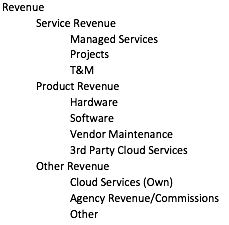
Budget Your Revenue
Define a reasonable estimate of your revenue for each revenue category monthly and annual total. For instance, if your Managed Services revenue has been $20,000 per month, how much are you going to grow that each month in 2016? You might say we can reasonably grow it $1,500/month each month next year. This means January managed services recurring revenue increases to $21,500; February to $23,000, and so on. Will that happen every month? Make a reasonable assumption based on your level of activity, expectations of your team, and historical data.
When done correctly, your Revenue lines might look something like this:
Once you have your revenue budgeted, you are ready to budget your Cost of Goods Sold.
Cost of Goods Sold
Put every cost associated with delivering the revenue for each particular line of business in Cost of Goods Sold. You will probably have multiple COGS lines for each revenue line. For instance, Managed Services has costs for the tools you use (such as PSA and RMM), costs for people (including salaries, taxes, insurance, etc…), and possibly travel or other items. All costs to deliver revenue must be included to most accurately gauge your profitability!
Enter these costs into the appropriate columns and you are ready to calculate your budgeted Gross Margin.
Gross Margin
Follow these steps to calculate your Gross Margin:
- Take the revenue line and subtract the sum of the COGS line for that revenue line. This determines your Gross Margin dollars for that Line of Business.
- Let’s also go one step further to calculate our GM percentage by dividing the GM dollars by Revenue dollars. This determines your budgeted GM percentage. Ideally, this number should be north of 50% on services and over 15% on product.
- Repeat steps 1 and 2 for each revenue/COGS line. Total them at the bottom to find your total Gross Margin.
Are you hitting the right Gross Margin numbers for your business? If you are not hitting those numbers, what do you need to change in your cost structures to improve on them and increase your profits? You may be pricing your products and services too low, or perhaps you are paying your people too much. Performing these calculations provides insight into your business and allows you to make the right adjustments.
Expenses
Next, budget expenses. You have a history for all your expenses, and expenses “below the line” of Gross Margin should not change much on a monthly basis. These include your administrative salaries, building costs, Sales & Marketing, and other expenses. When budgeted appropriately, you should understand the amount of your “nut,” or total costs per month (exclusive of the items that are required to deliver services). Budgeting all your expenses significantly improves your ability to correctly comprehend the total Gross Margin dollars you need each month to cover those expenses, and therefore make money!
EBITDA
Simple math: You make money when you spend less in expenses than you earn as Gross Margin dollars. Congratulations! Many of your peers are unable to achieve this!
EBITDA refers to Earnings Before Interest, Taxes, Depreciation, and Amortization. To calculate this, simply subtract your Expenses from your total Gross Margin. It is one way to define profit targets, but not the only way.
Net Income
The final calculation we perform is Net Income. Calculate the Interest, Taxes, Depreciation, and Amortization on your earnings (EBITDA) and subtract it from your earnings to get our Net Income number. Again, for 2016 these numbers are estimated based on what they have been in the past and how you project they will change based on your company’s growth in 2016 (and beyond).
Done! Well, at least the numbers part is… Net Income is your final number, no more calculations. I sincerely hope it is positive. If not, you need to take a hard look at your business and decide where to make some changes.
This leads me to my final point: A budget is worthless if you refuse to hold your Company accountable to achieving it. Positive, inspiring accountability drives every successful organization that has a wisely defined budget.
Do not delay budgeting. Take this as your chance to do something different for next year to bridge you to new territories of profitable growth. Our goal is to help educate and mentor leaders to develop new habits and implement better systems that positively impact your business now and for years to come. If you need help, email me!
And DO NOT MISS my webinar explaining the WHY – WHAT – HOW of budgeting for IT service organizations. Click here to register. Space is limited.
Quick time saving tip
Would you like to have more time in your day? It is relatively simple. Consider these challenges from Anthony Iannarino:
There is an old Buddhist saying that goes like this: "If you don't have time to meditate for one hour, meditate for two hours." Here are a few other ideas along this same line.
If you think that someone else is the problem, thinking that is your problem. If you think the problem is external, your problem is not recognizing that it's internal.
If you believe that something or someone is preventing you from being or having what you want, you don't yet recognize that you are the only person that can prevent you from being or doing what you want.
If you think that you don't have time to do the things that you want, your problem has nothing to do with time. It has everything to do with your priorities. (Dave's boldface...)
Anthony reminded me of our LEADERSHIP Essentials approach to creating more time in your day by:
#1 - Take time in Sanctuary (no distractions) weekly for 1-2 hours to review your TARGET goals and key objectives, and then set your priorities.
#2 - Remove emotion. Set aside "wants" and focus on needs - what will really build your career / company / wealth to have more freedom to positively impact others. Remove less important activities from your calendar so you have time to do what you do best.
#3 - Plan weekly in Sanctuary. Hold yourself accountable daily in a shorter Sanctuary each evening or early morning.
Now here is the rest of Anthony's advice from yesterday:
If you think you can't have more money unless or until someone gives you more money, then you don't understand that the only way to earn more is to create more value for others.
If you think you will be happy when something happens, or when you move to some new location in the future, then you misunderstand happiness. Happiness is a decision you make in the present moment. The present moment is the only one you have. The past is only pictures and movies, and so is the future.
If you think that your clients or prospects are your problems, that belief is your problem. Until you change your approach to them, they cannot change their approach to you.
What limits do you believe you have because someone or something is imposing those limits?
What would you do if you didn't believe you had those limits?
Time management and focus are key skills of effective leaders. Sign-up your leaders, including yourself, for our Certified LEADER program that starts the week of October 5 and runs through March 2016. Tell me what you want them to learn and will work with them to develop those habits.
What's love got to do with it?
Do you want to follow the example of the most successful billionaire of all time? Then love people sincerely.
This is the person who said people will know you by your love. The most memorable person taught by this master said you can have the greatest skills in the world, but if you do not love people then you have nothing.
So love has EVERYTHING to do with it. This begs the question, how can we be a role model of "love" in our organizations?
Please remember, the third strand of 3strands LEADERSHIP is Sincere Gratitude because you must value your employees in ways they prefer to create a self-motivating environment where they thrive.
1. You. It is very challenging to love others unless first you have a healthy appreciation of yourself. This is a balance of self-accountability when you make mistakes and appreciation for when you do something well. It also includes getting enough sleep, exercising regularly, eating a healthy diet, and maintaining a reasonable weight so you avoid the negative consequences of poor health.
LEADERS who are comfortable with themselves are less likely to make emotional decisions that negatively affect relationships.
2. Circle. Your "circle of life" includes your spouse or special friend, kids, relatives, friends, and very importantly, your mentors - formal or informal mentors. These people invest in you whenever you interact with them. Their responses and reactions to you affect your well being ("You") and your interactions with others.
What's an example of a healthy circle of life? Regular uninterrupted time with your spouse or special friend, and time interacting with your kids - without looking at your cell phone or another squawk box. Time hanging out and talking, playing games, or sharing adventures with friends. Regular time giving and receiving in mentoring relationships.
LEADERS who have a healthy circle of life die rich in relationships and alter the course of history.
3. Employees. I have interviewed hundreds of job candidates and employees for Clients. A common desire throughout the vast majority of these people is to work with people who give them respect, support, and encouragement.
Think about it: When is the last time you interviewed a job candidate who said they thrive on confrontation and can hardly wait to start arguing or abusing people in your company?
Your people want to feel you sincerely care about them, and then have your behaviors confirm you truly do. How you make them feel is much more important than what you say or do.
LEADERS who appropriately, sincerely appreciate their team members in ways they prefer (not necessarily the leaders' natural style), create connections to overcome challenges that stop others who are less loving.
4. Clients. What is the #1 thing your clients want from you? They want to trust you. Trust that you do great work for them, respond quickly, and have their best interests at heart.
Can your clients trust you if they believe you do not care about them - they are not feeling da love? No.
LEADERS who appropriately, sincerely appreciate their clients in ways they prefer (not necessarily the leaders' natural style), do better work, grow their business more rapidly, and have customers for life.
WHAT'S THE PROBLEM?
You let "stuff" eat up all your time and you do not make expressing Sincere Gratitude (that love thing...) to others.
Make the time. Living the Platinum Rule always lifts people up and makes our lives more fulfilling: Treat others the way they want to be treated. Love them with Sincere Gratitude.
P.S. In 1984 Tina Turner released a song titled, What's Love Got To Do With It. I never liked it. Still don't. Catchy rhythm, but I think the message stinks. Her song was not the inspiration for this encouragement.
SUGGESTION
Show Sincere Gratitude to your service manager, sales manager, operations manager, PARTNER, and/or other leader by signing them up for our Certified LEADER program that kicks off the week of October 5 and runs through March 2016. Help them become the leaders they were designed to be (and you want them to be)! Tell me what you want them to learn, and I will work with them to develop those habits.
3 questions to confirm you will make it
Are you wasting time? Could you get to your career / financial destination faster? Time lost can NEVER be regained.
Just get perspective here... If you fail to achieve the additional $100,000 you could have earned each year for 10 years, how much have you lost? Most of you will say, $1,000,000 but you would be wrong.
If you were wise enough to make the additional $100,000 a year, then you WOULD HAVE BEEN shrewd enough to make multiples of that amount in subsequent years. In other words, $100K in Year 1; $200K in Year 2; $400K in Year 3...
The bottom line is our lack of focus costs us much more than we realize when we are "too busy firefighting" (working in the business instead of on the business) to be our best.
Note: I use the "J-word" a few times today, but not religiously. No matter what our spiritual beliefs are, no leader has impacted more people's lives than Jesus of Nazareth. There is a lot we can learn from him. Please don't be offended.
QUICK SURVEY - 3 Questions to confirm you will make it. ("It" being wherever you want to go in your career or wealth.)
Who are you serving?
It should be someone who is more skilled, connected, successful... than you are. This is someone you want to be mentored by, but you cannot create a connection.
Rather than asking to be mentored or become their friend, just dive in and serve them. Let me give you two examples:
Decades ago Ray Johnston was a youth pastor. Although we were in a small couples group for about three years, I could not develop a close relationship with him. I tried twice... only twice. He was busy. Ray went on to start Bayside Church, which is the fastest growing, largest church in Northern California which now has over 15,000 people attending weekly services on multiple campuses. I do not blame Ray. It was my fault. If I had only served in his ministry, we could have developed a close relationship rather than just be friends.
Second story: One of my cousins, Robert MacPhee, wanted to become a professional speaker and he really liked Jack Canfield, author of the Chicken Soup for the Soul books. So he went and served at Canfield's events and over many years learned so much that now he speaks professionally himself.
Who are you serving during this season of your life? Are you learning things you could never learn on your own? Get close and sincerely serve.
Who are you investing in?
(1) Mentoring someone less experienced whom you want to mentor. (2) Who are you sacrificing yourself for? This is possibly someone you do not really want to mentor, but needs your help and you can give it sincerely, patiently, and professionally. Or it is a person you are excited to help. What are you doing to help someone who may never thank you?
If we are receiving as a servant, then we must be willing to give as an investor. Jesus taught if we give, then it will be given to us. (He was not speaking about business.) This does not mean we should expect a mentee, someone we are mentoring, to do anything for us, although you always gain from a mentee. I suggest it is simply the law of natural reciprocity: If you give then ultimately you will receive, in part because your giving creates a natural desire for others to give back to you.
Years ago I heard a very wise man explain a cord of three strands is not easily broken. This was the seed that became my 3strands LEADER definition. The first strand of your "rope" that leads you to climb your mountains is you. The second strand is we must be in relationship with someone who is wiser than us and actively learning from that person. The third strand is we should be investing in someone less experienced than ourselves.
In whom are you investing during this season of your life?
What is the core essence of your legacy?
Jesus said love. For some people it is money. Others want power. I am not here to judge your objectives.
My concern: How can you focus better on achieving your legacy... or have you even defined it? Way too many leaders have no clear end-goal defined. They just go through the day doing their best. Your best is not good enough.
Why? Because if you have not defined your destination then you are driving to nowhere. At some point a crisis will hit, and you will be off on some country road rather than at your destination. At that point, you may or may not be able to get where you MUST go to resolve the crisis. What is your destiny, and are you spending enough time on it during this season of your life?
BONUS QUESTION
How are you prioritizing your time to achieve these three strands of your legacy?
The bottom line is (1) We need a clear definition of what we want to achieve and when; (2) We need to spend more time on what we do best.
You are a victim
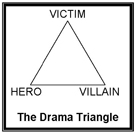
Ken Pense of Rapid Shift Coaching told me awhile back that everyone views themselves as a Hero, Victim, or Villain. What about you?
To be an effective leadership role model and communicator you must understand when you and others fall into the drama or conflict triangle. Workplace drama occurs because people allow themselves to get stuck in a self-focus, rather than a we-focus. They choose, consciously or subconsciously, to view others as adversaries rather than partners.
The Hero, Victim, and Villain personas are roles we play in conflict, and we may move from one role to another as the workplace drama unfolds.
Hero
Do you consider yourself a hero? Are you constantly "riding into conflict" to do what is right, save the fair maiden, and see justice done... only to have one horse after another killed out from under you?
Heroes seek to protect, defend, and sometimes even the score. You may have courage and take action with selflessness and nobility. At times the hero ventures forth to do what must be done and achieving "justice" is the only goal. Without true heroes who step forward and risk taking a stand, despite their discomfort or fear, the world would be an evil empire.
Unfortunately though, too often a hero's sincere righteousness becomes self-righteousness, or self-centered. Maybe their "cause" was not so just in the first place, or got distorted as power is gained by conquest...
ASK YOURSELF: Do I think others are not as good as me and they are slowing my progress? Am I on a mission to win at all costs?
Victim
True victims of persecution are not the focus of this column. My concern is leaders who act like a victim, or working with people who suffer from a victim mentality.
Wikipedia: Victim mentality is an acquired (learned) personality trait in which a person tends to regard him or herself as a victim of the negative actions of others, and to think, speak and act as if that were the case - even in the absence of clear evidence. It depends on habitual thought processes and attribution.
Most of us have had conflict with this type of person in our workplace. Again, their standards for others are higher than for themselves. Others are against them and life is not fair. It is interesting that a victim mentality is LEARNED...
Consider some people in certain professions who take advantage of this:
Lawyers: You are the victim. Spend money with me and I will help you get what you deserve.
Therapists: You poor victim. I will confirm your problems are someone else's fault so you do not have to take responsibility for your failures. It they just hadn't ____ you would have a great life.
Employees: I work really hard, but never get the credit I deserve. Those other employees (or our company policies) are the problem...
Leaders: My employees are the problem... (However you hired them, manage them - kind of, develop them - rarely, and retain them even when they truly do not perform. So who is the victim?)
ASK YOURSELF: Am I blaming others rather than focusing on the one person under my control (me)? Am I taking full responsibility for my mistakes, job duties, and results?
Villain
Obviously villains are the bad person. They can be mean, controlling, manipulative... However, few people consider themselves the villain. Typically this role is cast on another even though there is a fine line between being a hero and a villain.
Why? Because the villain has their own story, often rooted in being a victim. Their focus is on revenge and they have their own self righteousness. Although terrorists exhibit this behavior, just consider a recent time when someone offended you.
ASK YOURSELF: Am I trying to work together with others, or get even with something that has occurred in my life? Is my desire to achieve motivating me to cross the line of integrity I have defined for others?
How to avoid conflict and manage people to work more effectively is a key focus of our Certified LEADER program. Sign-up today for our next 6 month session starting the week of October 5. Don't miss this chance to learn the proven systems and habits of great leaders.
The bottom line is we need to avoid the conflict triangle and work together. As leaders, we must be role models and not let our triggers to anger lead us astray.
For more information you can search "Hero Victim Villain" on the web. My favorite article is by Gary Harper on his Joy of Conflict site. As leaders we have to intentionally help people work together and avoid the conflict / drama triangle. This work starts with ourselves.
Trim your vines
This past weekend I did a "honey do" project of clearing dead vines off part of our fencing.
As leaders, are you clearing the dead vines from your organization throughout the year, as needed? They choke out profits like crazy...
 This is a picture of the vines before I cleared them out. They were actually much worse than it looks.
Leadership "Dead Vine" Examples
1. Sanctuary
If you are allowing other activities to crowd-out your ability to have a quiet time weekly (preferably daily), then you are less focused on your most important priorities each week. Clear out the "dead vines" crowding your schedule and your freedom will allow you to better achieve your growth objectives.
2. People
All of your employees have some value, or you would not have hired them in the first place. However, some might not be performing at an optimum level, or worse. You may even have one (or more) that are toxic. You will waste hundreds of thousands of dollars hoping for miracle behavioral change in a poor performing or toxic employee. I have never seen it happen in a toxic employee. This is particularly true after you have tried to work with them to improve and they have failed.
The #1 hated job of a manager is to fire anyone... even someone who is toxic. However if we do not remove toxins and growing viruses from our body (company) then we die, or exist in a severely weakened state. Respectfully, empathetically, quickly, and properly terminate employees when it is clear they are hurting your organization. These "dead vines" choke out productive workers, and in some cases, motivate some of your good team members to leave.
NOTE: Letting a poor performing employee go is often the best thing for them too!
3. Process
When you know a process is weak or broken, work with your team to schedule its improvement. Do not procrastinate. Do not put it on the to-do list that lives forever. Schedule/delegate the work now, or put it in the "fridge" (better analogy than a "parking lot") with a specific date to schedule its repair. Set a reminder to check your fridge on time and bring it out to be "cooked" and fuel your growth. Missing or poor processes allow your people to get tangled up unnecessarily. Clear them out.
4. Habits
We all have habits that are unproductive. The challenge for most of us is not acknowledging them, but defining and committing to a step-by-step action plan with accountability to overpower a bad habit with a new one. If you are not working on overcoming a bad habit then you are allowing at least one to thrive. It is stealing time, money, health, relationships, everything from you. Bad habits are dead vines crowding out your ability to live your dreams. Focus. Clear them out one-by-one. Get help if you need it.
5. Relationships
Most people do not have many, if any, deep, caring friendships. When we die, the ONLY true asset we have is our relationships. If this is a challenge for you there are options, but you have to comprehend your relational habits and overcome fears. There are church and secular adventure groups. Nonprofits involved in causes that are meaningful to you. Exercise clubs of all varieties. (One of our developers is a CrossFit fanatic BECAUSE it is a group activity.) Get rid of the dead vines (unhealthy relationships) and work on building deeper relationships before it is too late.
TIP: If you want to build a relationship with someone, then serve them. If they are the leader of a nonprofit, then serve the nonprofit. It may take some time, but your service creates the opportunity for a healthy relationship to sprout, grow, and mature.
Do what makes more profits. Profit more from what you do.
We help leaders like you succeed more profitably and joyfully. We provide coaching, consulting, tools to better understand the strengths and motivators of your team, plus inspiring keynotes / workshops for your conferences, customer events, and internal gatherings. Contact us if you would like to learn more.
2 things you must be doing now
This will be quick. The cost of not doing these two things is too substantial to avoid this moment of accountability.
Money
PLEASE, stop losing money unnecessarily. We had a great webinar yesterday considering the Top 4 MSP Financial Mistakes. (There is something to learn here for my Clients in every industry.)
You need to see / listen this not only for the learning and opportunity to hold yourself accountable to implementing systems and developing habits of higher profitability, but also to see the poll results of other leaders.
PPT Deck & Audio - listen while you drive or workout...
Brochure on our vCFO services
3strands LEADERSHIP and Weekly W.I.N.s
The discipline of slowing down to think, hold ourselves accountable, and focus on what is truly most important is often our biggest problem. Take 2 minutes to review my updated online summary of 3strands LEADERSHIP and how to achieve a Weekly W.I.N. here.
That page also has a link to download my updated T.A.R.G.E.T. Goals Guide for employees that explains how to set and achieve significant objectives on a regular basis. Consider memorizing my new tag line to remind yourself to focus on profits, because they fuel your freedom to pursue your dreams:
Do what makes more profits. Profit more from what you do.
Let us help you succeed more profitably and joyfully. We provide coaching, consulting, tools to better understand the strengths and motivators of your team, plus inspiring keynotes / workshops for your conferences, customer events, and internal gatherings.
The 4 Biggest Financial Failures of MSPs
Every year we watch managed service providers succeed and fail. Leaders often drive their team to new heights, or stumble to new lows. Unfortunately, failing executives often equate busy-ness with high productivity or profitability and forget the core basics of money.
Because there is such a need for CFO expertise, we are launching a Virtual CFO service ("vCFO"). Email me if you want to learn more.
To help you today better understand where your profits are leaking out of your organization, we reached out to Brian Hoppe, former CFO of McLane Intelligent Solutions. Brian has spent years at MSPs managing operations and improving financial health.
Here are his 4 Biggest MSP Financial Failures (they apply to almost any industry) - each one could be costing you thousands in unnecessary waste, inefficiencies, and risk:
#1 - Ignoring the Metrics
Either you master the metrics, or they master you. Your business is speaking to you every day, if not every hour. If you are not willing to listen, then you miss out on huge opportunities for improvement.
Are you tracking the right metrics daily - weekly - monthly? Do you clearly and correctly assess your services gross margin? Are you tracking a 2-3X billing and 5-10X sales model to achieve maximum product, project, and managed services contract profitability? Are your revenue and CoGS in the right buckets? Is your chart of accounts set up correctly? Are you tracking sales so you catch issues early, before you lose opportunities?
We know many MSP's whose systems track many of the metrics they need, but lack the discipline to monitor them. The result is poor financial performance. Not sure what metrics to track or how to find them? Another MSP we know doesn't have all the metrics they need, but is implementing systems to generate them. They are following a plan to get where they need to be within the next 3-6 months and you can too.
#2 - Lurking in "Tomorrowland"
You tell yourself, "We're not profitable now, or as profitable as we would like, but if we can just add more revenue then we will be." That's foolish.
We see this happen too often. One MSP we know is always thinking about tomorrow and never focused on today! As a result, they have not fixed their metric and margin issues for years and remain in a financial abyss. More revenue is great, but it does not solve your problem. Even if you can increase revenue despite your margin issues, you have the same problems, they are just bigger.
On the other hand, we know of another MSP who engaged a virtual CFO, reversed their fortunes within a year, and built a six-figure cash reserve.
Which company do you want to be?
#3 - Easy Sales Compensation
Too often sales people, particularly if they are long-term employees, are paid too much salary rather than being challenged by a more heavily weighted performance-based plan.
Do you have a monthly quota for each sales person? Is it realistic? Are you managing it with them daily and weekly? Are you compensating behaviors that lead to sales, or just the sales? Are you paying based on the gross or net? Where is each type of compensation appropriate? Are you targeting a 5-10X sales model for compensation to automatically drive profitability?
Managing a sales team can be like adult daycare or coaching an Olympic athletic team. It depends on your strategy and the people you hire. Make sure you have the right people on the bus, your sales strategy is clear, your plan is effective, and you have someone in place to drive the details plus help each individual meet or exceed their targets.
#4 - No Budget = Limited Profits
It is amazing how many managed service providers operate without a clearly defined budget based on numbers from the previous period, with clear projections and targets. Without this basic discipline there is limited upside you can achieve because every review of finances is a best guess rather than a focus on the facts that bring the most money possible to your bottom line.
Budgeting is one of the most important things you can do. What would it take for you to put together a budget for the next 3-12 months? Do you know the right questions to ask? Is your budget based on real numbers, or hope? Does your budget fluctuate monthly based on historical information? Do you know what your returns should be? Are you looking through the windshield rather than the rear view mirror?
Do you want more? Join us for a 30-45 minute webinar on Tuesday, August 11th at 10:00 a.m. PST / 11 MST / noon CST / 1pm EST. I am interviewing Brian Hoppe to get more of his perspective on these costly financial failures. Click here to register.
Finally, this is not a complete list of every financial mistake you can make, just the most common ones. Contact us if you would like to learn more about how you can improve the financial health and operational efficiency of your business, or our upcoming vCFO services.
Five leaders, five ideas
There was a Harvard Business Review article recently that analyzed interviews with 5 incredibly successful coaches of the past in search of common ways to win in very competitive situations.
The coaches:
Sir Alex Ferguson, legendary coach of Manchester United football
Joe Girardi, New York Yankees Manager - 500 game winner
Bela Karolyi, coached gymnasts to 9 Olympic golds
Bill Parcells, turned around 3 NFL teams
Bill Walsh, SF 49er Coach - 3 Super Bowl wins
My conclusions differ a bit from the writer.
Habits
Decisions often have to be made quickly and our instant responses or reactions to situations define our leadership impact. Often there is limited time or no time to think.
This is why my consulting and coaching work incorporates habit development. Joe Girardi said you cannot think too much. "The key is preparation... The data has to become instinctual. You can't think about it in the middle of a pitch."
Adaptation
We teach this very effectively with our Talent Assessments. The key is to adapt your behavior, especially your communication style, to the preferred style of the employee, Client, or other person whom you are engaging.
Your extremely effective behavior or communication with one person can be a disaster with another. Know your people. Teach your team to understand and respect their differences, and adapt to each others' preferred behaviors to improve productivity and fulfillment.
Bela Karolyi gave this insight: "Find out what part of their mind is clicking, what part of their character is responding to you, and what's the one thing you have to avoid."
Consider Coach Karolyi's advice, and then be more intentional rather than just behave instinctively most of the time.
Encouragement
Even superstars can have their feelings hurt. Sir Alex Ferguson coached, "Few people get better with criticism; most respond to encouragement instead. So I tried to give encouragement when I could. For a player - for any human being - there is nothing better than hearing 'Well done.' Those are the two best words ever invested. You don't need to use superlatives."
This applies to your weakest team member AND your strongest. Your team is only as good as the person who appears to be contributing the least, and you can only extend your strengths as far as your superstars are willing to engage with others.
The key here is to be sincere. Do not embellish, stretch the truth, or say something that is a lie. Brief, honest, heart-felt appreciation is an example of Sincere Gratitude, the third strand of 3strands LEADERSHIP.
Candor
Yes, being direct, honest, and sincere is good, but if your natural communication style is judgment rather than encouragement then you are tearing people AND TEAMS down rather then building them up.
Bill Walsh advised, "It sounds just great to say that you are going to be honest and direct. But insensitive, hammer-like shots that are delivered in the name of honesty and openness usually do the greatest damage to people. The damage ends up reverberating throughout the entire organization..."
Applying Coach Walsh's advice comes back to your habits and ability to adapt to the preferred behaviors of others. Candor communicated well is a requirement for strong relationships.
Belief
Too many of us have a childhood memory or lifelong message ingrained in our soul that we "are not good enough." Choose a different message. Believe in your people.
Develop 3strands LEADER habits to come alongside them instead of come down on them. Adapt to their behavioral preferences to build a stronger bond with them. Sincerely encourage others based on specific contributions they have made. Be open and caring about others.
I hope your July is closing strong. August and September are great times to work on leadership, company culture, and client experience. Work ON your business, not FOR your business. Don't miss these windows of opportunity before the 4Q rush! NOW is the time to develop your company's ability to grow.
Fear. You got it. Know it.
Yeah, I know, you feel very capable. However, EVERYONE has fears. If you can be candid enough to understand your fears then you will be a better leader.
Our fears affect everything we do. Often subconsciously. Therefore taking time to better understand them can be incredibly valuable.
Let me just give you three examples to consider:
Trust
You do not trust someone. The problem is not trust. The main issue is fear. Without the fear you would trust them, so the fear comes first. You are afraid they will... whatever.
You have two options: (1) Remove your fear. For instance, if you believe God will protect you, then you do not have to be afraid. You just have to be humbly discerning. Or, you can choose to make the behavior of others that you fear an expectation rather than a fear. Then because you expect the behavior it is no longer a surprise and you can design systems to limit or eliminate any negative impact. (2) Remove the person from your business or personal life if their behaviors are unacceptable.
Winning
You want to win so bad that you fear failure, which paralyzes your ability to make timely decisions. Too often you suffer from "analysis paralysis" and it bottlenecks the growth of your team.
Again, you have two options: (1) Delegate more, but not all decisions. Focus on asking questions to confirm risk and how to shut out competition. This plays to your strengths, but then require a one-page summary of the opportunity. You make your decision based on that information. Decide overnight, no more. (2) Organize a four-person team to make decisions. You only get one vote and may not hold up key decisions that have reasonable risk.
Esteem
This is another version where you fear failure. You have an internal voice telling you, "I'm not good enough." Therefore you are sensitive when competitors succeed while you struggle. You do not quit activities that fill your schedule and move on as long as the "patient is still breathing." If you stop something it feels like confirmation you are not good enough. Another failure.
Yet again, you have two options: (1) Set deadlines with accountability partners. These are people you trust. When you want to extend the deadline let them decide, not you. (2) Narrow your focus. Often one of your key problems is that you are over-extended. Win in one thing rather than try to stay in the game in multiple activities. Cut way back, and then expand slowly with accountability from others.
Fear affects everyone.
I hope you take a moment in your Sanctuary time, driving in the car, or working out, to consider your fears. Mastering them is important for fully living your dreams.
Let me know if I can help in any way. Do what you love. Love what you do. Lots of people have said this (it is a slogan of Life is Good apparel). But it takes action to achieve.
Client Experience Exercise
Be more competitive by improving the experience Clients AND prospects have interacting with your people. How?
"Live It" yourself. In other words, experience how the BEST companies serve others to be inspired how to improve your own team's Client interactions. ("Live It" is part of L.O.I.: Live It - Observe It - Improve It, one of the desired results of my original Success With People system.)
Steve Meek of The Fulcrum Group reminded me last week of my favorite exercise to improve the experience people have interacting with your company. Here it is:
Team Building Exercise
Have your people name businesses they feel provide an awesome customer experience. Identify twice as many companies as you have people participating in this exercise.
Although Zappos, Nordstrom, and other large companies may come to mind and are valuable to have on your list, we recommend your people include local firms known for providing great service. For instance, I have an auto mechanic who has serviced my cars to for over 20 years because I totally trust them. (They replaced a broken water pump just last week.) Maybe there are things to learn from great local companies too.
Agree on the two companies for which each person is responsible. The data on each company might include:
- Name of the person or people on your team who is responsible for gathering data from the company
- Date the report on this company is due
- Company name
- Website address
- Physical address
- Phone
- Contact, if you know one, who has provided great service previously (you may or may not want to involve them in this Activity)
- Expectation: What do they do differently with employees to build a strong company culture?
- Expectation: What do they do differently with clients to demonstrate their strong company culture?
Prepare to buy something from them
Each person's job is to creatively explore and fully comprehend why their "best" companies provide such a better customer experience. Give your people $50-$100 per company to purchase something and report back to the group on their experience. Allow your people to keep what they buy.
Discuss how you will test them
Do not assume you or your people understand how to do this market research competently. Have an open discussion to share ideas on how to shop so your people experience "the best" company responses in a variety of situations, such as asking for advice, purchasing, returning goods and support. Here are some interactions you might consider:
- Ask "stupid" questions before the purchase.
- Ask foolish questions after the purchase.
- Complain (but not too much).
- Return your purchase and buy something else.
- Consider behaving in an easy-going manner with some companies and a "difficult" customer with others, however we do not recommend anyone behaves like a jerk.
Each person can take a different approach, but sharing these ideas helps people consider different ways to engage their "best" companies.
Use all five senses
Share ideas within the group on how they can use all five senses to better understand their feelings throughout the experience with each of their "best" companies. Multiple senses are involved even when interacting with people online. Here are some thoughts to get your discussion going:
- Sight: How is the building designed inside and out? What do you see in the signage, product placement, colors and anything else that increases your trust in each "best" company? What is most effective and why?
- Smell: What do you smell? Is it natural from the products or environment, or a scent they have intentionally added?
- Hear: What music or sounds are in the background? How does it affect your experience?
- Taste: What tastes are involved in your experience (coffee, tea, water fountain, candy)? How does it improve or detract from your purchasing experience?
- Feel: What does your experience with the company feel like physically and emotionally as you interact with their people, products, website, offices and other aspects of their business?
Use Experience Analysis Worksheets
You can use Experience Analysis Worksheets (a tool I developed based on something from John DiJulius) for these Activities to record key data your people bring back from their purchasing expeditions.
Although I came up with this activity on my own, other companies striving to become GREAT are following a similar process. Years ago I read about Ed Zimmer, former CEO of Ecco, a maker of backup alarms and lights for trucks in Inc Magazine. He explained one of the ways he contributed to the company's $200 million in sales was helping his customer service people better understand the experience of their clients. He said:
"...we even bought gift certificates to L.L. Bean and gave them two or three customer service folks at the time, so they could order something for themselves and see what the process was like. We want our customers to have that kind of experience [as L.L. Bean]."
Here is how we suggest you complete this activity before moving on... (there are 5 potential steps in all we can encourage Clients to do):
- Have a meeting to share the results of the purchasing expeditions.
- Discuss how your initial Expectations compared to the ways "the best" companies actually engage their employees and clients.
- Consolidate what you learned from "the best" companies that you want to apply today and in the future. Possibly organize the actions you want to take in phases with due dates consistent with your other company culture efforts.
You will have fun, AND identify ways to be a better organization. Happy hunting!