
Your people problems? Gone.
The 4 Management Disciplines Newsletter delivers proven ways to be your best and lead a championship team.
Every championship sports team runs proven plays.
Every Monday morning - I give you four proven plays great leaders use to solve problems in how you Hire, Manage, Develop, and Retain great people.
2 minute read. No fluff. No ads.
Trusted by over 10,000 leaders.
NOTE: David is no longer writing this newsletter. Visit www.simpleliberty.com to read his latest posts.
All Newsletters

The Top 5 M2W Podcast Episodes of All-Time
As we take a break to reflect and recharge, we wanted to take a moment to celebrate our most popular episodes ever on The Manage 2 Win Podcast.
As we take a break to reflect and recharge, we wanted to take a moment to celebrate our most popular episodes ever on The Manage 2 Win Podcast.
From meditation to sales to politics, this list has a bit of everything. You will find candid conversations with entrepreneurs that have developed habits and strategies to catapult their business to success. You will hear stories of personal growth, prison time, and family.
#1

#23 - Yoga and Meditation for Business, with Travis Eliot
July 3, 2019 | 13,600 views on YouTube | 159 audio downloads
Travis discusses mindfulness, the difference between yin and yang yoga, how yoga and meditation can be beneficial for everyone, especially business people, and how one of the most violent inmates in a Maine prison became a yoga fanatic.
Listen to the episode →
#2

#47 - A Candid Review of the Entrepreneurial Operating System
November 25, 2019 | 3,500 views on YouTube | 117 audio downloads
Luis Alvarez shares the story of his introduction to the book Traction and his company's implementation of the Entrepreneurial Operating System, commonly referred to as EOS.
Alvarez Technology Group has been in business for 20 years but they've encountered a radical improvement in their operations by adopting the best practices laid out in EOS.
Listen to the episode →
#3

#19 - Write-ups & the Performance Improvement Process
May 31, 2019 | 1,400 views on YouTube | 43 audio downloads
In this episode, David shares a few stories of clients who failed to properly correct employee behavior with a PIP, then goes on to describe what a PIP is, why it is important, and how to implement it.
Listen to the episode →
#4

#139 - America's Second Civil War, and What To Do About It
July 8, 2021 | 505 views on YouTube | 115 audio downloads
Peter warns America’s current civil war has consumed our identity, and it’s time to reclaim it. We must break our addiction to the misinformation, fake news, and selfish political agendas we digest on our various media platforms and other content sources.
Instead, let’s focus on unity. What do we have in common, rather than what divides us? Peter’s new book, The Second Civil War: A citizen's guide to healing our fractured nation advises us on how to return to our life’s purpose and who we really are, as we work together to regain our national pride
Listen to the episode →
#5

#9 - How to 10X Your Sales, with Amanda Holmes
March 7, 2019 | 574 views on YouTube | 21 audio downloads
Amanda Holmes is CEO of Chet Holmes International. CHI has helped over 200,000 businesses get to the next level with 12 core competencies for doubling sales. They offer the best-selling book, The Ultimate Sales Machine, written by their founder Chet Holmes.
When Chet passed away at the age of 55, Amanda took over the company. Her story and sales advice have been featured in Inc. Magazine and the Entrepreneur Weekly podcast, as well as many other prominent blogs, shows, webinars, and events.
Listen to the episode →

5 Ways to Become a Great Leader, What You Can Learn from Phil Jackson
Here are 5 tactics utilized by the Zen Master, Phil Jackson to become one of the greatest winners and leaders of our lifetime. You can pick up on these methods of managing to become a more effective leader for your team.
Phil Jackson is often recognized as one of the most outstanding leaders ever.
Renowned for his unparalleled success as a coach in the NBA, Jackson's impact went beyond championship titles.
His leadership, characterized by a transformational style, mindfulness, and always fostering unity, reshaped the conventional thinking of coaching and catapulted him into the realm of legendary leadership figures. Through his exceptional ability to cultivate an individual´s potential while establishing a collective sense of purpose, Jackson's legacy offers invaluable insights for those seeking to elevate their own leadership prowess and leave an enduring mark on their teams and organizations.
Through his autobiography, Eleven Rings, we get the opportunity to take a deep dive into his brain, memories, and experiences, to further explore what made him such a winner.
Here are 5 practices that made Phil Jackson an extraordinary leader.

By Keith Allison from Baltimore, USA - RO9A3387, CC BY-SA 2.0, https://commons.wikimedia.org/w/index.php?curid=6223045, modified
1. Creating a Shared Vision of Success
"I flashed back to 1989 when I took over as head coach and had talked to Michael (Jordan) about how I wanted him to share the spotlight with his teammates so the team could grow and flourish. In those days he was a gifted young athlete with enormous confidence in his own abilities who had to be cajoled into making sacrifices for the team.
“Now he was an older, wiser player who understood that it wasn't brilliant individual performances that made great teams, but the energy that's unleashed when players put their egos aside and work toward a common goal... Good teams become great ones when the members trust each other enough to surrender the 'me' for the 'we.'"
– Phil Jackson
Phil was lucky to be on teams with some of the greatest basketball players ever.
Kobe Bryant, Michael Jordan, Scottie Pippen, and Shaquille O'Neal, to name a few.
However, you don’t win 11 championships without having an intense understanding of how to lead and succeed.
He figured out that the formula for creating a great team included molding a group of individuals into a cohesive unit by fostering a collective commitment. Phil understood that selflessness, trust, and a desire to play for your tribe instead of yourself would inevitably put his team in a position to win.
After the Bulls won their first 3-peat (3 straight championships), Phil alluded to a schematic model borrowed from the book, Tribal Leadership. He stated that by winning those three championships, the Bulls had gone from a Stage 3 team (“I’m great, you’re not”) into a Stage 4 team (“We’re great, they’re not”). What made them a great team was the belief that THEY were great, not that each individual player was great.

2. Transformational Leadership
Transformational leadership is defined by Langston University as:
“…a leadership approach that causes change in individuals and social systems. In its ideal form, it creates valuable and positive change in the followers with the end goal of developing followers into leaders.”
An example of this approach is Phil’s work with Kobe Bryant and the Los Angeles Lakers. Jackson's guidance in employing mindfulness techniques helped Bryant navigate high-pressure situations and hone his emotional intelligence. By the end of his career, Kobe was recognized for his unparalleled mental fortitude on the basketball court. Jackson's commitment to nurturing players' personal growth, along with their athletic ability, showed the essence of transformational leadership that extends far beyond sports.
One of the aspects that made Phil such an exceptional leader was his ability to understand his players beyond basketball. With this understanding, he found ways to motivate and inspire them individually, instilling confidence in even the lowest members of the team.
3. Delegating Authority
“Needless to say, the coaching profession attracts a lot of control freaks who remind everyone constantly that they’re the alpha dog in the room. I’ve been known to do this myself. But what I’ve learned over the years is that the most effective approach is to delegate authority as much as possible and to nurture everyone else’s leadership skills as well. When I’m able to do that, it not only builds team unity and allows others to grow but also—paradoxically—strengthens my role as leader.”
- Phil Jackson
For some reason, many leaders believe it is their duty to control everything at every point. A truly successful team will have multiple leaders, each ready to step up when the time comes.
The less you need to micromanage your team for them to achieve success, the greater your success as a leader.
4. Player-Centric Approach
Tied into our previous point, Phil Jackson’s leadership is characterized by being incredibly player-centric. This is part of the reason why many of his old players still revere him as an incredible person and mentor.
He took the time to understand their lives both on and off the court, showing a genuine interest in their personal growth and challenges. This created an environment of trust and respect, where players felt valued not only for their athletic skills but also treated equally as human beings.
Jackson's player-centric approach was evident in his work with superstar players like Michael Jordan and Kobe Bryant. Rather than imposing his will on great talents, he engaged them in the decision-making process, giving them a sense of ownership. He recognized that their insights and perspectives were invaluable in shaping team dynamics and strategies. This collaborative approach not only empowered the players but also fostered a strong sense of camaraderie and unity within the team.
Jackson's knack for managing egos and personalities was proof of his player-centric leadership style. He understood that egos could disrupt team chemistry and harmony, so he skillfully navigated them while maintaining a collective focus on the team's goals. Jackson showed this in his work with players like Dennis Rodman, whose unconventional behavior just became part of team dynamics. Their end goal was still to win a championship.
This ethos of putting the players at the center of his coaching philosophy set Jackson apart as a remarkable leader.
5. Manager not Controller
“Phil Jackson was a master of managing personalities. He controlled Dennis by not attempting to control him.,”
- Former Bulls forward Jason Caffey.
One of the biggest hurdles the Chicago Bulls team faced in their second 3-peat championship run was the off-court behavior of Dennis Rodman. When he was out partying or wrestling Hulk Hogan instead of practicing with the team, many scolded Jackson for not having a harsh hand.
"Coaching Dennis Rodman was a unique challenge. He was an individual with his own style, but he brought an intensity and determination that few could match. My approach was to give him a certain level of freedom while also setting clear boundaries. I knew that his energy and defensive prowess were invaluable to the team, so I worked on finding ways to harness his strengths within our system."
– Phil Jackson
Phil set some boundaries with Rodman, but essentially let him be himself, he knew this would make him most effective on the basketball court. He managed what could be managed while understanding that by punishing Rodman for being extravagant he would completely alienate a player that was crucial to the team.
This is one of the many reasons why having a deep understanding of your players’ strengths, weaknesses and motivations is pivotal to becoming an outstanding leader and eventually winning some championships.
Would You Like to Connect Better With Your Team?
Our Talent Assessment services are one of the best tools any manager can have to truly understand their team.

Leadership Skills Must Be Valued Above Leadership Tendencies
One of the reasons I wrote my first book, Success With People, is because of the realization that I had leadership tendencies rather than true leadership skills.
Years ago, I was speaking with a coworker about a particular manager. The coworker commented that the manager really felt he was a leader. After further consideration, we realized he was more of a competitor than a leader…
One of the reasons I wrote my first book, Success With People, is because of the realization that I had leadership tendencies rather than true leadership skills.
Years ago, I was speaking with a coworker about a particular manager. The coworker commented that the manager really felt he was a leader. Upon further consideration, however, it became clear the manager was more of a competitor than a leader. They would jostle for position, argue without considering other people’s opinions, and fostered a negative environment within their team.
Just because someone likes to compete and have things their way does not mean they are an effective leader. Quite the contrary, competitors are often some of the worst leaders.
Chimpanzees and Leadership
A basic example of this can be seen from Jane Goodall’s research and observation of chimpanzees. Every group of chimpanzees has a social hierarchy, much like a business. At the top of the group is the alpha-male, who has climbed the ladder of the social hierarchy through one of two ways: Collaborative leadership or dominant leadership (there are also alpha-females, but I’m going to reference examples of alpha-males in this post for simplicity).

Photo by Ryan Al Bishri, 2016
Source: https://unsplash.com/photos/grayscale-photo-of-two-monkeys-reXwAuEdkVM
Collaborative leaders tend to foster strong alliances with other chimpanzees by making friends and engaging in positive behavior that encourages social cohesion. They provide healthy boundaries, protect the weak, and encourage the strong. These collaborative leaders are not always the biggest and the strongest chimpanzees - they don’t have to be. They use their personal skills to coalitions and develop relationships with everyone in their group, including other males who will then rush to the aid of the alpha-male when he is in need.
In contrast, dominant alpha-male chimpanzees see the social hierarchy from a purely competitive worldview. They rely heavily on aggression and brute strength to command obedience and bend others to their will. Yes, they enjoy the perks of being at the top, but they lead through fear and generate far less loyalty. In fact, a brutish, competitive chimpanzee is often less likely to become the alpha-male because they lack the skills necessary to earn the respect and admiration of their peers.
How to Succeed as a Leader (hint: Develop your skills!)
So how do you move from being a person who is competitive with leadership tendencies to one of skill and top performance? Develop a growth mindset and focus on continuous improvement.

Here are some steps that may help:
Develop self-awareness: Understanding your strengths and weaknesses, as well as your natural tendencies, can help you identify areas for improvement and develop strategies to enhance your performance. A lot of our clients utilize our talent assessments when they are hiring new employees, but we highly recommend leaders take the assessments also to learn how they can work best.
Set clear goals: Identify specific goals that you want to achieve and develop a plan for achieving them. Break down the goals into smaller, achievable steps, and track your progress along the way.
Seek feedback: Feedback from colleagues, mentors, and supervisors can help you identify areas where you need to improve and provide guidance on how to do so.
Practice self-reflection: Take time to reflect on your experiences and identify what worked well and what could be improved. Use this information to make adjustments and refine your approach.
Learn from others: Seek out role models and mentors who have demonstrated top performance and learn from their experiences and best practices. A business coach or consultant can be a priceless resource.
Embrace challenges: Be willing to take on new challenges and stretch yourself beyond your comfort zone. This can help you build new skills and capabilities.
Continuously learn: Make learning a priority and seek out opportunities to develop new skills and knowledge. Consider attending training sessions, reading industry publications, or pursuing additional education.
By adopting these strategies, you can develop the skills and top performance needed to succeed as a leader.

Not Doing This is Crazy: How to Run a Daily Huddle
One important aspect of effective leadership is to make certain you and your people are focusing on key priorities each day. You can’t do that unless you are communicating with your team and hearing from them regularly.
The solution? A daily huddle.
One important aspect of effective leadership is to make certain you and your people are focusing on key priorities each day. You can’t do that unless you are communicating with your team and hearing from them regularly.
One solution? A daily huddle.
Years after John D. Rockefeller used the tactic of the daily huddle to build Standard Oil into one of the largest companies ever, Verne Harnish promoted the concept of “daily huddles” in his 2002 book, Mastering the Rockefeller Habits.
You can use daily huddles in your business to build rapport, increase communication, and improve performance.

The Rockefeller Habit of a Daily Huddle adopted by Steve Jobs and Jony Ive
According to Harnish, John D. Rockefeller would walk to work every morning and walk home every night with his brother and the three other guys who started the company. During those daily walks, they would discuss what was going on in the business and make almost all of the important business decisions. When Rockefeller moved Standard Oil to New York City in 1885, he continued this daily practice even though the people in his inner circle changed.
At some point, Rockefeller morphed his daily huddle from a walk and talk into a daily luncheon where he would sit, eat, and talk with the key leaders of Standard Oil. As the company grew, the meetings grew to include the nine directors of the company.
Almost a century later, Steve Jobs utilized the same tactic in daily meetings with Apple’s design chief, Jony Ive. They would have lunch together most days, and spent their afternoons in “the sanctuary of the design studio”. Just about every day, Jobs would ask Ive, “What have you said ‘no’ to today?” The question served as a focusing exercise for Ive (as many huddles do). Jobs understood design was critical to Apple’s success and wanted Ives to spend his valuable time on the most important priorities.
Asking that question every day provided clarity to both Jobs and Ives.

Guidelines for a Daily Huddle: Every Company Can Have Them
Fortunately, you don’t have to be Standard Oil or Apple to implement and benefit from daily huddles.
In fact, daily huddles are at the heart of the SCRUM and Agile methodologies and have become a best practice in the small business community. Patrick Lencioni says, “If you’re a small organization, not doing this is crazy. When you’re small, you can develop connections among staff that make you more nimble. Daily check-ins help you build a culture of unity and sustain it as you grow.”
Short, daily meetings will keep you and your team focused on the same strategic goals, answer pressing questions, and maintain accountability.
Here are some guidelines for your daily huddle:
Start on time.
No more than 15 minutes.
Problem solving is forbidden - information only.
End on time.
Beyond that, you can customize your daily huddles in an endless number of ways. Some companies meet the first thing in the morning, others might hold their huddle right before lunch. Some leaders decide to hold the meeting at a specific time, like 8:43am, so it’s unique and memorable. Some huddles just include the senior staff, while others include the entire company. Some follow the same agenda every time, and still others make it up on the fly.
Regardless of how daily huddles are structured, they are an essential tool for CEOs at rapidly growing companies who are trying to maintain an entrepreneurial culture.
What should be the focus of a Daily Huddle?
A daily huddle is not the time for criticism, strategy, or stories from your vacation. It’s a time to communicate and get on the same page.
It’s also an exercise that should allow you to lose the “long leash”, stay close to your direct reports, and have them do the same with their people.
The general focus of daily huddles should be three-fold:
Priorities: What are we doing for the next 24 hours? What’s our daily focus? What’s the most important thing to get done today?
Measurement: What KPIs are we measuring? What are the numbers? How are we doing?
Remove roadblocks: What is holding us back? Where are we stuck?

Examples of Daily Huddles
Years ago, Inc. Magazine’s Leigh Buchanan wrote an article titled, “The Art of the Huddle - How to run a prompt, productive, and painless morning meeting.” In it, she provided 5 excellent examples of daily huddles. I have summarized them for you below.
I like the article because it gives you 5 brief examples of how to hold a quick morning meeting. It’s great to learn how some other companies are doing their huddles so you can create your own format that best serves your company culture. In brief, the 5 are:
The team builder - The objective is to improve communication. Participants review their day’s to-do lists together. The meetings also help identify non-communicators to weed them out.
The coordinator - The objective is to establish priorities and coordinate efforts. Participants meet at 11:45 a.m. for 15 minutes. It’s easy to limit the time because everyone is hungry.
The efficiency expert - Everyone in the office (20-40 people) share their top priority for the day in 8-15 seconds. They start at 8:43 a.m. to reinforce the importance of each minute.
The motivator - Starts with good news about the company or an individual, and ends with a cheer for the contributions of one employee. Also, the leader announces 3 critical numbers and a dept. head reviews their group activities.
The strategic planner - In 30-60 seconds each manager explains what they are doing that day to advance the quarterly and yearly company goals, what progress they made the previous day, and what roadblocks they are encountering.
I hope you enjoyed this piece on daily huddles. Have any questions or comments? Leave them in the comments section below or contact us anytime, we’d love to hear from you.

Dave's Dirty Dozen Email Rules
It’s been four years since we launched Dave's Charm School’s online platform and many people have benefited from the courses, not least of which is the Communications 101 course covering active listening, body language, communicating respectfully, and more.
One of the lessons in the course is titled “Email, IM, Texting Standards” and includes my Dirty Dozen Email Rules. These rules are incredibly helpful for any executive, manager, or front-line employee that wants to present themselves professionally and communicate effectively via email.
Every rule may not apply to you, but most of them probably do. Feel free to copy and edit my list to create your own list that works at your company.
It’s been four years since we launched Dave's Charm School’s online platform and many people have benefited from the courses, not least of which is the Communications 101 course about active listening, body language, communicating respectfully, and more.
One of the lessons in the course is titled “Email, IM, Texting Standards” and includes my Dirty Dozen Email Rules. These rules are incredibly helpful for any executive, manager, or front-line employee that wants to present themselves professionally and communicate effectively via email.
Every rule may not apply to you, but most of them probably do. Feel free to copy and edit my list to create your own list that works at your company.
Without further ado, here’s Dave’s Dirty Dozen Email Rules:
#1 Communicate based on their preferred style
The best way to get your message across in a written medium is to adjust your writing style to the way the recipient of your email prefers to receive information. If you don't know what that is, figure it out in advance, because it may determine whether your message is received properly or not.
For example, executives are often juggling multiple priorities at once and don’t have time for a lengthy story on why Employee A was having a problem with Employee B. When emailing them, you’ll want to be clear, concise, and to the point.
One resource that can help with communication is knowing someone’s preferred communication styles. Our Clients use our talent assessments for this and benefit greatly.
#2 No hiding behind email – speak, do not write negatives
When we are experiencing difficulty with others there is a high sensitivity to written words. There is no tone of voice, no visual cues as to the person’s feelings or intention, and it’s difficult to ask a quick question to clarify something.
If you have an issue with someone it is best to talk with them in-person or by phone. Avoid “flaming emails”. You know, those emails where someone just unloads all their frustrations in multiple paragraphs. Don’t do that.
When there is a problem, verbal conversations are best. Don’t hide behind your computer. If necessary, follow-up after the verbal conversation with a brief, respectful email to confirm key points.
#3 Make the subject line clear, updated, and catchy
Every email you send should have a good, relevant subject line. Be brief. Be clear. Motivate.
The subject line of your email can determine whether or not your communication is read at all. Do you need it to be a hook to motivate someone to open your email? Then try to grab their attention with something catchy, especially if the information is important/urgent. Then, as you go back and forth with someone and the length of the email gets longer and longer, update the the subject line to keep it relevant as the focus of your comments change.
#4 Only copy necessary people
If you use email a lot, it probably runs your workday. Don’t you hate receiving an email that you didn’t need to be copied on? It’s a waste of time for you and anyone else involved.
Make sure you only copy people on emails who absolutely need to be informed. Blind copies can come back to bite you, so use the BCC option discriminately. Forward emails to others only when appropriate, and only when you would be comfortable if they were doing the same thing with your communications. Consider the cost of a BCC becoming public.
#5 Be brief
There’s a time and a place for your full report. Email probably isn’t it, and if it is, you should attach the report, not put it in the text of the email.
Be brief. Be bright. Be gone. The vast majority of people, especially at work, don’t want to read your life story. We’ve all got work to do, people! Get to the point.
Use attachments and links to limit the length of email body copy. Schedule a verbal discussion when interaction is needed. Use email for notes, brief announcements, and confirmation of details, action items, and agreement.
#6 Format information for scanning, not reading
There is too much to do and not enough time. In addition to being brief in your length of content, you should also format your content for easy digestion.
Here’s how: Design your communication to be scanned rather than read. Take those big paragraphs and put them into bullet points. This will take you a little bit more time to compose your email, but it demonstrates respect to the recipient, increases the likelihood of a response, and improves overall productivity.
#7 Make it easy to take action
This is an easy one that is often overlooked. What’s the purpose of all this email? To get work done.
Therefore, if you want someone to do something in-person or online, take the time to provide accurate info and links.
NOTE: Check your links before sending.
#8 Never say anything you do not want in the newspaper
In a verbal conversation, people will forget an off-hand comment or joke in a matter of minutes. But email never dies, unless managed by an unethical politician (zing!).
Therefore, you should choose your words cautiously when composing an email. As my eighth grade English teacher used to say, "Peruse your verbatim carefully” before clicking the Send button. A wise person chooses to avoid risk and save some comments for a verbal conversation at another time, if at all.
#9 Use drafts, proofread, and auto spell/grammar check
Since email can be such a difficult medium for communication, you want to make sure you are sending the right email. You don’t always have to send the first version. If the text doesn’t feel right for an important email, let it sit in your Drafts folder for 30 minutes, then revisit. You may even want to wait until the next day to send a very important, non-urgent email.
When you do review your draft, proofread it multiple times. Do a spelling and grammar check. Draft a second version, if necessary.
Finally, if there’s a voice in your head telling you to get a second opinion, ask someone you trust to review your email and provide their opinion. Usually that voice encouraging you to get their opinion is trying to save you from unnecessary drama.
#10 Include a professional signature
This is easy. Have a consistent professional signature for everyone in your organization. There are many ways to do this, but the key components of a signature should be the following:
An end to your email, like “Sincerely, David”
Your full name
Your title
Your email address and possibly a phone number
Your company name
Your company logo
Links to social media, meeting scheduling services, or support (optional)
We use Calendly to help automate the process of setting appointments, so I include a link in my email signature for people to schedule appointments with me. Here is an example of my signature:

#11 Schedule time for email
I turned off notifications for every email coming into my Inbox years ago. I now limit my time each day to look at email, although at times I will pop in for brief bursts of Inbox review in between meetings.
The simple fact is email can be a huge distraction. I don’t have control over when my emails arrive, how urgent they are, or how many there are. But I do have control over myself and I can choose how much control my inbox has over me.
Unless you work in customer support, you don’t have to be on constant alert. Close your email program, focus all your efforts on work, then check your email at regular intervals.
#12 Respond quickly and clear Inbox daily
Your goal each day should be to clear your Inbox. For some of us it is a Herculean task. But it’s a really great way to keep you focused, clear your head for the next project, and make sure to tie up any loose ends.
Try to touch an email only once. Open it, respond to it or take action, then file it away. I like to use folders to save emails for future reference. Quick, brief responses are fine. Sometimes your quick reply may be only to commit to get something done at a later time.
No response is UNACCEPTABLE if the email is from someone you know.
——
And that’s it!
I could go on. The course is called Communications 101, after all, and there are so many unwritten rules to communicating effectively. However, this should give you plenty to consider. I hope you found these tips helpful and can apply them to save time, avoid drama, and improve relationships moving forward.
How to Disagree
Do you want to have a strong team? Teach them how to disagree productively.
A good starting point is to first evaluate how you and your team argue with others.
There are different ways people disagree, argue, or debate. Typically, some disagreeable situations are more emotional than others. Disagreement is not bad. However, the way people disagree can be unproductive and/or hurtful.
Do you want to have a strong team? Teach them how to disagree productively.
A good starting point is to first evaluate how you and your team argue with others.
There are different ways people disagree, argue, or debate. Typically, some disagreeable situations are more emotional than others. Disagreement is not bad. However, the way people disagree can be unproductive and/or hurtful.
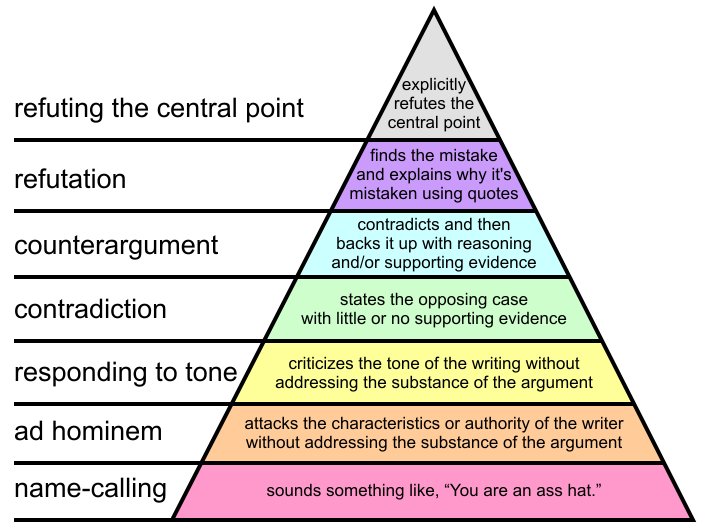
Paul Graham, a smart programmer and successful entrepreneur proposed a "disagreement hierarchy" in a 2008 essay, How to Disagree. He organized styles of arguments into a seven-point hierarchy and suggested, "If moving up the disagreement hierarchy makes people less mean, that will make most of them happier."
Graham also designed the hierarchy as a pyramid. This is logical because there are a limited number of people who are highly skilled at resolving disagreements. Therefore, the smallest space of his hierarchy (the top) represents the disagreement style demonstrated by the least number of people. (Wikipedia)
Here is Graham’s disagreement hierarchy:

Disagreements, arguments, and debates are words that can have a negative tone. However, these conversations can be very healthy, sincere, respectful, truth seeking, and productive. It is positive that people have different opinions, approaches, perspectives, and additional facts. Debate and disagreement are often necessary to determine the best solution.
Would you like to win every disagreement?
It is possible.
However, it depends on your definition of “winning.” The most common objective of people who disagree effectively is to find the best answer without unnecessarily harming their relationship with the other party. Adopt this approach and you can win every argument. The only exception is when you must withdraw because the other party is unreasonable or not aligned with your objectives.
Learn from the Hierarchy
Ask yourself two questions as you consider these seven disagreement styles as an individual, or with a group:
#1 – What disagreement style best describes my most common behavior when I’m arguing with others?
#2 – What style best describes my peers at work, and people I hang out with personally?
Comprehending your disagreement style enables you to develop better habits that result in reaching agreement more calmly, efficiently, and effectively.
Considering how others disagree is important because studies have concluded we become like the people with whom we spend the most time. If their habits are good, then they help us develop better habits. However, when their habits are bad, they subconsciously teach us negative behaviors.
Another important clue to consider: How you respond to each of these styles.
This discussion does not include how to respond to each disagreement style. However, you can learn how to avoid or more positively respond and resolve arguments in less time by developing habits based on these best practices.
There is one other habit that can help you tremendously.
It is: Don’t take anything said personally. Another person’s negativity says more about their wounds and mistakes than it does about you. James Clear, author of Atomic Habits, puts it this way: “Not taking things personally is a superpower.” (04/30/2020 post)
The focus of this teaching is how to effectively disagree in real-time arguments that occur in-person, during online meetings, and in-writing. This advice applies somewhat differently to indirect disagreements, such as online attacks, gossip, or internal anger and frustration.
The following is how we explain each disagreement style, and my advice based on our work at www.manage2win.com and my 47 years’ business experience.

Name-Calling
This first disagreement style is a bullying or fear response, rather than providing facts to refute something. Name-calling is a red flag to be extra careful in how you respond to the person or avoid them altogether. It may indicate the wounds from their life experience are fueling fears and a distorted perception of reality.
Name-callers are quick to judge others negatively. It’s often rude, coarse commentary that’s unhealthy, unproductive, and partially or totally untrue.
CONCLUSION: Name-calling does not help avoid or resolve an argument.
Ad Hominem
The second style is, Ad hominem, which is Latin for “to the man (or person).” It means someone attacks the character, motive, or other attribute of a person who has an opposing view rather than simply calling them a derogatory name or term.
Ad hominem is often based on partial truth. Part of the overall statement is true, but not all of it. Partial truths can connect with and fuel the fears of the attacker. This fools them into exaggerating the partial truth into an unfair, negative belief about the other person.
For instance, Joe may attack Susan, saying she wants Marilyn to lead a project because Marilyn is her friend. He says Susan’s totally biased. However, there is more to the truth. Marilyn is Susan’s friend. However, Marilyn is also very capable to lead the project, has one or more skills that make her a good choice, and there is time in her schedule to do the work.
Sometimes the Ad hominem approach is used because the attacker is trying to manipulate the other person without being candid about their reasoning. For instance, Joe might be motivated to attack Susan because he wants to lead the project or have one of his buddies do it.
CONCLUSION: Attacking someone ad hominem does not help avoid or resolve an argument.
Responding to Tone
The third style is how people respond to the tone of someone’s voice or writing. For instance, someone may have a condescending or angry tone, or they are rude in some other way.
The respondent who attacks the person’s tone may be correct the other person’s tone is offensive or inappropriate. However, tone is subjective. It does not determine the accuracy of the rude person’s statement or conclusions.
Getting upset about someone’s tone focuses on how they deliver their argument. This is better than attacking a person. However, it is still not offering facts or logic to prove the attacker’s position in the argument or debate.
CONCLUSION: Attacking someone’s tone of voice does not help avoid or resolve an argument.

Contradiction
This fourth style is the turning point in argumentative skills. However, it is still weak because the response simply states disagreement as opinion. No facts or qualified references are offered.
Using the example above, Joe may complain, “Marilyn is not senior enough for this project. Bernie would be a better choice.”
Susan might respond defensively with a simple statement, “Marilyn’s the best choice.” As you can see, neither side in the argument has provided facts or qualified references to reinforce their statements.
The good news is this approach is not attacking a person. It can start a process for the parties to focus on where they agree and disagree.
However, contradiction is a surface conversation that can cause two problems: (1) It can inflame emotions because there is no factual data to bring about a new decision; and (2) The argument can be controlled by the person who has better communication skills; or simply is a verbal and/or physical bully. This is true even when their opinion is wrong.
CONCLUSION: Respectfully contradicting someone with an opposing opinion rather than facts and quality references may start productive dialog. It can also negatively intensify the emotions of an argument or give the more highly skilled communicator an unfair advantage because the approach remains subjective.
Counterargument
The fifth style is counterarguments. This approach is disagreeing with facts and/or qualified references supporting your conclusions. When done respectfully, this positive behavior can make progress towards agreement, or at least identify where you agree to disagree.
However, problems occur when counterargument statements are too broad or general. As a result, the person offering the counterargument may shift the disagreement away from the main point. This may focus on part of the other person’s conclusion, a point they feel was indicated by the original person’s statement, or something they feel is related.
Continuing with our prior example, Joe may say, “Are you sure Marilyn’s the best choice? That project is important. Marilyn’s great, but she doesn’t have many certifications.” Susan could respond by saying, “I don’t think certifications are important. You do a lot of great work in areas where you don’t have any certifications. When’s the last time you got certified, and on what?”
In this example, the counterargument led to a debate about certifications, rather than who’s the best person to lead the project.
Another issue is when counterarguments extend the disagreement into assumptions, and/or judgment based on partial information or bias by one or both people.
Ideally, someone using the counterargument style is phrasing statements as questions to promote an open dialog. They also listen carefully to consider the other person’s thoughts. This approach succeeds when it is done within seven boundaries for polite, sincere disagreement:
#1 - Protect the relationship you have with the other person by being respectful and empathetic.
#2 - Clarify the specific issue being argued.
#3 – Sincerely seek to understand the other party’s conclusions, with an intent to find common ground. It is important to respect the person’s emotions. However, focus the conversation on the facts and how they relate to resolving the issue.
#4 – Discuss the facts and conclusions from qualified references.
#5 - Be open to gathering more facts and qualified opinions / research.
#6 - Focus first on where you both agree, and next on where you still disagree.
#7 - Don’t feel pressure to resolve the disagreement at once when the issue is not urgent.
CONCLUSION: Counterarguments are most effective as questions that lead to further discussions. This lays a strong, safe foundation to move to agreement through discussion, research, and consideration of facts and conclusions of qualified references.
Refutation
The sixth style is refutation, which is when someone attempts to disprove something. It is important to note that you must be an active listener to effectively refute anyone. This is because active listening enables you to comprehend what they believe, the emotions behind their conclusions, and the facts they’re presenting.
Active listening is giving someone your full attention when they are speaking. You are listening to what they say while also considering their nonverbal communication. At appropriate times, you respectfully repeat back brief statements they made to confirm you are correctly comprehending the information. If applicable, at the conclusion of the conversation you verify their expectations and action items to be taken.
As you repeat back each summary, it is effective to first explain where you agree, and possibly why. This demonstrates how you are working with the other person and often creates options to consider that lead to resolution.
Here is a productive approach to refuting someone’s statements:
#1 – State something where you disagree and ask them to confirm you are understanding them correctly.
Listen and fully consider their response.
#2 - Ask questions about facts that seem to contradict the other person’s conclusions.
Listen and fully consider their response.
#3 - Discuss where you feel qualified references and/or research contradict those the other person presented.
Listen and fully consider their response.
#4 – Assuming you have not changed your mind, explain why you feel your conclusion remains the most logical, accurate based on the facts, and fair considering the impact of the decision on others.
Listen and fully consider their response.
Active listening and respectful dialog help the other person feel safe. This encourages candor as you work through the issues. It also should enable both of you to be more open to consider alternatives to your original conclusions. New decisions occur based on trust and new information.
CONCLUSION: Respectful refutation can help people disagree more calmly, and reach resolution more quickly.

Refuting the Central Point
This seventh and best disagreement style is the top of the pyramid. It builds upon Counterarguments and Refutation to be the most skilled method of disagreeing with others, particularly when you are refuting someone in a respectful, empathetic, and specific manner.
Refuting the Central Point means the conversation starts by agreeing on a clear statement of where there is disagreement, and a mutual desire to find the best outcome. This focus fuels healthy conversation.
The discussion to confirm a clear central point may shift one person’s focus to something slightly different, or to one or more minor points that individually or collectively are significant to her/him. Although this may be frustrating, it emphasizes the value of having a clear central point or statement, so the disagreement does not decline into less important areas.
The key to refuting the other party’s position is to prove their central point is incorrect, or not the best. It is best to avoid debating your opinions. It is more productive and respectful to refute the specific central point by providing specific facts and/or the conclusions of qualified references and/or research that reinforce your proposed solution.
In a sincere dialog, you may decide to adopt their conclusion. This occurs when new information is shared that leads you to agree with part or all of the other person’s position. This is healthy. This conclusion is still a win because the goal is not fight or flight survival, but to find the best answer.
Beware of partial truths, opinions posed as facts, and references based on weak or otherwise flawed research or actual events. Assume the other person’s mistakes are honest. They are simply unaware of the truth or best decision. However, they are sincerely open to finding the best solution.
In other cases, people are intentionally dishonest or afraid to admit they’re wrong. The higher up your disagreement style and skills are on this pyramid, the easier it is for you to identify these two issues and overcome them.
Conclusion
Someone may win a debate because they are more eloquent, a bully, or simply because the data discussed was intentionally or unintentionally limited, or false.
Winning does not always mean the winner is right.
What can you do?
Train yourself and your people how to disagree with one another respectfully and empathetically. Part of this development is discussing real-life scenarios where your people individually and/or as a team have encountered disagreement. Help people to always choose integrity and put relationships first.
These skills help you stop a more skillful debater or bully from forcing a bad decision.
Never stop developing your habits, and those of your team, to have positive, respectful, and productive disagreements. These behaviors are required for your organization to be its best and thrive in any environment.

Four Questions to Ask When Creating Succession Plans
Back in 2007 the The Wall Street Journal published an article titled Too Many Companies Lack Succession Plans, Wasting Time, Talent.
In the article, Carol Hymowitz discussed the importance of succession plans and how “Only about half of public and private corporate boards have CEO-succession plans in place… This is the case even at giant global companies that have thousands of employees and spend millions each year to recruit and train talent.”
Carol’s article primarily focuses on large companies, but succession plans are just as important for SMBs (more on that below).
Does you have a succession plan?
Back in 2007 the The Wall Street Journal published an article titled Too Many Companies Lack Succession Plans, Wasting Time, Talent.
In the article, Carol Hymowitz discussed the importance of succession plans and how “Only about half of public and private corporate boards have CEO-succession plans in place… This is the case even at giant global companies that have thousands of employees and spend millions each year to recruit and train talent.”
Carol’s article primarily focuses on large companies, but succession plans are just as important for SMBs (more on that below).
Does you have a succession plan?

I’ll keep it simple: If your answer is “no”, you should create a succession plan for the key roles in your company. If you die or become unable to work for whatever reason it is important for your business to run smoothly in your absence. A succession plan protects your assets and serves your customers. Being lazy and procrastinating about succession plans is irresponsible.
The Importance of a Succession Plan
Let’s do a quick review: A succession plan is basically your process for identifying and preparing people for leadership roles. It’s your “If I die here’s who will be in charge” plan. It’s also a way to insure your company against unexpected departures among key employees.
Also, a succession plan is not a one-time process. It is an integral part of a company’s culture.
“Succession planning isn’t an event, it is a process best managed over three, five, even ten years…”
Companies who are wisely managed know who takes over for key executives should they leave the company for any reason. Think of it like backing up company data - except the data in this case is people.
Succession Plans are Just as Important for Small-to-Midsize Companies as they are for Large Companies (and maybe even more important)
Many companies, large and small, fail in the area of succession planning. Too many CEOs neglect to acknowledge their own mortality, or lack the humility to properly share the responsibility of their role with a successor. More commonly, corporate boards and company executives simply fail to prepare for catastrophe. When things are going well, it’s easy to procrastinate about preparing for change.
For instance, back in the 2000s, Citigroup and Merrill Lynch didn’t begin searching for replacement CEOs until the moment the current CEO stepped down or was ousted.
Is that surprising? To many people it is. Despite history’s many examples to the contrary, the prevailing notion is to believe large organizations are better organized than everyone else. But it’s often not true. Large organizations are not much different than small organizations when it comes to predicting and planning for problems.

However, large companies do have one advantage over small companies: More resources.
Imagine a small, family-owned business with 25 employees that suddenly loses its CEO to a tragic accident. The CEO essentially ran the company, juggling multiple responsibilities and serving as it’s key representative. Unfortunately, the CEO was not grooming anyone to take over the top leadership role.
Now, imagine the same situation occurs with a large company that has 25,000 employees.
To find a replacement CEO, there are technically more people qualified to run the 25-person business. But the larger company simply has way more resources. They have more money, more people, a larger collective network to draw from, and more benefits. Even if the business is failing, there are plenty of people who would jump at the chance to run a 25,000 person company than a 25-person company. Just putting that experience on a resume is beneficial.
That’s why it’s just as important for small businesses to take succession planning seriously. If the unexpected happens, you owe it to your employees to have a plan in place.
Four Questions to Ask Yourself When Creating Succession Plans
Want to start working on a succession plan, or fine tune your existing succession plan? Start with these four simple questions:
What are the key roles in our company?
Who are the candidates who could fill those roles in the future?
What do candidates need to learn and experience to make them fully capable of performing the key role?
How can we schedule activities to train and provide opportunities for the candidates to experience situations that enable them to develop the skills and perspective to fill a key role?
Now, answering these questions will put you on the right track. But you still must adopt the right mindset.
Sitting executives must practice humility and be willing to let go. Surround yourself with people who are willing to offer new perspectives, and be ready to share power with your successors. Consider grooming your successor by promoting them to positions of power, like President or COO, and give them more responsibility. Work closely together and familiarize your board with the heir apparent.
Finally, choose your successors based on their future ability to succeed, not by their past accomplishments. Your company may need leaders with different strengths and talents than previous leaders.
Please consider developing or updating your succession plan as part of your key priorities every year. To be an effective leader you need to be developing others.

You Can Change the World
Are your days overflowing with firefighting, reacting to interruptions, and a lot of drama?
… As Charlie Brown would say, “AAUGH!”
When our lives are like this, time passes quickly. Opportunities are lost.
Are your days overflowing with firefighting, reacting to interruptions, and a lot of drama?
When our lives are like this, time passes quickly. Opportunities are lost.
It’s now February. January is gone. Many of us are progressing with our 2019 New Year’s Resolutions (**high five**). However, others barely wrote down some thoughts on 2019 targets and are stuck in a too-familiar, unfulfilling existence of just being busy.
You know the routine because we've all been there: Get up in the morning. Go to work. Spend most of the day reacting to circumstances rather than driving strategic outcomes. Drag ourselves home. Eat. Sleep. Repeat… repeat… repeat…
As Charlie Brown would say, “AAUGH!”
Click here for image
STOP THE MADNESS!! :-/
Yes, changing our bad habits takes more time than a quick household chore, and we can’t jump into a phone booth (if we could even find one anymore) to rip off our clothes down to our neon blue tights, bright red cape and muscle shirt with the “S” on the chest to save the world.
So… maybe you lost the first month of 2019 to busyness. That’s okay, but what are you going to do about it?
Embrace February 1 as your new New Year! Break out of your busyness matrix. This is a second opportunity to make 2019 your best year yet.
Start here. Read this overview of Navy Admiral William McRaven’s commencement speech to the 2014 graduating class of University of Texas at Austin. He gives simple daily habits to develop guaranteed to change the world, starting with your own.

Click here to listen to the full speech
If you want to change the world, then…

Click here for image
#1 – Make your bed
… immediately after you get up in the morning, and do it with excellence! Let this responsibility start the day as an accomplishment reinforcing your commitment to be the best you can be.
Not only that, but when you are worn out at the end of the day, it’s wonderful to get into a clean, fresh, inviting bed.

Click here to view this photo of the miracle 1936 University of Washington crew team’s Olympic win.
#2 – Work in teams.
You cannot change your world, or the world around you, alone. Choose your team well because change requires assistance from others. Your mother was right: We become like the people with whom we spend the most time.
Your job is fun and fulfilling when you enjoy the people with whom you work. It’s a disaster when you and/or your leaders hire the wrong people or retain poor performers too long.
Admiral McRaven uses the analogy of a crew team with fellow rowers and a coxswain. You need others, and they need to be the right people. It’s a good picture to remember.

Click here for image
#3 – Measure a person by the size of their heart
… not the size of their flippers.
Often people jump to judgment based on a person’s height, ethnicity, education, or social status. It is important to acknowledge the exterior of a person, however, do not stop there. The most important human qualities manifest from the inside out – our values, character, soft skills, competence, intelligence, willingness to grow/change, our ability to be coached, and actual skills.
Here are three standards that help build a good team, which I call “Simple Liberty:” (1) Good character wins; (2) Equal opportunity for everyone; and (3) Work for the common good and/or a higher purpose. Teams thrive when there is a shared commitment to these three values.

Click here for image
#4 – Being a “sugar cookie” is temporary
… when we learn from our mistakes and apply what this new knowledge to avoid repeating those errors. During SEAL training a “sugar cookie” is someone who failed uniform inspection and was required to run, fully clothed into the surf, and then, soaking wet from head-to-toe, roll in the sand. The SEAL then had to stay in that wet, cold, sand-covered uniform for the rest of the day.
Failure happens! But it’s a stop along the journey, not your destination. You have keep going. Tenacity over perseverance are both ways to overcome the failures we all experience in life. Perseverance means we don’t give up. Tenacity means we apply what we learn to not repeat mistakes and discover better ways to achieve.
Be tenacious.

#5 – Don’t fear the circus.
Every day the Admiral’s class of SEALS were put through grinding physical challenges – obstacle courses, long swims and/or runs, hours of calisthenics, etc. to test their mental toughness as well as build them up physically. Every activity had a standard to meet.
When someone failed, and everyone did at times, their name was put on the “circus” list. The circus was TWO MORE HOURS of calisthenics designed to break you, or build you – your choice.
Admiral McRaven encourages us that everyone gets stronger in a “circus.” This is important to remember. Life’s challenges can seem like a burden, but with a good attitude and tenacity the extra work required to overcome each challenge strengthens you.
Continue through each of your challenges with tenacious focus, positivity, and an openness to learning. Tunnels are temporary. There is a light at the end.

Click here for image
#6 – Take reasonable risks.
Admiral McRaven shares the story of a Navy SEAL who conquered an obstacle course by sliding down one portion head-first, when everyone for decades had crawled or climbed. The result of his reasonable risk was to complete the course in record-setting time.
How did he do it?
The SEAL first carefully assessed the situation and completed the route safely multiple times the standard way. Then he felt the potential for success outweighed the risk of injury. He made a tough decision and went for it. What many of us fail to realize is all of life is risky. Carefully assess each situation and take reasonable risks.

Click here for image
#7 – Don’t back down from sharks.
Navy SEALS train in the ocean. Sharks live in the ocean. Therefore, sharks are a constant threat to anything/anyone in the ocean. The SEALS are trained to hold their ground if a shark starts to circle their position. Do not back away. If the shark attacks, they are instructed to summon all their strength and punch him in the snout. He will back away.
If you are to change the world, then you must not let bullies convince you to back down. Our “bully” may be a person, a debt to pay, a tempting opportunity we are pressured to pursue but should not, an internal message from a life wound, a failing relationship, or another circumstance.
There are many bullies in this world we encounter on our life’s journey. Prepare. Courageously hold your ground. Stand for good character, equal opportunity, and the common good.

Click here for image
#8 – Be your best when life is its darkest.
Admiral McRaven explains part of SEAL training is to place bombs on the hulls of large ships at port. Due to the hull’s design, depth of the water, and the fact the drill is done at night, the SEAL cannot even see their own hand in front of their face when they are next to the hull. Nevertheless, the bomb HAS to be placed accurately on the hull of the ship. There is no room for error.
The SEAL swims 2 miles underwater to reach the target. The training simulates working with live ammunition, and an enemy seeking to kill them if discovered. It is cold, lonely, and highly stressful. If you are going to change the world, then you have to learn to be your best when times are awful. Remember, just as day follows night, darkness is overcome by light. Whatever you are facing, the challenge will pass.
Most of us are not SEALS and don’t have to scuba solo. However, there are times when we find ourselves cold, in the dark moments of life, and highly stressed.
Stay calm. Remain focused. Proceed systematically. Go back to Life Lesson #2 – Work in teams. Reach out to people you trust. Their support helps you fully consider your map, the risks of each route, and how to better reach your destination.

Click here for image
#9 – Start singing instead of giving up.
The ninth week of SEAL training is Hell Week. Wednesday of that week is when the aspiring SEAL class gets to experience the mud flats above Tijuana. As sun set, the Admiral’s entire class was ordered into the shivering cold, wet mud, which consumed each man until nothing was visible except their heads.
The instructors then announced to the group that they can get out of the mud if just 5 of them quit the training. The Admiral explained some were ready to give up. The instructors continued harassing them. There were still 8 more hours of bone-chilling cold to suffer through before the sun rose and they could earn their way to freedom from the mud. The situation looked bleak.
Then one SEAL started to sing. His voice was off-key, but the core of his being was strong. His enthusiasm was contagious. Soon they all were singing and disregarding the instructors’ threats of longer mud time if they continued. They persisted. They refused to submit and quit. Instead, they prevailed without losing a single SEAL.
All it takes is one person to change the world, one person who refuses to lose hope. Consider the lives of Abraham Lincoln, Dr. Martin Luther King Jr., Nelson Mandela, and others who have overcome incredible odds to help mankind.
YOU are one person. Refuse to lose hope. Your hope is contagious. SING!

Click here for image
#10 – Don’t ever ring the bell.
In the center of the SEAL training compound there is a brass bell for all to see and have easy access. Any student can ring the bell at any time to quit. It is a temptation for some, and an inspiration for others to maintain their grit.
The Admiral’s lesson is never, ever quit.
Our lives, like SEAL training, will present challenges more difficult than we expected. Nevertheless, have confidence that though there may be mountains in your path, these mountains were made for you to climb. Each mountain helps you grow your character, wisdom, and skills.
Prepare. Stay the course. Take reasonable risks. Do NOT ring the bell.
THANK YOU, Admiral McRaven, for these 10 life lessons and your service for our nation!
Thank YOU for reading this newsletter / post!
It’s not too late to make 2019 your best year ever!!!
Visit M2W podcasts on our website and YouTube; and Dave’s Charm School as you and your teams implement the 10 Life Lessons above.
Let us help you change the world!
Move beyond your career. Live your calling.
Sincerely,
David Graham Russell
Leadership Activist, Author & Consultant

Start Here. Now.
It’s the end of 2018. Did you achieve all of your objectives this year professionally and personally? Did you even have objectives for 2018? If you are honest with yourself, the likely answer is no.
The good news is, you get another chance in 2019.
The bad news is, your unproductive habits are ready to sabotage 2019.
It’s the end of 2018. Did you achieve all of your objectives this year professionally and personally? Did you even have objectives for 2018? If you are honest with yourself, the likely answer is no.
The good news is, you get another chance in 2019.
The bad news is, your unproductive habits are ready to sabotage 2019.
In the 1999 science fiction film, The Matrix, Morpheus awakens Neo to the real world. Neo’s reality was a ravaged wasteland where most of humanity have been captured by a race of machines that live off of the humans' body heat and electrochemical energy. Human minds are imprisoned within an artificial reality known as the Matrix.

Is your mind stuck in a Matrix of bad habits that have you imprisoned in mediocrity? Everyone has a mind matrix of their own making in at least one area of their life.
Perhaps you procrastinate on doing something different because the status quo is too comfortable. You are in a pit, on a snowy day, with a lion. Although it's scary at times, you have convinced yourself the lion will not eat you.
Most of your focus is just getting through each day rather than getting out of your pit.
Or perhaps you believe the Big Lie, that you're doing everything you can and things are okay. When you started your business, was your objective to be "okay"? When you got married, was your objective to have an "okay" marriage? When you decided to get in better shape, was your goal to be in "okay" shape?
"Okay" sucks. You are meant for more. But you must have the courage and the discipline to stop lying to yourself.
Change your expectations. Stop having a goal to just get through the day. Stop allowing yourself to react your way through each day. Stop letting your bad habits control your days.
Instead, focus on setting and achieving your career and company goals.
Start here, where you are, with a new commitment to be all that you can be. It doesn't matter how many mistakes you have made. Your age, finances, job title, knowledge, skills, and current opportunities, or lack thereof, cannot stop you if you commit to start here and now.
The most valiant warriors have wounds, but time and time again, they start here. They start now.
You can too!
Stop being a sucker for the Big Lie. In at least one area of your life you did not achieve significant progress in 2018. Rip the Big Lie from your conscious mind. Stop repeating it over and over. Stop using it as an excuse. Stop trying to feel comfortable when you know you can do better.
Do something different in 2019!
Here's a few things we are offering to help you get started:
Certified LEADER program - starting January 7 (register by Dec 31 to automatically save $250).
Dave’s Charm School - soft skills training, low cost, train 1-3 lessons each week.
Hire the Best system – you will spend $100,000 on new hires in 2019, invest a fraction of that to hire better people and avoid posers.
Talent Assessments – Improve your current employee productivity, and better match job candidates to your openings with our Talent Assessments. We have Clients who will not hire unless they consider our unique profiles and give our opinion of whether to hire or not.
LEADERSHIP Essentials – Work with me for 3-6 months to improve your leadership and company culture so your organization can thrive.
Start here. Start now. On your own, or with me.
Just do something different!
Merry Christmas! Happy Hanukkah! Happy New Year! Happy Holidays!

Weak Debriefs Are Killing You
In the book, Flawless Execution, author and former U.S. Air Force pilot James Murphy describes how the Air Force uses a continuous improvement process to reduce errors, casualties, and losses.
Two of his recommendations struck me – how the Air Force prepares for missions, and how they learn from them – the debrief. I think the debrief is a serious weakness in most companies.
In the book, Flawless Execution, author and former U.S. Air Force pilot James Murphy describes how the Air Force uses a continuous improvement process to reduce errors, casualties, and losses.
Two of his recommendations struck me – how the Air Force prepares for missions, and how they learn from them – the debrief. I think the debrief is a serious weakness in most companies.
Murphy states the U.S. Air Force has perfected the debrief process so anything learned from one mission can be applied 2-3 hours later in another mission.
Pilots are required after every mission to candidly review the mission, consider what went right, discuss where improvement is needed, and clearly define changes to make in subsequent missions to improve success.
This debrief process is exalted in Air Force circles as the key to their 98% mission completion rate.

Debriefing on board USS Ronald Reagan (CVN-76)
Now, in my work with Clients I find there are three critical, interdependent parts to successful service delivery:
Plan
Deliver
Debrief
Most service providers are reasonably effective at planning and delivering. However, any debrief is minimal because they move so quickly from ticket to ticket, project to project, and Client to Client. When problems occur, the common approach is to glance at the documentation in their PSA, patch the issue, and rush forward.
Unfortunately, this is not an efficient way to operate. Problems repeat or expand, and too often the documentation lacks important details.
This is not an employee issue. It is a cultural issue and a costly procedural flaw caused by a weak system.
Instead of operating with a reactionary firefighter mentality, try implementing a debrief process for every project and major service ticket. It will enable you to respond to issues more comprehensively so future efforts are more efficient and effective.
The Debrief Process
A transformative debrief process discusses the result of the project, what went right, where improvements can be made, and how to change processes, communication, and other aspects of future projects.
Murphy recommends a 7-step S.T.E.A.L.T.H. debrief process. Let’s use his process, with my suggestions, as a baseline for you to implement a better debrief process in your organization:
Set the Time
I’m guessing your debriefs are either non-existent or pathetic. The first thing to do is add debriefs to your project plans. Even small projects benefit from a good review after completion. A comprehensive debrief is a critical part of your service delivery process.
Debrief meetings are mandatory
The time, place, and general agenda of the debrief is part of every project plan
During the debrief, schedule additional separate meetings for any strength or weakness that requires a more comprehensive review
Depending on the size of the project, the debrief should last a minimum of 10 minutes to a maximum of one hour.
Tone
Everyone in the debrief needs to feel safe when speaking candidly.
The first step to creating this open environment is to have a system for how debriefs are done.
The second step is to limit participation in debriefs to the people who were directly involved in the project, and when appropriate their manager.
The third step is before each debrief. The leader of the debrief conversation is the role model for candor, humility, active listening, and decision making.
Therefore, assess your current state-of-mind before starting any debrief. You need to treat others with respect, empathy, and kindness while facilitating clear, efficient discussion of the work completed.
If you are angry or emotionally stressed it can reduce the candor of the meeting’s conversation and damage relationships. You cannot afford either of those losses.
Also, as mentioned above, the leader sets the tone. Humbly admitting your mistakes, even when small, reinforces safety and encourages others to be equally candid. Glossing over your mistakes or dismissing them destroys the debrief.
Execution vs. Objective
Limit the agenda and focus to the project completed.
Focus on the facts during the debrief. What was the objective? Did we meet or exceed all of the expectations for this task or project? Was it on time? Were the key metrics achieved?
“Yes” and “No” are the answers. Respectfully avoid skimming over key details, allowing excuses, and indecisive conclusions.
Start by stating the objective and comment on where the project succeeded and where it could improve.
Analyze Execution
Get to the disease rather than dwell on the symptoms. What happened? Why did it succeed or fail? Where can we make changes to be even better?
Were there internal gaps in communication, or with Client contacts? Was time entry and documentation completed hourly or daily as work was completed? Can the processes we followed be improved?
Remember not to just focus on the negative. The positives should also be evaluated to consider how to do more of what worked well. This is building on your strengths.
People should not interrupt one another, or repeat what has already been said except to summarize a point and then add something new of value.
Every idea is welcomed, and reasonable extensions of ideas are considered. The goal is continuous improvement where identified changes are then tested in upcoming projects.
Lessons Learned
Gather what you learned, transfer it to a shared server / cloud location for easy team access, and then apply what was learned. This is critical.
Without this process, successes are forgotten, mistakes repeat and expand, and opportunities to bond your team around common, meaningful goals is lost. (Along with a ton of profits!)
Murphy recommends each Lesson Learned is listed:
Objective of the mission
Result of the mission
Cause of the lesson (symptom – good or bad)
Root cause of the lesson (what truly caused the need for the Lesson Learned)
Single Point of Accountability (SPA) – the key thing needing change to improve
Time – when to implement the change, and when its effectiveness will be measured
Transfer Knowledge
Next, who needs this information, when, and how do you get it to them?
Be careful to complete each communication loop of a debrief. There should not be silos of information, but rather one team with one plan pursuing one goal: Flawless execution.
Knowledge without application has no value. The Air Force applies their debrief Lessons Learned hours later in new missions. You can do the same. Apply proposed solutions right away so you can test their effectiveness.
The improvements you make based on your debrief meetings may prove to be the catalyst for growth and profitability you have been seeking.
High Note
First, cover the negatives and things needing improvement.
Second, review the positives and the potential positive impact of the changes that were agreed upon.
Last, but not least, remember to include sincere encouragement, gratitude, and recognition of great work. Everyone wants to feel sincerely valued as a member of your team. Closing with a sincere compliment to the group for their actions, ideas, conclusions, commitment… amplifies their strengths and gives them added confidence to succeed in their next project.
Conclusion
Consider implementing a better debrief process. When you think about the potential results, a well-run debrief has an incredibly high ROI.
And… join me for a transformational deep dive into leadership in our 1.5 day Leadership 201 Workshop in the Spring of 2019 – a Varnex community exclusive! Ask Tim Bynarowicz for more information.

It's Time to Train Your Leaders
Every year the effectiveness of your management team determines your results.
Managers don't just assign tasks and drive them to completion. They develop relationships with their team and counterparts. They comfort, console, instruct, and act as a guide. When your front-line employee encounters a crisis, the first person they turn to is not going to be the CEO, it's going to be their manager. The skills and wisdom of the manager will determine whether the crisis is averted or inflamed, and whether the employee is empowered or deflated.
Every year the effectiveness of your management team determines your results.
Managers don't just assign tasks and drive them to completion. They develop relationships with their team and counterparts. They comfort, console, instruct, and act as a guide. When your front-line employee encounters a crisis, the first person they turn to is not going to be the CEO, it's going to be their manager. The skills and wisdom of the manager will determine whether the crisis is averted or inflamed, and whether the employee is empowered or deflated.
As Victor Lipman says in his Forbes article titled 10 Reasons Why Companies Should Invest More In Management Training:
"An employee's relationship with his or her direct manager is the most important single factor in employee engagement."
That's just the first reason. There are nine more.
How much better would your team leaders be if they could get 6 months of one on one coaching and group training? From our experience, the improvement is palpable.
Alan Lawson, Service Delivery Manager at PICS ITech, found our Certified LEADER program to be transformational:

Alan Lawson
Service Delivery Manager, PICS ITech
I found that learning how to communicate with people through physical queues, good cop bad cop, delegation, accountability, and Sincere Gratitude gave me the most value.
As a very introverted person, I found this course invaluable towards guiding me through the maze of questions involving social interaction, engaging people, and learning the ins and outs of management. I highly recommend this course to everyone because I know that every person can find the value and be a 3Strand Leader.
This is just one example of how one manager improved their management skills. We have countless others.
Don't wait to train your management team. Whether it's an internal program or a formal, professional management training program like our Certified Leader Program, develop your managers now to make certain you hire the best people, achieve maximum efficiencies from your technical resources, and have a thriving company culture.
We only have 5 openings left in our Certified Leader Program that begins in early January.
Register one or more participants before December 31st to receive $250 off the first month!
Strengthen your leadership team, including yourself, so 2019 will be your best year ever!

Steps to Make Tough Decisions
Tough decisions are job security for leaders. You must have strong problem solving skills and high levels of patience and determination.
If there weren’t tough decisions to make, then anyone could be a leader. Difficult choices amidst twisted data points and emotions are normal, so don’t get upset by having to deal with drama.
Tough decisions are job security for leaders. You must have strong problem solving skills and high levels of patience and determination.
If there weren’t tough decisions to make, then anyone could be a leader. Difficult choices amidst twisted data points and emotions are normal, so don’t get upset by having to deal with drama.
What would you do in the following situations?
#1 - An employee is not meeting your expectations. You have tried a variety of methods to improve their outcomes, but nothing works. Do you fire them?
#2 - A 50-50 partner in your business is hurting more than helping your business. How do you end the partnership without destroying what you have built?
#3 - You desperately need to hire someone to fill an open position. You have limited candidates, maybe only one. You know the best candidate is not ideal, but… do you hire her/him and hope she/he exceeds your expectations?
I was recently teaching a Certified Leader class about 3Strands Leadership. I explained the first strand, Systematic Power. This is the foundation of leadership, that a leader is consistent, fair, and has great habits. The six key areas of Systematic Power are how a leader:
#1 - Holds people accountable, starting with self-accountability
#2 - Makes decisions
And the 4 disciplines of a great manager
#3 - Hire
#4 - Manage
#5 - Develop
#6 - Retain
After reviewing these 6 areas, one participant mentioned they struggled to deal with stressful and difficult situations. Like when an employee needs to confronted about poor behavior, or there is a major crisis with a customer.

This participant asked for a system to make tough decisions. I obliged.
Always Defer to your Values
People make decisions based on their values. Our values are defined in a three-step process:
(1) Our beliefs manifest themselves through our upbringing and experiences.
(2) Our beliefs define what we consider to be truth, right, and wrong.
(3) Our definition of truth establishes our standards of integrity.
Our standards of integrity and our commitment to integrity determines our thoughts, behaviors, and ultimately how we make decisions. Furthermore, most people don’t take the time to consider where their values come from, or even what they truly are.
Great leaders have clear, specific, personal, and organizational values that provide boundaries for making wise decisions. When facing a difficult decision, always start with your values, personal or otherwise.
Practice Active Listening
Most of the time the initial quantity and quality of information given and considered by us is incomplete, negatively affecting our ability to make the best decisions. There are important details, possible outcomes, and more that might be missing.
However, despite this obvious gap in the data, we feel pressure to decide quickly or postpone indefinitely. Each of these approaches are habits of a weak leader.
Instead, when faced with a problem, you need to immediately begin to research, engage with people, ask questions, and practice active listening to discern the depths of a situation and how each possible decision affects others. Do not fly solo. Engage your team to not just understand, but comprehend the data and your options.
Great leaders ask great questions.
Have some sort of Deadline
It is too easy to let a problem linger, and never resolve the issue. When faced with a tough decision, commit to a deadline early in the process.
Obviously you don't want to rush a decision, and you cannot allow others to rush you. But you also don't want to go to the other extreme, which is waiting so long that you are procrastinating. Excessive delay hurts people, relationships, and/or assets.
Sometimes it is unclear when the decision must be made. In those cases, take some time to decide when the decision must be made.
Great leaders are timely with decisions.
Have Courage
Talk with people about the situation who are strong enough to say you’re wrong. You need a combination of courage and respectful candor, and then the wisdom not to quickly dismiss anything that contradicts your bias or temptation.
When we ask people for advice, we must seriously consider what they have to say. Their perspective may be exactly what we need, the spark for an idea that leads to improved clarification of the issue, possible solutions, and how those results may affect others.
Great leaders fully engage with wise counsel.
Utilize Systematic Power
Systematic Power is the first strand of 3strands Leadership. One of the key applications of Systematic Power is having a consistent, fair, yet flexible process to make decisions.
The process can be consistent, yet shorter for less complicated and/or time sensitive decisions.
Being systematic builds strong habits related to best practices. It builds trust with others. It helps you better manage your time.
Great leaders are systematic in decision-making.
Pilot a Solution
Can you test your preferred decision in CRT mode? CRT is at low Cost, with limited people Resources, and in a short period of Time.
Maybe you test your decision by posing it as an option to the person who brought you the problem. Or, you may talk with people who have to implement or support your decision, and/or those who are affected by it.
Too many leaders make a decision and announce it as a new company standard. This sets an expectation with others that the decision will not change, but then it does. This can upset people who trusted the leader when he said something like, “From now on, this is our standard!”
I always recommend decisions are introduced as a pilot or test. Why? Positioning the decision as a pilot or test sets a more realistic expectation with others. For instance, a new rule established as a test sets the expectation that it will change, improve, or fail within the test period. They are comfortable with changes or having the rule replaced by a better one because it is their expectation.
Great leaders test decisions and leave room for improvement.
Avoid acting like a Helicopter
Too often leaders make decisions without properly delegating who is responsible for fully defining, implementing, and supporting them; providing the resources to make it happen; or the timeframes for completion and review of outcomes.
Instead, the leader flies in to the war zone, drops a package, and flies away without any follow-up or follow-through.
The solution fails.
The leader blames others. However, in reality, the “helicopter drop leader” dropped a bomb by not engaging people, and did not follow-up afterwards to help people develop the new habits, systems, and tools to implement and support the decision.
Making a wise decision is important. Systematically giving authority, providing resources, and following-up to build skills, acknowledge progress, and discuss improvements is even more important.
Great leaders stay engaged without micromanaging.

Success in a World of Narcissists
How do you hire and fully engage employees when we live in such a narcissistic world where emotions are considered equal to, or even more reliable truth than facts or logic?
Please note, when I say "employees", it includes every leader and owner.
How do you hire and fully engage employees when we live in such a narcissistic world where emotions are considered equal to, or even more reliable truth than facts or logic?
Please note, when I say "employees", it includes every leader and owner.
Thousands of years ago an old, renown teacher taught his students that you can observe someone's behaviors to determine whether they are filled with wisdom and discernment. The 9 Attributes of Wisdom he encouraged you to look for are:
Love
Joy
Peace
Patience
Kindness
Goodness
Faithfulness
Gentleness
Self-control
Our hiring process should put everyone through a test drive, where we give them real work to complete to assess their timeliness, quality, and the way they work with others. During the test the individual should exhibit at least some of the 9 behaviors above indicating they have some maturity and wisdom. This confirms it is highly probable they can be a great team member and further strengthen your company culture.
However, most organizations do not test candidates for soft skills, quality of work, learning ability, and timeliness. Then they get upset when a new employee fails in these areas. Why do so many job candidates lack wisdom, which drives their ability to consistently achieve results?
A major contributing factor is adults and future generations are being taught a polarizing opposite to the 9 attributes of wisdom by too much of today's media and too many educational institutions.
For instance, one could argue the 9 Attributes of Narcissism encouraged by a lot of our media and educational institutions today is:
Hate
Low self-esteem
Anger
Impatience
Selfishness
Perversion
Higher standards for others
Bullying
"If it feels good then do it"
Fake news reinforces whatever someone wants to promote. It is commonplace today and designed to look like truth. Yes, the authors of fake news lack integrity, but the issue goes much deeper. The damage is people believe fake news is real because it validates the 9 Attributes of Narcissism. Even after having fake news exposed many of those readers refuse to let go of the lies they read, heard, or watched that validated their negative judgment of others.
If you don't believe me, then just do an online search for "fake news."
Anti-Trump people may like this one
Pro-Trump people may like this article
Pick any issue or celebrity. You can find an opinion article, podcast/radio show, or video where someone is exaggerating or totally distorting truth.
So… what do you do as a leader?
This situation is complex, however, here are some ideas to consider as a starting point:
#1 – Hire carefully. Pose real-life scenarios to job candidates to see how they think. Have them take a test drive of up to 1 week where they do actual work. This enables you to see how well they apply what they learn, follow your best practice processes, relate to others, and own their mistakes.
#2 – Have a robust onboarding program for new employees that teaches them your values (how your people do work and make decisions). Run them through exercises so you confirm they are applying your values to how they work.
#3 - Practice “Good Cop Leadership,” which is modeled after good cop bad cop negotiation style. Leaders should always be the "good cop.” The "bad cop" are your company standards, best practice processes, client expectations, government laws… Your role as the leader is to respectfully, empathetically, encouragingly come alongside employees when they make mistakes to discuss how can WE get through this/correct this. Be firm on the boundary and refer to your "bad cops." Be nice, but firm.
#4 – Train your people on soft skills on a regular basis. Try a free subscription to Dave's Charm School and use the training material as the "bad cop." Often times it's much easier to point out where people are making a mistake or not meeting company standards when you use a third-party as the bad guy. We have Clients who subscribe to Dave's Charm School because it is the fastest, easiest way to train their people on soft skills, and using it as the “bad cop” enables them to have deeper, more transformational conversations about difficult issues.
#5 – Be a 3strands Leader and a role model of Systematic Power, Meaningful Work, and Sincere Gratitude.
Don't let untruths and emotions infect your company culture. Teach your people new habits to overcome the temptations of bad habits. Develop the 9 Attributes of Wisdom taught thousands of years ago to your people so your workplace can thrive.

Appreciating Your Team
A big part of engaging your team is showing them you appreciate their work. You can do this in a number of ways.
In 1995 Gary Chapman published a breakthrough book titled, The 5 Love Languages.
A big part of engaging your team is showing them you appreciate their work. You can do this in a number of ways.
In 1995 Gary Chapman published a breakthrough book titled, The 5 Love Languages. The Five Love Languages discusses five ways to express and experience love in five different ways. He has since written several versions of this teaching on how to understand the way you prefer to be loved / appreciated, and how to appreciate others in ways they prefer.

In 2012, he wrote, The 5 Languages of Appreciation in the Workplace: Empowering Organizations by Encouraging People. To summarize, he recommends:
Words of Affirmation
Quality Time
Acts of Service
Tangible Gifts
Physical Touch
These five "languages of appreciation" can be an excellent way to recognize and praise your team. However, there are a few nuances and tips I want to discuss.
First, be wary when utilizing the Physical Touch love language in the workplace
It’s too easy to make a mistake, or intentionally touch someone inappropriately. A high five is usually okay, an arm around the shoulder is risky, and a full-on hug can go terribly wrong. When the subject of appreciation comes up with our Clients, I usually refer to Gary’s 4 Workplace Languages of Appreciation, not 5.
Know thyself first
Look at the list of love languages above. Which is your most preferred method of appreciation? And your second? If you just don’t relate to the list or don’t fully comprehend the list above, then you need to read one of the versions of the book. Don’t hide behind “That’s not the way I was raised” or “That's not my style”. Think about the times when you have felt appreciated at work. When did someone take the time to make you feel special and how did they do it?
Buy the book and read it, or at least listen to the audio version. Study it with an open mind. Learn how to improve your ability to respectfully engage with others.
Explain to others how you want to be appreciated
Do not assume other people understand how you want to be appreciated or expect them to read your mind. Tell them. The beauty of Gary’s work is he simplifies our preferences into five categories.
Communicate to others, as appropriate, how you prefer to be appreciated.
Ask your people how they want to be appreciated
We have a wonderful appreciation survey you can download here. Part of the survey asks them to confirm their primary language of appreciation.
Make someone your Gratitude Guru.
Appoint someone in your organization who is great at appreciating others, giving praise, and making people feel special. This individual is the owner of affirmation in your organization to make certain everyone feels respected, appreciated, and valued. Setup tracking of significant recognition. Do it sincerely, equally, and respectfully based on each employee’s preferences.
Be a role model
Do not let busyness crowd out time for Sincere Gratitude, the third strand of 3strands Leadership. Make your people feel valued. Even if you delegate primary affirmation responsibilities to a Gratitude Guru, leaders still have to regularly value people in ways they prefer.
Finally, do not appreciate people the way you want to be appreciated
For instance, I know a leader who gives gifts and promises to be nice, but the recipients do not trust the person. As a result, the recipients view the gifts as insincere bribes and the promises as untrustworthy. They prefer two of the other love languages.
Why does this leader keep giving gifts and making promises? Because that’s the love languages they are most comfortable using. When encouraged to use some of the other love languages, this leader responded: “Oh, I could never do that…” Big mistake.
Would you communicate in Russian with someone who only speaks Spanish?
Would you try to relate to an Opera snob by discussing punk rock or salsa music?
Of course not! Then, why would you speak a language of appreciatio

A new manager and a better leader!
Cory Kaufman is a member of our current Certified LEADER class that concludes in two weeks. He has been with his company, Assured Technology Solutions in Lake Oswego, Oregon for 16 years. About two years ago he was promoted to Office Manager.
Cory Kaufman is a member of our current Certified LEADER class that concludes in two weeks. He has been with his company, Assured Technology Solutions in Lake Oswego, Oregon for 16 years. About two years ago he was promoted to Office Manager.

Cory Kaufman
"As a new manager, the Certified Leader Course has been a blessing. Whether your team is large or small, the training and accountability is invaluable. Throughout the course I've grown not only in personal productivity, positive habits, and knowledge, but also in overall confidence to be the systematic leader I need to be in my current role.
"I looked forward to the one-on-one phone calls with David for accountability and advice. He genuinely cared for me and my development both personally and professionally. I look at this course as a milestone in my career, I cannot be more thankful."
Leaders love our Certified LEADER program because we develop their strengths, work on some of their weaknesses, and almost always enable them to create more time in their workday.
Our Certified LEADER program is often a lot of I.T. service managers (help desk, NOC, field service...), but we have also had owners, controllers, CFO's, VP of product development, operations managers, and other types of leaders gain valuable insight from the program too.
Leaders affect everything in your organization. The efforts of one leader inspires all of their direct reports to be more engaged, and more productive. Plus, the improvement of that team positively affects a lot of other things happening in your company.
Why not be your best?
Our next Certified LEADER program starts the week of July 9th. Learn more and sign-up here before it's too late. We only have a few openings.
Contact us if you have any questions.

Above + Below The Line Exercise
Every leader has a slightly different path to move their career and team from one point to another, which qualifies as their definition of success.
How well have you defined your destination, path to get there, and are progressing towards it?
Every leader has a slightly different path to move their career and team from one point to another, which qualifies as their definition of success.
How well have you defined your destination, path to get there, and are progressing towards it?
You are in one of two situations:
(1) You are demonstrating some level of mastery as you navigate the river rapids of your business adventure, rising and falling with the outcomes of your decisions powerfully flowing around and under you, while avoiding the rocks and not getting sucked into hole. Or…
(2) The river of your events is pushing and pulling you in directions and to destinations more than you are maintaining control, and piloting your way through it.

The rudder for mastery as a leader is how and when you make tough decisions that lead to your behaviors and create the results of your legacy.
Let me give you a discussion exercise you can use with your team to build their ability to make better decisions based on what you feel is important.
One good example for this exercise is your company values. These values define HOW everyone, and I mean EVERYONE (including you) should be behaving. If you have worked candidly as a team with wisdom to define meaningful values, then these core behaviors are great for this exercise.
For instance, let’s say you have INTEGRITY as one of your core values.

Question #1
What result as individuals and an organization are we trying to achieve by consistently demonstrating integrity?
Discuss and list outcomes of behaving with integrity. (Do NOT list the behaviors of integrity, but the results.)
INSTRUCTIONS
On a large whiteboard, or presentation Post-It pad list the Outcomes of Integrity.
Next, you are going to create two opposing lists. There are typically two ways to create a visual result of this part of the exercise. Below your list of outcomes, you can first list Dishonest behaviors below a horizontal line and Integrity behaviors on top of the line. Or, you can list Dishonest behaviors on the left or right, and Integrity behaviors on the opposite side, even writing directly opposing behaviors in the same row / line.
Question #2
Let’s make two lists to better comprehend the behaviors, and subsequent outcomes of demonstrating integrity at all times.
First, what are some behavioral examples of dishonesty, the opposite of our core value of integrity?
NOTE: Dishonesty is a soft skill failure. People who allow themselves to be tempted into dishonest behaviors lack training and accountability on the value of integrity. They have bad habits that need to be overcome with new, more powerful, good habits so they can live with integrity at all times.
INSTRUCTIONS
Have your team create a list. It should be at least five behaviors. It might be dozens or up to 100. Try not to limit people’s ability share their thoughts. Allow similarities because sharing specific behaviors expands people’s comprehension of how to apply the value in their every day decision-making. Make certain everyone feels heard, and their ideas respected.
Here are some examples of Dishonest behavior:
- Lying
- Stealing
- Cheating
- Breaking a promise to do something
- Missing a deadline
- Tardiness
- Slight exaggeration in an expense report
- Doing personal calls on work time
- Not doing administrative work you require of others (entering time…)
- Not enforcing performance boundaries – at all, or disrespectfully

Question #3
Now let’s list behaviors that are consistent with our core value of Integrity above the line (or across from the Dishonest behaviors if you chose that style of visual presentation).
These behaviors can be the opposite of each of the Dishonest behaviors. Again, there is no limit to the number of behaviors you list.
Here are some examples of Integrity behavior:
- Telling the truth
- Respecting other people’s property
- Protect
- Fulfilling a promise
- Meeting or beating a deadline
- Being on time or early
- Accurate, honest expense report
- Personal calls only during breaks or outside of work time
- Completing administrative work you require of others on time
- Enforcing performance boundaries equally for all
Discuss how the easy-to-identify Dishonest (evil?) behaviors affect outcomes. Here are some areas those failures may hurt:
- Time
- Financial – Revenue, Cost and/or Profit
- People
- Sales / opportunities
- Stress / health
- Relationships
- Reputation
Bring recent situations into the conversation as examples, either positive or negative. Do NOT call out the failures of anyone.
Discuss the power of habits. Bad habits, the Dishonest behaviors, never go away. How can we as an organization and individuals develop new, better habits of Integrity to overcome bad habits and temptations to be Dishonest, even in a small way?

ZINGERS
The examples above are straightforward, black and white, yes and no. However, life doesn’t always work that way.
Leaders have to skillfully navigate the gray areas of life.
Question #4
What situations come up where we can demonstrate integrity legally or by our policies, but actually the decision lacks integrity or outright violates the heart of our integrity value?
For example, let’s say a customer subscribes to a service. They have a free trial for 30 days and then are automatically charged. 11 Days after the charge, the customer contacts you asking for the subscription to be cancelled and a refund on the first month’s charge because they did not use the product/service.
Option #1: You can confirm they did not use the product/service. What do you do?
Option #2: You cannot confirm whether they used the product/service. What do you do?
You see, if you want to have your people demonstrate the best possible integrity, then everyone has to do so when:
(1) No one is watching.
(2) The letter-of-the-law supports one decision, but true integrity and consistency with your values requires you to demonstrate grace. And, the person joyfully, sincerely, and/or empathetically chooses grace.
Decisions are easier when you discuss the “zingers” and interruptions that may occur, and decide together how your organization responds to them in advance.
Develop your leaders to avoid doing what is comfortable when that decision is actually not right.

It Wasn't The Plan
Ask any 6 year old about their dreams or what they want to be when they grow up.
None will say, “I want to be homeless, begging for money, and addicted to drugs.”
Yet... that’s reality for some people.
It wasn't the plan.
Ask any 6 year old about their dreams or what they want to be when they grow up.
None will say, “I want to be homeless, begging for money, and addicted to drugs.”
Yet... that’s reality for some people.
It wasn't the plan.

What was your plan? Was it your plan to…
- Have your business be basically the same size it was 25 years ago?
- Still be responding to texts, emails, and phone calls on evenings and weekends?
- Be in a business partnership that is frustrating, stressful, and/or abusive?
- Still have so many bad habits that hurt your effectiveness as a leader?
None of us defined any of the areas above as a goal we wanted to achieve in life. I'm sure each of you have some other regrets you could add to this list.
How do we initiate a turning point in our lives so WE NEVER GO BACK again to the bad habits that are currently holding us down?
We each need a plan that builds on our strengths, overcomes our weaknesses, and enables us to experience the fulfillment of being our best.

The starting point
If you are a leader, then I suggest the place to start is twofold:
#1 – Get an accountability partner or professional coach. Someone who helps you set clear, meaningful goals, not let you fool them with excuses, challenges you candidly, and respectfully holds you accountable.
#2 – Get certified. We are about to start our second and final 2018 class of Certified LEADER. This is 24 weeks, alternating live online training and 1:1 coaching with me. (You get coaching and an accountability partner in one!)
NOTE: Our current Certified LEADER class that started in January was oversold, so we are currently doing two group classes.
Learn more and sign-up at www.MANAGEtoWIN.com/certified-leader-program. Space is limited because I only have so many hours each week for coaching.
I have had owners, top executives, and plenty of mid-level and new managers participate. All of them have been hungry to learn how to be a great leader and willing to work on their bad habits.
If you look at our Certified LEADER page and still are wondering whether it is right for you or one of your managers, then just email us or click here to schedule time to talk about it.

What is your plan?
If you feel stuck, or stagnant, and if you have felt this way for quite some time, you need to make a change. The good news is you are not alone, a lot of leaders are in the same situation.
However, that is not really good news for you or the world. Refuse to maintain your status quo, and make a choice.
Your clock is ticking and time is passing that you will never have again.

A Simple Exercise to Measure Your Strengths and Weaknesses
Do you want a real assessment of your performance?
Here is a simple exercise to get a glimpse of your current leadership strengths, weaknesses, and impact of your company culture. It takes less than 5 minutes.
Do you want a real assessment of your performance?
Here is a simple exercise to get a glimpse of your current leadership strengths, weaknesses, and impact of your company culture. It takes less than 5 minutes.
First, jot down each list by hand, on your mobile device, computer, or print this and fill-in the blanks.
What are the 7 most important “things” one employee – a superstar, average, or struggling team member - wants from you, her/his manager, and/or your company, listed in order of priority?
List them below in order of priority. Place an "X" next to the frequency each one typically occurs.

Although they may share similar desires, each employee probably wants different things. When you focus on one person, it helps you consider how best to engage that individual. If you prefer, make a list for all of your direct reports, everyone on a team, or all employees in a group.
Now, flip the equation
How are you, their manager, and/or your company, fully engaging this individual or group of employees in a meaningful career?
List the 7 most important things you do for them in order of priority. Place an "X" next to the frequency each one typically occurs.

What are we looking for?
HOW you are engaging employees is equal to or greater than WHAT they want from their boss/employer.
In order for this to work, you need to remove all of your assumptions about how engaged your people are and list the real ways you, your leaders, and company are meeting their work-related needs.

Now, find out if your lists are correct
Your lists are probably inaccurate, but don't worry, there's a simple way to check. Simply ask the employee or group of employees to do the same exercise.
Do NOT share with them the two lists you wrote above before they write their own versions.
Ask them: What are the 7 most important “things” you want from me, your manager and/or our company, listed in order of priority?

Again, flip the equation
How am I, your manager, and/or our company fully engaging you in a meaningful career? List the 7 most important things we do for you in order of priority.

Compare your assessment to those of your employees. There will be differences, however, the key is to resolve them.
Understand the Differences
Differences between managers and employees is a common theme in troubled companies. They are most often due to a lack of Systematic Power, my first strand of 3Strands Leadership. Systems and processes are likely missing, broken, or need updates.
These systems are what I work on each week with Clients, as individual leaders or as an entire organization.
Here are some common gaps in an organization’s Systematic Power:
Inconsistent accountability
Leaders are often poor role models and they don't realize it. They have good intentions without a solid game plan, and it prevents positive results. This leads to excuses, and the ensuing drama kills any opportunities for consistent, sustained growth. Furthermore, any lack of integrity can magnify this problem until the company implodes.
Different standards
Many companies have competing internal standards. The result is an “us vs. them” mentality, whether it is between management and staff, or different work-groups. It destroys productivity, progress, and the ability to make tough, fair decisions in a reasonable time-frame.
A poor or non-existent hiring system
A poor hiring system cascades poor performance throughout a company. People are hired who do not match the needs of the position, or your culture, and it costs time, money, stress, and lost opportunities.
Lack of regular training, starting at the top
Companies often fail to train their employees on a regular basis in hard skills and soft skills. The result is a flourishing of bad habits throughout your organization. Poor productivity not only thrives, but is defended or accepted as reasonable.
What's the solution?
The solution to these problems is to first understand the areas in which your company is currently struggling. Use the surveys above to get started.
A little employee feedback can go a long way.
Once you have a measurement of your strengths and weaknesses you can take action. Expand on your strengths, while minimizing your weaknesses.
Do your employees love your pay-for-performance plan? Awesome. Do a quick review to make sure it is working properly, and confirm it's effectiveness with your team.
Do your employees want more feedback from management on their performance? Implement it. Get on a schedule of providing regular feedback to your team. Whether it's regular reviews, or a weekly habit of brief conversations, give them the feedback they need.
Take one step in the right direction and you'll be ready for another one.

Dealing With Shame
What decisions have you made recently based on your shame?
Probably more than you realize.
What decisions have you made recently based on your shame?
Probably more than you realize.
One of the definitions of shame on Dictionary.com is, “the painful feeling arising from the consciousness of something dishonorable, improper, ridiculous, etc., done by oneself or another.”
Shame is a painful emotion responding to a belief we have failed in some way. It can motivate us consciously, for instance if we become embarrassed. This is a relatively minor form of shame.
I am writing to challenge you to go deeper.
The shame that blocks us from being our best is typically more subversive. It is buried deep behind strongholds (false beliefs based on emotional wounds) and affects our decision-making subconsciously.
Brené Brown shared an interesting story from her book, Rising Strong, about shame on her blog this week.
If you are willing to face the shame of your past mistakes, or current belief in yourself, one option is to go through the process of a RAIN meditation.
Here is a 4-step process and link to the Mindful website offering this advice:

The key reason we experience shame is because humans were designed with a sense of right and wrong. Otherwise, anything goes and shame would not exist.
We have shame because our brain constantly assesses our self-worth against the standards existing in our DNA, established by our parents, and/or developed through our life experiences.
Shame can be resolved in a healthy manner, such as the RAIN process above where you acknowledge the shame; stay with it for minutes or hours; forgive yourself, and if applicable, ask for forgiveness from others; and then move forward learning from the experience and not repeating the mistake.
Is shame potentially motivating some of your decisions, behaviors, and actions?
I suggest the answer is, yes.
Here are some examples of how shame could be negatively affecting you:
Anger / Blame Others
We may understand someone else's mistake and how it hurts others because we have made similar errors ourselves. One common response is for us to project blame and anger onto them, partly as a scapegoat for the punishment we feel we deserve. This is a defensive response to our disgust or disappointment with ourselves.
Anger is more comfortable to experience than shame. (Psychology Today)
Unfortunately, transferring our shame to another person is a form of self-deception. This decision, which is often unconscious, relieves some of the symptoms of shame-based pain and discomfort temporarily, but does not heal the disease of our shame.
Addiction
Unresolved shame can motivate some people to medicate their pain with alcohol, drugs, overeating (physically abusing yourself), obsessing about your image through over-exercising or other harmful activities.
Feeling Not Good Enough
Another common response to shame is intense competition to prove you are good enough. Unfortunately, the goal of achieving peace and inner joy by being the best can only be temporary. They need to prove yourself never ends until you take the time to go through the process to "peel back the onion" to the point where you reach your shame and resolve it.
Anticipating the Pain
People with unresolved shame may anticipate, rightly or wrongly, that they are about to be judged as inadequate. This motivates them to strike first before being hurt (again).
This may drive them to manipulate the self-esteem of the person they expect will hurt them. They may use insults or other actions intended to hurt that person so they can feel equal or superior to them.
Once again, these behaviors do not eliminate the shame. This meanness only distracts the shamed person away from the pain of their past mistakes. There is no resolution, restitution, or healing.
Low Self-Esteem
One way to consider shame is as an example of powerful deception. Remind yourself the best lies are based on a shred of truth. Yes, you made a mistake. However, was it really a wound that feels like it can never heal?
The intent of shame is to take you out of the game by making you feel inferior and motivating you to live in the mistakes of your past. This keeps you from focusing on the meaningful experiences of your past, the blessings of today, and the potential available in your future.
What should you do?
Shame is a rattlesnake in your garden. Kill it.
Invest time to candidly identify past mistakes that cause you shame.
Spend time alone in a safe place to consider each mistake, remind yourself of how you were trying to do your best at that time, and own each mistake.
Focus on where to go from here, including how to stop allowing shame to dictate your decisions, relationships, and results.
One option is to work with a professional to help you through this process. That is not my expertise. The advice in this article is based on what I have experienced personally and observed in others throughout my life. This commentary is for informational purposes only.
You can win this battle against shame. Start with a reality check. Work through the process. You will emerge stronger, but it is a process you must journey through. It is similar to a caterpillar that has to work its way through the process of emerging from a cocoon on its own to experience the joy and fulfillment of being a butterfly.
Painful. Difficult. Yet, life giving.

You can overcome shame. I cannot help you as a therapist or professional counselor, however I am encouraging you as a fellow leader.

Win the battle against your Army of Orcs
Every day we have too many options. However, the more you focus your time, the clearer you see the masses against you.
Every day we have too many options. However, the more you focus your time, the clearer you see the masses against you.
There are the urgent tasks and requests screaming at you for attention.
There are the family and health requirements that you want to do to experience love, joy, and good health.
There are friends who struggle to find time in your calendar for fun and laughter.
There are projects and tasks to improve something in your career, team, and/or organization.
And then... there is your ONE Thing, that special opportunity to accomplish something to make everything else easier or unnecessary.
Yet, this activity gets pushed aside most easily.
Why?
(warning: spoiler alert!)

The photo above is Aragorn, the man who would be king of Gondor, in the final episode of the movie trilogy, The Lord of the Rings. He is making a final stand against the army of Mordor, a foul horde of orcs and goblins and trolls.
Aragorn and his allies have fought long and hard over many months against the evil that seeks to keep them from living a long, fulfilling life.
Are you in a similar battle, consciously or subconsciously?
Is your schedule overflowing, yet unfulfilling?
Are too many days lost to fighting fires, rather than building something meaningful that lasts?
Are you driven by past wounds to prove yourself or somehow compensate for one of your mistakes?
These are some of your "orcs". These are the challenges, put in front of you by yourself or others, consciously or subconsciously for one purpose: To destroy you.
How do you fight your orcs?
Aragorn leads his allies into battle against insurmountable odds. There are tens of thousands of orcs, yet only a few thousand men with him.
Not exactly stacking the odds in his favor, eh? Sometimes leaders have to make tough decisions.
In this case, Aragorn is trying to distract the army of Mordor while Frodo and Sam climb Mount Doom in an attempt to destroy the One Ring.
But let's assume that Aragorn is not trying to become the poster child for suicide missions.
How could he possibly win a battle against such odds?
Notice one thing: Aragorn and his men can only fight one orc at a time. Yes, he may slash two with his sword, moving in an arc from one to the other. However, his focus has to be on what is in front of him.
One at a time. One foe must be down before he can move on to another.
So it is with you, as a leader. (If you are breathing, you are a leader). The challenges you face cannot be tackled successfully all at once. You must focus on one domino at a time.
Try this approach:
- Pause at a time when there are no distractions from people, email, etc.
- Focus this daily time in brief Sanctuary - confirm you are focusing on the most urgent task
- Make it a habit by scheduling regular time in your calendar to reflect, evaluate, and focus
Pretty soon you will find that Sanctuary is a longer look at your battlefield, and a boon for your productivity. Are you heading in the right direction? Are you pursuing the "flag" you really need to capture, or are you chasing an illusion of achievement that is actually less important?
To win your daily battle against your unique army of orcs, it takes focus, commitment, and comprehension of what is truly most important.