
Your people problems? Gone.
The 4 Management Disciplines Newsletter delivers proven ways to be your best and lead a championship team.
Every championship sports team runs proven plays.
Every Monday morning - I give you four proven plays great leaders use to solve problems in how you Hire, Manage, Develop, and Retain great people.
2 minute read. No fluff. No ads.
Trusted by over 10,000 leaders.
NOTE: David is no longer writing this newsletter. Visit www.simpleliberty.com to read his latest posts.
All Newsletters

5 Ways to Become a Great Leader, What You Can Learn from Phil Jackson
Here are 5 tactics utilized by the Zen Master, Phil Jackson to become one of the greatest winners and leaders of our lifetime. You can pick up on these methods of managing to become a more effective leader for your team.
Phil Jackson is often recognized as one of the most outstanding leaders ever.
Renowned for his unparalleled success as a coach in the NBA, Jackson's impact went beyond championship titles.
His leadership, characterized by a transformational style, mindfulness, and always fostering unity, reshaped the conventional thinking of coaching and catapulted him into the realm of legendary leadership figures. Through his exceptional ability to cultivate an individual´s potential while establishing a collective sense of purpose, Jackson's legacy offers invaluable insights for those seeking to elevate their own leadership prowess and leave an enduring mark on their teams and organizations.
Through his autobiography, Eleven Rings, we get the opportunity to take a deep dive into his brain, memories, and experiences, to further explore what made him such a winner.
Here are 5 practices that made Phil Jackson an extraordinary leader.

By Keith Allison from Baltimore, USA - RO9A3387, CC BY-SA 2.0, https://commons.wikimedia.org/w/index.php?curid=6223045, modified
1. Creating a Shared Vision of Success
"I flashed back to 1989 when I took over as head coach and had talked to Michael (Jordan) about how I wanted him to share the spotlight with his teammates so the team could grow and flourish. In those days he was a gifted young athlete with enormous confidence in his own abilities who had to be cajoled into making sacrifices for the team.
“Now he was an older, wiser player who understood that it wasn't brilliant individual performances that made great teams, but the energy that's unleashed when players put their egos aside and work toward a common goal... Good teams become great ones when the members trust each other enough to surrender the 'me' for the 'we.'"
– Phil Jackson
Phil was lucky to be on teams with some of the greatest basketball players ever.
Kobe Bryant, Michael Jordan, Scottie Pippen, and Shaquille O'Neal, to name a few.
However, you don’t win 11 championships without having an intense understanding of how to lead and succeed.
He figured out that the formula for creating a great team included molding a group of individuals into a cohesive unit by fostering a collective commitment. Phil understood that selflessness, trust, and a desire to play for your tribe instead of yourself would inevitably put his team in a position to win.
After the Bulls won their first 3-peat (3 straight championships), Phil alluded to a schematic model borrowed from the book, Tribal Leadership. He stated that by winning those three championships, the Bulls had gone from a Stage 3 team (“I’m great, you’re not”) into a Stage 4 team (“We’re great, they’re not”). What made them a great team was the belief that THEY were great, not that each individual player was great.

2. Transformational Leadership
Transformational leadership is defined by Langston University as:
“…a leadership approach that causes change in individuals and social systems. In its ideal form, it creates valuable and positive change in the followers with the end goal of developing followers into leaders.”
An example of this approach is Phil’s work with Kobe Bryant and the Los Angeles Lakers. Jackson's guidance in employing mindfulness techniques helped Bryant navigate high-pressure situations and hone his emotional intelligence. By the end of his career, Kobe was recognized for his unparalleled mental fortitude on the basketball court. Jackson's commitment to nurturing players' personal growth, along with their athletic ability, showed the essence of transformational leadership that extends far beyond sports.
One of the aspects that made Phil such an exceptional leader was his ability to understand his players beyond basketball. With this understanding, he found ways to motivate and inspire them individually, instilling confidence in even the lowest members of the team.
3. Delegating Authority
“Needless to say, the coaching profession attracts a lot of control freaks who remind everyone constantly that they’re the alpha dog in the room. I’ve been known to do this myself. But what I’ve learned over the years is that the most effective approach is to delegate authority as much as possible and to nurture everyone else’s leadership skills as well. When I’m able to do that, it not only builds team unity and allows others to grow but also—paradoxically—strengthens my role as leader.”
- Phil Jackson
For some reason, many leaders believe it is their duty to control everything at every point. A truly successful team will have multiple leaders, each ready to step up when the time comes.
The less you need to micromanage your team for them to achieve success, the greater your success as a leader.
4. Player-Centric Approach
Tied into our previous point, Phil Jackson’s leadership is characterized by being incredibly player-centric. This is part of the reason why many of his old players still revere him as an incredible person and mentor.
He took the time to understand their lives both on and off the court, showing a genuine interest in their personal growth and challenges. This created an environment of trust and respect, where players felt valued not only for their athletic skills but also treated equally as human beings.
Jackson's player-centric approach was evident in his work with superstar players like Michael Jordan and Kobe Bryant. Rather than imposing his will on great talents, he engaged them in the decision-making process, giving them a sense of ownership. He recognized that their insights and perspectives were invaluable in shaping team dynamics and strategies. This collaborative approach not only empowered the players but also fostered a strong sense of camaraderie and unity within the team.
Jackson's knack for managing egos and personalities was proof of his player-centric leadership style. He understood that egos could disrupt team chemistry and harmony, so he skillfully navigated them while maintaining a collective focus on the team's goals. Jackson showed this in his work with players like Dennis Rodman, whose unconventional behavior just became part of team dynamics. Their end goal was still to win a championship.
This ethos of putting the players at the center of his coaching philosophy set Jackson apart as a remarkable leader.
5. Manager not Controller
“Phil Jackson was a master of managing personalities. He controlled Dennis by not attempting to control him.,”
- Former Bulls forward Jason Caffey.
One of the biggest hurdles the Chicago Bulls team faced in their second 3-peat championship run was the off-court behavior of Dennis Rodman. When he was out partying or wrestling Hulk Hogan instead of practicing with the team, many scolded Jackson for not having a harsh hand.
"Coaching Dennis Rodman was a unique challenge. He was an individual with his own style, but he brought an intensity and determination that few could match. My approach was to give him a certain level of freedom while also setting clear boundaries. I knew that his energy and defensive prowess were invaluable to the team, so I worked on finding ways to harness his strengths within our system."
– Phil Jackson
Phil set some boundaries with Rodman, but essentially let him be himself, he knew this would make him most effective on the basketball court. He managed what could be managed while understanding that by punishing Rodman for being extravagant he would completely alienate a player that was crucial to the team.
This is one of the many reasons why having a deep understanding of your players’ strengths, weaknesses and motivations is pivotal to becoming an outstanding leader and eventually winning some championships.
Would You Like to Connect Better With Your Team?
Our Talent Assessment services are one of the best tools any manager can have to truly understand their team.

Leadership Skills Must Be Valued Above Leadership Tendencies
One of the reasons I wrote my first book, Success With People, is because of the realization that I had leadership tendencies rather than true leadership skills.
Years ago, I was speaking with a coworker about a particular manager. The coworker commented that the manager really felt he was a leader. After further consideration, we realized he was more of a competitor than a leader…
One of the reasons I wrote my first book, Success With People, is because of the realization that I had leadership tendencies rather than true leadership skills.
Years ago, I was speaking with a coworker about a particular manager. The coworker commented that the manager really felt he was a leader. Upon further consideration, however, it became clear the manager was more of a competitor than a leader. They would jostle for position, argue without considering other people’s opinions, and fostered a negative environment within their team.
Just because someone likes to compete and have things their way does not mean they are an effective leader. Quite the contrary, competitors are often some of the worst leaders.
Chimpanzees and Leadership
A basic example of this can be seen from Jane Goodall’s research and observation of chimpanzees. Every group of chimpanzees has a social hierarchy, much like a business. At the top of the group is the alpha-male, who has climbed the ladder of the social hierarchy through one of two ways: Collaborative leadership or dominant leadership (there are also alpha-females, but I’m going to reference examples of alpha-males in this post for simplicity).

Photo by Ryan Al Bishri, 2016
Source: https://unsplash.com/photos/grayscale-photo-of-two-monkeys-reXwAuEdkVM
Collaborative leaders tend to foster strong alliances with other chimpanzees by making friends and engaging in positive behavior that encourages social cohesion. They provide healthy boundaries, protect the weak, and encourage the strong. These collaborative leaders are not always the biggest and the strongest chimpanzees - they don’t have to be. They use their personal skills to coalitions and develop relationships with everyone in their group, including other males who will then rush to the aid of the alpha-male when he is in need.
In contrast, dominant alpha-male chimpanzees see the social hierarchy from a purely competitive worldview. They rely heavily on aggression and brute strength to command obedience and bend others to their will. Yes, they enjoy the perks of being at the top, but they lead through fear and generate far less loyalty. In fact, a brutish, competitive chimpanzee is often less likely to become the alpha-male because they lack the skills necessary to earn the respect and admiration of their peers.
How to Succeed as a Leader (hint: Develop your skills!)
So how do you move from being a person who is competitive with leadership tendencies to one of skill and top performance? Develop a growth mindset and focus on continuous improvement.

Here are some steps that may help:
Develop self-awareness: Understanding your strengths and weaknesses, as well as your natural tendencies, can help you identify areas for improvement and develop strategies to enhance your performance. A lot of our clients utilize our talent assessments when they are hiring new employees, but we highly recommend leaders take the assessments also to learn how they can work best.
Set clear goals: Identify specific goals that you want to achieve and develop a plan for achieving them. Break down the goals into smaller, achievable steps, and track your progress along the way.
Seek feedback: Feedback from colleagues, mentors, and supervisors can help you identify areas where you need to improve and provide guidance on how to do so.
Practice self-reflection: Take time to reflect on your experiences and identify what worked well and what could be improved. Use this information to make adjustments and refine your approach.
Learn from others: Seek out role models and mentors who have demonstrated top performance and learn from their experiences and best practices. A business coach or consultant can be a priceless resource.
Embrace challenges: Be willing to take on new challenges and stretch yourself beyond your comfort zone. This can help you build new skills and capabilities.
Continuously learn: Make learning a priority and seek out opportunities to develop new skills and knowledge. Consider attending training sessions, reading industry publications, or pursuing additional education.
By adopting these strategies, you can develop the skills and top performance needed to succeed as a leader.

Not Doing This is Crazy: How to Run a Daily Huddle
One important aspect of effective leadership is to make certain you and your people are focusing on key priorities each day. You can’t do that unless you are communicating with your team and hearing from them regularly.
The solution? A daily huddle.
One important aspect of effective leadership is to make certain you and your people are focusing on key priorities each day. You can’t do that unless you are communicating with your team and hearing from them regularly.
One solution? A daily huddle.
Years after John D. Rockefeller used the tactic of the daily huddle to build Standard Oil into one of the largest companies ever, Verne Harnish promoted the concept of “daily huddles” in his 2002 book, Mastering the Rockefeller Habits.
You can use daily huddles in your business to build rapport, increase communication, and improve performance.

The Rockefeller Habit of a Daily Huddle adopted by Steve Jobs and Jony Ive
According to Harnish, John D. Rockefeller would walk to work every morning and walk home every night with his brother and the three other guys who started the company. During those daily walks, they would discuss what was going on in the business and make almost all of the important business decisions. When Rockefeller moved Standard Oil to New York City in 1885, he continued this daily practice even though the people in his inner circle changed.
At some point, Rockefeller morphed his daily huddle from a walk and talk into a daily luncheon where he would sit, eat, and talk with the key leaders of Standard Oil. As the company grew, the meetings grew to include the nine directors of the company.
Almost a century later, Steve Jobs utilized the same tactic in daily meetings with Apple’s design chief, Jony Ive. They would have lunch together most days, and spent their afternoons in “the sanctuary of the design studio”. Just about every day, Jobs would ask Ive, “What have you said ‘no’ to today?” The question served as a focusing exercise for Ive (as many huddles do). Jobs understood design was critical to Apple’s success and wanted Ives to spend his valuable time on the most important priorities.
Asking that question every day provided clarity to both Jobs and Ives.

Guidelines for a Daily Huddle: Every Company Can Have Them
Fortunately, you don’t have to be Standard Oil or Apple to implement and benefit from daily huddles.
In fact, daily huddles are at the heart of the SCRUM and Agile methodologies and have become a best practice in the small business community. Patrick Lencioni says, “If you’re a small organization, not doing this is crazy. When you’re small, you can develop connections among staff that make you more nimble. Daily check-ins help you build a culture of unity and sustain it as you grow.”
Short, daily meetings will keep you and your team focused on the same strategic goals, answer pressing questions, and maintain accountability.
Here are some guidelines for your daily huddle:
Start on time.
No more than 15 minutes.
Problem solving is forbidden - information only.
End on time.
Beyond that, you can customize your daily huddles in an endless number of ways. Some companies meet the first thing in the morning, others might hold their huddle right before lunch. Some leaders decide to hold the meeting at a specific time, like 8:43am, so it’s unique and memorable. Some huddles just include the senior staff, while others include the entire company. Some follow the same agenda every time, and still others make it up on the fly.
Regardless of how daily huddles are structured, they are an essential tool for CEOs at rapidly growing companies who are trying to maintain an entrepreneurial culture.
What should be the focus of a Daily Huddle?
A daily huddle is not the time for criticism, strategy, or stories from your vacation. It’s a time to communicate and get on the same page.
It’s also an exercise that should allow you to lose the “long leash”, stay close to your direct reports, and have them do the same with their people.
The general focus of daily huddles should be three-fold:
Priorities: What are we doing for the next 24 hours? What’s our daily focus? What’s the most important thing to get done today?
Measurement: What KPIs are we measuring? What are the numbers? How are we doing?
Remove roadblocks: What is holding us back? Where are we stuck?

Examples of Daily Huddles
Years ago, Inc. Magazine’s Leigh Buchanan wrote an article titled, “The Art of the Huddle - How to run a prompt, productive, and painless morning meeting.” In it, she provided 5 excellent examples of daily huddles. I have summarized them for you below.
I like the article because it gives you 5 brief examples of how to hold a quick morning meeting. It’s great to learn how some other companies are doing their huddles so you can create your own format that best serves your company culture. In brief, the 5 are:
The team builder - The objective is to improve communication. Participants review their day’s to-do lists together. The meetings also help identify non-communicators to weed them out.
The coordinator - The objective is to establish priorities and coordinate efforts. Participants meet at 11:45 a.m. for 15 minutes. It’s easy to limit the time because everyone is hungry.
The efficiency expert - Everyone in the office (20-40 people) share their top priority for the day in 8-15 seconds. They start at 8:43 a.m. to reinforce the importance of each minute.
The motivator - Starts with good news about the company or an individual, and ends with a cheer for the contributions of one employee. Also, the leader announces 3 critical numbers and a dept. head reviews their group activities.
The strategic planner - In 30-60 seconds each manager explains what they are doing that day to advance the quarterly and yearly company goals, what progress they made the previous day, and what roadblocks they are encountering.
I hope you enjoyed this piece on daily huddles. Have any questions or comments? Leave them in the comments section below or contact us anytime, we’d love to hear from you.

Dave's Dirty Dozen Email Rules
It’s been four years since we launched Dave's Charm School’s online platform and many people have benefited from the courses, not least of which is the Communications 101 course covering active listening, body language, communicating respectfully, and more.
One of the lessons in the course is titled “Email, IM, Texting Standards” and includes my Dirty Dozen Email Rules. These rules are incredibly helpful for any executive, manager, or front-line employee that wants to present themselves professionally and communicate effectively via email.
Every rule may not apply to you, but most of them probably do. Feel free to copy and edit my list to create your own list that works at your company.
It’s been four years since we launched Dave's Charm School’s online platform and many people have benefited from the courses, not least of which is the Communications 101 course about active listening, body language, communicating respectfully, and more.
One of the lessons in the course is titled “Email, IM, Texting Standards” and includes my Dirty Dozen Email Rules. These rules are incredibly helpful for any executive, manager, or front-line employee that wants to present themselves professionally and communicate effectively via email.
Every rule may not apply to you, but most of them probably do. Feel free to copy and edit my list to create your own list that works at your company.
Without further ado, here’s Dave’s Dirty Dozen Email Rules:
#1 Communicate based on their preferred style
The best way to get your message across in a written medium is to adjust your writing style to the way the recipient of your email prefers to receive information. If you don't know what that is, figure it out in advance, because it may determine whether your message is received properly or not.
For example, executives are often juggling multiple priorities at once and don’t have time for a lengthy story on why Employee A was having a problem with Employee B. When emailing them, you’ll want to be clear, concise, and to the point.
One resource that can help with communication is knowing someone’s preferred communication styles. Our Clients use our talent assessments for this and benefit greatly.
#2 No hiding behind email – speak, do not write negatives
When we are experiencing difficulty with others there is a high sensitivity to written words. There is no tone of voice, no visual cues as to the person’s feelings or intention, and it’s difficult to ask a quick question to clarify something.
If you have an issue with someone it is best to talk with them in-person or by phone. Avoid “flaming emails”. You know, those emails where someone just unloads all their frustrations in multiple paragraphs. Don’t do that.
When there is a problem, verbal conversations are best. Don’t hide behind your computer. If necessary, follow-up after the verbal conversation with a brief, respectful email to confirm key points.
#3 Make the subject line clear, updated, and catchy
Every email you send should have a good, relevant subject line. Be brief. Be clear. Motivate.
The subject line of your email can determine whether or not your communication is read at all. Do you need it to be a hook to motivate someone to open your email? Then try to grab their attention with something catchy, especially if the information is important/urgent. Then, as you go back and forth with someone and the length of the email gets longer and longer, update the the subject line to keep it relevant as the focus of your comments change.
#4 Only copy necessary people
If you use email a lot, it probably runs your workday. Don’t you hate receiving an email that you didn’t need to be copied on? It’s a waste of time for you and anyone else involved.
Make sure you only copy people on emails who absolutely need to be informed. Blind copies can come back to bite you, so use the BCC option discriminately. Forward emails to others only when appropriate, and only when you would be comfortable if they were doing the same thing with your communications. Consider the cost of a BCC becoming public.
#5 Be brief
There’s a time and a place for your full report. Email probably isn’t it, and if it is, you should attach the report, not put it in the text of the email.
Be brief. Be bright. Be gone. The vast majority of people, especially at work, don’t want to read your life story. We’ve all got work to do, people! Get to the point.
Use attachments and links to limit the length of email body copy. Schedule a verbal discussion when interaction is needed. Use email for notes, brief announcements, and confirmation of details, action items, and agreement.
#6 Format information for scanning, not reading
There is too much to do and not enough time. In addition to being brief in your length of content, you should also format your content for easy digestion.
Here’s how: Design your communication to be scanned rather than read. Take those big paragraphs and put them into bullet points. This will take you a little bit more time to compose your email, but it demonstrates respect to the recipient, increases the likelihood of a response, and improves overall productivity.
#7 Make it easy to take action
This is an easy one that is often overlooked. What’s the purpose of all this email? To get work done.
Therefore, if you want someone to do something in-person or online, take the time to provide accurate info and links.
NOTE: Check your links before sending.
#8 Never say anything you do not want in the newspaper
In a verbal conversation, people will forget an off-hand comment or joke in a matter of minutes. But email never dies, unless managed by an unethical politician (zing!).
Therefore, you should choose your words cautiously when composing an email. As my eighth grade English teacher used to say, "Peruse your verbatim carefully” before clicking the Send button. A wise person chooses to avoid risk and save some comments for a verbal conversation at another time, if at all.
#9 Use drafts, proofread, and auto spell/grammar check
Since email can be such a difficult medium for communication, you want to make sure you are sending the right email. You don’t always have to send the first version. If the text doesn’t feel right for an important email, let it sit in your Drafts folder for 30 minutes, then revisit. You may even want to wait until the next day to send a very important, non-urgent email.
When you do review your draft, proofread it multiple times. Do a spelling and grammar check. Draft a second version, if necessary.
Finally, if there’s a voice in your head telling you to get a second opinion, ask someone you trust to review your email and provide their opinion. Usually that voice encouraging you to get their opinion is trying to save you from unnecessary drama.
#10 Include a professional signature
This is easy. Have a consistent professional signature for everyone in your organization. There are many ways to do this, but the key components of a signature should be the following:
An end to your email, like “Sincerely, David”
Your full name
Your title
Your email address and possibly a phone number
Your company name
Your company logo
Links to social media, meeting scheduling services, or support (optional)
We use Calendly to help automate the process of setting appointments, so I include a link in my email signature for people to schedule appointments with me. Here is an example of my signature:

#11 Schedule time for email
I turned off notifications for every email coming into my Inbox years ago. I now limit my time each day to look at email, although at times I will pop in for brief bursts of Inbox review in between meetings.
The simple fact is email can be a huge distraction. I don’t have control over when my emails arrive, how urgent they are, or how many there are. But I do have control over myself and I can choose how much control my inbox has over me.
Unless you work in customer support, you don’t have to be on constant alert. Close your email program, focus all your efforts on work, then check your email at regular intervals.
#12 Respond quickly and clear Inbox daily
Your goal each day should be to clear your Inbox. For some of us it is a Herculean task. But it’s a really great way to keep you focused, clear your head for the next project, and make sure to tie up any loose ends.
Try to touch an email only once. Open it, respond to it or take action, then file it away. I like to use folders to save emails for future reference. Quick, brief responses are fine. Sometimes your quick reply may be only to commit to get something done at a later time.
No response is UNACCEPTABLE if the email is from someone you know.
——
And that’s it!
I could go on. The course is called Communications 101, after all, and there are so many unwritten rules to communicating effectively. However, this should give you plenty to consider. I hope you found these tips helpful and can apply them to save time, avoid drama, and improve relationships moving forward.
Teach Solving NOT Selling
We just launched our latest course, Solving NOT Selling, in Dave’s Charm School.
This 14-lesson course is designed for service technicians who are uncomfortable discussing unexpected problems that cost a Client additional money.
However, everyone in your organization needs the skills and habits to discuss difficult topics.
Although this training is focused on service techs, we encourage everyone in your company to complete this course. This includes owners, CEOs, executives, receptionists, maintenance workers, and warehouse staff. Everyone means ALL your people.
We just launched our latest course, Solving NOT Selling, in Dave’s Charm School.
This 14-lesson course is designed for service technicians who are uncomfortable discussing unexpected problems that cost a Client additional money.
However, everyone in your organization needs the skills and habits to discuss difficult topics.
Although this training is focused on service techs, we encourage everyone in your company to complete this course. This includes owners, CEOs, executives, receptionists, maintenance workers, and warehouse staff. Everyone means ALL your people.

Back to our wonderful service technicians… One big concern of service techs is they don’t want to be perceived as selling anything. The good news is you do NOT have to sell. You just have to solve problems.
The lessons are:
Fear
Cost
Time
Our Clients Pay For…
Solving With a Sales Team
Solving on Your Own
Communication Soft Skills
Problem and Presentation
Selling Behaviors
Buying Behaviors
Driving Forces / Motivators
Why Speak Up
Let’s Talk Money
4 Common Outcomes
Explain a Problem, Propose a Solution
Each of these typical outcomes reinforce the fact service techs solve problems and do NOT sell. Your primary responsibility is to promptly and competently explain a problem and your proposed solutions in a manner Clients can understand. Then, your Clients make the decision whether or not to act on your advice.
We encourage you to discuss these lessons with others on your team. Decide how each person can comfortably respond to these unexpected situations in ways that solve the problems and remove the pain, cost, and risk to your Clients.
Please note: This course discusses service technicians who are onsite and/or face-to-face with Clients. However, our advice and best practices still apply in similar situations where remote services are being provided.
Try 30-day free on Dave’s Charm School. Start with Solving NOT Selling, or another one of our popular soft skills courses.
How to Disagree
Do you want to have a strong team? Teach them how to disagree productively.
A good starting point is to first evaluate how you and your team argue with others.
There are different ways people disagree, argue, or debate. Typically, some disagreeable situations are more emotional than others. Disagreement is not bad. However, the way people disagree can be unproductive and/or hurtful.
Do you want to have a strong team? Teach them how to disagree productively.
A good starting point is to first evaluate how you and your team argue with others.
There are different ways people disagree, argue, or debate. Typically, some disagreeable situations are more emotional than others. Disagreement is not bad. However, the way people disagree can be unproductive and/or hurtful.
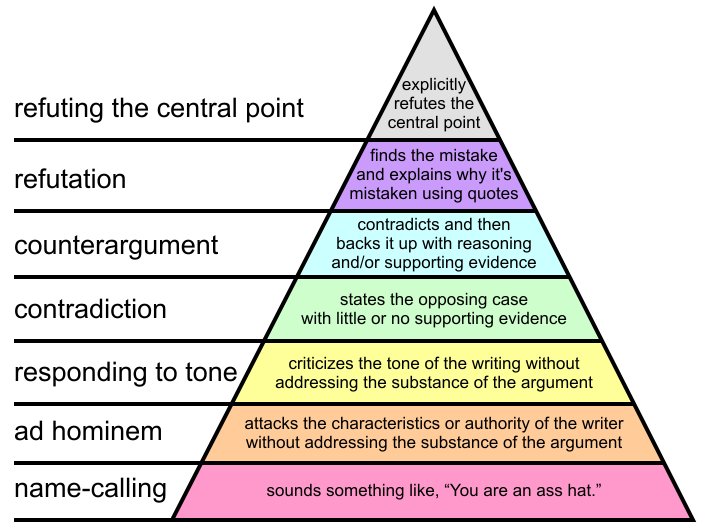
Paul Graham, a smart programmer and successful entrepreneur proposed a "disagreement hierarchy" in a 2008 essay, How to Disagree. He organized styles of arguments into a seven-point hierarchy and suggested, "If moving up the disagreement hierarchy makes people less mean, that will make most of them happier."
Graham also designed the hierarchy as a pyramid. This is logical because there are a limited number of people who are highly skilled at resolving disagreements. Therefore, the smallest space of his hierarchy (the top) represents the disagreement style demonstrated by the least number of people. (Wikipedia)
Here is Graham’s disagreement hierarchy:

Disagreements, arguments, and debates are words that can have a negative tone. However, these conversations can be very healthy, sincere, respectful, truth seeking, and productive. It is positive that people have different opinions, approaches, perspectives, and additional facts. Debate and disagreement are often necessary to determine the best solution.
Would you like to win every disagreement?
It is possible.
However, it depends on your definition of “winning.” The most common objective of people who disagree effectively is to find the best answer without unnecessarily harming their relationship with the other party. Adopt this approach and you can win every argument. The only exception is when you must withdraw because the other party is unreasonable or not aligned with your objectives.
Learn from the Hierarchy
Ask yourself two questions as you consider these seven disagreement styles as an individual, or with a group:
#1 – What disagreement style best describes my most common behavior when I’m arguing with others?
#2 – What style best describes my peers at work, and people I hang out with personally?
Comprehending your disagreement style enables you to develop better habits that result in reaching agreement more calmly, efficiently, and effectively.
Considering how others disagree is important because studies have concluded we become like the people with whom we spend the most time. If their habits are good, then they help us develop better habits. However, when their habits are bad, they subconsciously teach us negative behaviors.
Another important clue to consider: How you respond to each of these styles.
This discussion does not include how to respond to each disagreement style. However, you can learn how to avoid or more positively respond and resolve arguments in less time by developing habits based on these best practices.
There is one other habit that can help you tremendously.
It is: Don’t take anything said personally. Another person’s negativity says more about their wounds and mistakes than it does about you. James Clear, author of Atomic Habits, puts it this way: “Not taking things personally is a superpower.” (04/30/2020 post)
The focus of this teaching is how to effectively disagree in real-time arguments that occur in-person, during online meetings, and in-writing. This advice applies somewhat differently to indirect disagreements, such as online attacks, gossip, or internal anger and frustration.
The following is how we explain each disagreement style, and my advice based on our work at www.manage2win.com and my 47 years’ business experience.

Name-Calling
This first disagreement style is a bullying or fear response, rather than providing facts to refute something. Name-calling is a red flag to be extra careful in how you respond to the person or avoid them altogether. It may indicate the wounds from their life experience are fueling fears and a distorted perception of reality.
Name-callers are quick to judge others negatively. It’s often rude, coarse commentary that’s unhealthy, unproductive, and partially or totally untrue.
CONCLUSION: Name-calling does not help avoid or resolve an argument.
Ad Hominem
The second style is, Ad hominem, which is Latin for “to the man (or person).” It means someone attacks the character, motive, or other attribute of a person who has an opposing view rather than simply calling them a derogatory name or term.
Ad hominem is often based on partial truth. Part of the overall statement is true, but not all of it. Partial truths can connect with and fuel the fears of the attacker. This fools them into exaggerating the partial truth into an unfair, negative belief about the other person.
For instance, Joe may attack Susan, saying she wants Marilyn to lead a project because Marilyn is her friend. He says Susan’s totally biased. However, there is more to the truth. Marilyn is Susan’s friend. However, Marilyn is also very capable to lead the project, has one or more skills that make her a good choice, and there is time in her schedule to do the work.
Sometimes the Ad hominem approach is used because the attacker is trying to manipulate the other person without being candid about their reasoning. For instance, Joe might be motivated to attack Susan because he wants to lead the project or have one of his buddies do it.
CONCLUSION: Attacking someone ad hominem does not help avoid or resolve an argument.
Responding to Tone
The third style is how people respond to the tone of someone’s voice or writing. For instance, someone may have a condescending or angry tone, or they are rude in some other way.
The respondent who attacks the person’s tone may be correct the other person’s tone is offensive or inappropriate. However, tone is subjective. It does not determine the accuracy of the rude person’s statement or conclusions.
Getting upset about someone’s tone focuses on how they deliver their argument. This is better than attacking a person. However, it is still not offering facts or logic to prove the attacker’s position in the argument or debate.
CONCLUSION: Attacking someone’s tone of voice does not help avoid or resolve an argument.

Contradiction
This fourth style is the turning point in argumentative skills. However, it is still weak because the response simply states disagreement as opinion. No facts or qualified references are offered.
Using the example above, Joe may complain, “Marilyn is not senior enough for this project. Bernie would be a better choice.”
Susan might respond defensively with a simple statement, “Marilyn’s the best choice.” As you can see, neither side in the argument has provided facts or qualified references to reinforce their statements.
The good news is this approach is not attacking a person. It can start a process for the parties to focus on where they agree and disagree.
However, contradiction is a surface conversation that can cause two problems: (1) It can inflame emotions because there is no factual data to bring about a new decision; and (2) The argument can be controlled by the person who has better communication skills; or simply is a verbal and/or physical bully. This is true even when their opinion is wrong.
CONCLUSION: Respectfully contradicting someone with an opposing opinion rather than facts and quality references may start productive dialog. It can also negatively intensify the emotions of an argument or give the more highly skilled communicator an unfair advantage because the approach remains subjective.
Counterargument
The fifth style is counterarguments. This approach is disagreeing with facts and/or qualified references supporting your conclusions. When done respectfully, this positive behavior can make progress towards agreement, or at least identify where you agree to disagree.
However, problems occur when counterargument statements are too broad or general. As a result, the person offering the counterargument may shift the disagreement away from the main point. This may focus on part of the other person’s conclusion, a point they feel was indicated by the original person’s statement, or something they feel is related.
Continuing with our prior example, Joe may say, “Are you sure Marilyn’s the best choice? That project is important. Marilyn’s great, but she doesn’t have many certifications.” Susan could respond by saying, “I don’t think certifications are important. You do a lot of great work in areas where you don’t have any certifications. When’s the last time you got certified, and on what?”
In this example, the counterargument led to a debate about certifications, rather than who’s the best person to lead the project.
Another issue is when counterarguments extend the disagreement into assumptions, and/or judgment based on partial information or bias by one or both people.
Ideally, someone using the counterargument style is phrasing statements as questions to promote an open dialog. They also listen carefully to consider the other person’s thoughts. This approach succeeds when it is done within seven boundaries for polite, sincere disagreement:
#1 - Protect the relationship you have with the other person by being respectful and empathetic.
#2 - Clarify the specific issue being argued.
#3 – Sincerely seek to understand the other party’s conclusions, with an intent to find common ground. It is important to respect the person’s emotions. However, focus the conversation on the facts and how they relate to resolving the issue.
#4 – Discuss the facts and conclusions from qualified references.
#5 - Be open to gathering more facts and qualified opinions / research.
#6 - Focus first on where you both agree, and next on where you still disagree.
#7 - Don’t feel pressure to resolve the disagreement at once when the issue is not urgent.
CONCLUSION: Counterarguments are most effective as questions that lead to further discussions. This lays a strong, safe foundation to move to agreement through discussion, research, and consideration of facts and conclusions of qualified references.
Refutation
The sixth style is refutation, which is when someone attempts to disprove something. It is important to note that you must be an active listener to effectively refute anyone. This is because active listening enables you to comprehend what they believe, the emotions behind their conclusions, and the facts they’re presenting.
Active listening is giving someone your full attention when they are speaking. You are listening to what they say while also considering their nonverbal communication. At appropriate times, you respectfully repeat back brief statements they made to confirm you are correctly comprehending the information. If applicable, at the conclusion of the conversation you verify their expectations and action items to be taken.
As you repeat back each summary, it is effective to first explain where you agree, and possibly why. This demonstrates how you are working with the other person and often creates options to consider that lead to resolution.
Here is a productive approach to refuting someone’s statements:
#1 – State something where you disagree and ask them to confirm you are understanding them correctly.
Listen and fully consider their response.
#2 - Ask questions about facts that seem to contradict the other person’s conclusions.
Listen and fully consider their response.
#3 - Discuss where you feel qualified references and/or research contradict those the other person presented.
Listen and fully consider their response.
#4 – Assuming you have not changed your mind, explain why you feel your conclusion remains the most logical, accurate based on the facts, and fair considering the impact of the decision on others.
Listen and fully consider their response.
Active listening and respectful dialog help the other person feel safe. This encourages candor as you work through the issues. It also should enable both of you to be more open to consider alternatives to your original conclusions. New decisions occur based on trust and new information.
CONCLUSION: Respectful refutation can help people disagree more calmly, and reach resolution more quickly.

Refuting the Central Point
This seventh and best disagreement style is the top of the pyramid. It builds upon Counterarguments and Refutation to be the most skilled method of disagreeing with others, particularly when you are refuting someone in a respectful, empathetic, and specific manner.
Refuting the Central Point means the conversation starts by agreeing on a clear statement of where there is disagreement, and a mutual desire to find the best outcome. This focus fuels healthy conversation.
The discussion to confirm a clear central point may shift one person’s focus to something slightly different, or to one or more minor points that individually or collectively are significant to her/him. Although this may be frustrating, it emphasizes the value of having a clear central point or statement, so the disagreement does not decline into less important areas.
The key to refuting the other party’s position is to prove their central point is incorrect, or not the best. It is best to avoid debating your opinions. It is more productive and respectful to refute the specific central point by providing specific facts and/or the conclusions of qualified references and/or research that reinforce your proposed solution.
In a sincere dialog, you may decide to adopt their conclusion. This occurs when new information is shared that leads you to agree with part or all of the other person’s position. This is healthy. This conclusion is still a win because the goal is not fight or flight survival, but to find the best answer.
Beware of partial truths, opinions posed as facts, and references based on weak or otherwise flawed research or actual events. Assume the other person’s mistakes are honest. They are simply unaware of the truth or best decision. However, they are sincerely open to finding the best solution.
In other cases, people are intentionally dishonest or afraid to admit they’re wrong. The higher up your disagreement style and skills are on this pyramid, the easier it is for you to identify these two issues and overcome them.
Conclusion
Someone may win a debate because they are more eloquent, a bully, or simply because the data discussed was intentionally or unintentionally limited, or false.
Winning does not always mean the winner is right.
What can you do?
Train yourself and your people how to disagree with one another respectfully and empathetically. Part of this development is discussing real-life scenarios where your people individually and/or as a team have encountered disagreement. Help people to always choose integrity and put relationships first.
These skills help you stop a more skillful debater or bully from forcing a bad decision.
Never stop developing your habits, and those of your team, to have positive, respectful, and productive disagreements. These behaviors are required for your organization to be its best and thrive in any environment.

Four Questions to Ask When Creating Succession Plans
Back in 2007 the The Wall Street Journal published an article titled Too Many Companies Lack Succession Plans, Wasting Time, Talent.
In the article, Carol Hymowitz discussed the importance of succession plans and how “Only about half of public and private corporate boards have CEO-succession plans in place… This is the case even at giant global companies that have thousands of employees and spend millions each year to recruit and train talent.”
Carol’s article primarily focuses on large companies, but succession plans are just as important for SMBs (more on that below).
Does you have a succession plan?
Back in 2007 the The Wall Street Journal published an article titled Too Many Companies Lack Succession Plans, Wasting Time, Talent.
In the article, Carol Hymowitz discussed the importance of succession plans and how “Only about half of public and private corporate boards have CEO-succession plans in place… This is the case even at giant global companies that have thousands of employees and spend millions each year to recruit and train talent.”
Carol’s article primarily focuses on large companies, but succession plans are just as important for SMBs (more on that below).
Does you have a succession plan?

I’ll keep it simple: If your answer is “no”, you should create a succession plan for the key roles in your company. If you die or become unable to work for whatever reason it is important for your business to run smoothly in your absence. A succession plan protects your assets and serves your customers. Being lazy and procrastinating about succession plans is irresponsible.
The Importance of a Succession Plan
Let’s do a quick review: A succession plan is basically your process for identifying and preparing people for leadership roles. It’s your “If I die here’s who will be in charge” plan. It’s also a way to insure your company against unexpected departures among key employees.
Also, a succession plan is not a one-time process. It is an integral part of a company’s culture.
“Succession planning isn’t an event, it is a process best managed over three, five, even ten years…”
Companies who are wisely managed know who takes over for key executives should they leave the company for any reason. Think of it like backing up company data - except the data in this case is people.
Succession Plans are Just as Important for Small-to-Midsize Companies as they are for Large Companies (and maybe even more important)
Many companies, large and small, fail in the area of succession planning. Too many CEOs neglect to acknowledge their own mortality, or lack the humility to properly share the responsibility of their role with a successor. More commonly, corporate boards and company executives simply fail to prepare for catastrophe. When things are going well, it’s easy to procrastinate about preparing for change.
For instance, back in the 2000s, Citigroup and Merrill Lynch didn’t begin searching for replacement CEOs until the moment the current CEO stepped down or was ousted.
Is that surprising? To many people it is. Despite history’s many examples to the contrary, the prevailing notion is to believe large organizations are better organized than everyone else. But it’s often not true. Large organizations are not much different than small organizations when it comes to predicting and planning for problems.

However, large companies do have one advantage over small companies: More resources.
Imagine a small, family-owned business with 25 employees that suddenly loses its CEO to a tragic accident. The CEO essentially ran the company, juggling multiple responsibilities and serving as it’s key representative. Unfortunately, the CEO was not grooming anyone to take over the top leadership role.
Now, imagine the same situation occurs with a large company that has 25,000 employees.
To find a replacement CEO, there are technically more people qualified to run the 25-person business. But the larger company simply has way more resources. They have more money, more people, a larger collective network to draw from, and more benefits. Even if the business is failing, there are plenty of people who would jump at the chance to run a 25,000 person company than a 25-person company. Just putting that experience on a resume is beneficial.
That’s why it’s just as important for small businesses to take succession planning seriously. If the unexpected happens, you owe it to your employees to have a plan in place.
Four Questions to Ask Yourself When Creating Succession Plans
Want to start working on a succession plan, or fine tune your existing succession plan? Start with these four simple questions:
What are the key roles in our company?
Who are the candidates who could fill those roles in the future?
What do candidates need to learn and experience to make them fully capable of performing the key role?
How can we schedule activities to train and provide opportunities for the candidates to experience situations that enable them to develop the skills and perspective to fill a key role?
Now, answering these questions will put you on the right track. But you still must adopt the right mindset.
Sitting executives must practice humility and be willing to let go. Surround yourself with people who are willing to offer new perspectives, and be ready to share power with your successors. Consider grooming your successor by promoting them to positions of power, like President or COO, and give them more responsibility. Work closely together and familiarize your board with the heir apparent.
Finally, choose your successors based on their future ability to succeed, not by their past accomplishments. Your company may need leaders with different strengths and talents than previous leaders.
Please consider developing or updating your succession plan as part of your key priorities every year. To be an effective leader you need to be developing others.

What Are Soft Skills and Why Are They Important?
Soft skills. It’s a term you’ve probably heard before. From executives and consultants, to Seth Godin and Inc Magazine, people are talking about the importance of soft skills so much it feels like a new diet craze.
However, when you take some time to investigate, it becomes clear that “soft skills” just means “likeable”, “conscientious”, or “admirable”. It’s a broad term used to describe almost all non-technical skills.
Soft skills. It’s a term you’ve probably heard before. From executives and consultants, to Seth Godin and Inc Magazine, people are talking about the importance of soft skills so much it feels like a new diet craze.
However, when you take some time to investigate, it becomes clear that “soft skills” just means “likeable”, “conscientious”, or “admirable”. It’s a broad term used to describe almost all non-technical skills. According to Wikipedia, the term “soft skills” encompasses a combination of people skills, social skills, communication skills, character traits, attitudes, career attributes, social intelligence and emotional intelligence quotients that enable people to navigate their environment, work well with others, perform well, and achieve their goals with complementing hard skills.
These skills have always existed. They have been utilized and perfected in many successful organizations. However, their popularity has increased as the mass majority of people have caught on to the fact that these skills are super important and they can be taught to anyone.
Where did the term “Soft Skills” come from?
Soft skills have been around forever, they are not new. Before it became an official term, Dale Carnegie described many soft skills in his book How to Win Friends and Influence People.
However, we started using the term “soft skills” because of the US military.
Around 1959 the US Army started investing heavily in training procedures that utilized technology to improve workflow and learning efficiency. They created a regulation (a doctrine, a set of guidelines or rules) called Systems Engineering of Training (CON Reg 350-100-1) that laid the groundwork for designing and producing courses for specific Army jobs. According to author Dr. Paul G. Whitmore, the courses created under this regulation would cover job related skills involving people and paper – inspecting things, supervising people, preparing reports, or designing structures – skills that did not involve machines.

This was the catalyst for the creation of “soft skills” as a term. While the term did not appear in CON Reg 350-100-1, the regulation spurred the analysis of skills and skill development in the modern military.
The term “soft skills” eventually and formally appeared in a report on a 1972 CONARC Soft Skills Conference, or a 1972 US Army training manual (I believe they are one in the same).
At the 1972 soft skills conference, Dr. Whitmore and John P. Fry presented three papers dealing with skills analysis and training procedures. I was able to find a reference to Dr. Whitmore’s papers at the Defense Technical Information Center (DTIC). After giving them a call and speaking with a representative, they directed me to the National Technical Reports Library where I was able to download the March 1974 version of the reports. The three papers are:
“What Are Soft Skills?” by John P. Fry and Paul G. Whitmore
“The Behavioral Model as a Tool for Analyzing Soft Skills” by Paul G. Whitmore
“Procedures for Implementing Soft-Skill Training in CONARC Schools” by John P. Fry
These papers were presented at the 1972 CONARC Soft SKills Conference. Page II-7 of the conference report reads:

text highlight added by me
So that’s it. “Soft skills” (along with many other things) originated within the US Army.
Today these skills are also referred to as “people skills” or “emotional intelligence”. Seth Godin thinks we should stop calling them soft skills because the word “soft” makes them sound like they are not important. Regardless of what you call them, they exist, and they are so important that the US Army held a multi-day conference about them.
The question is: Why are they important?
Why are soft skills important?
Everything you do involves other people, directly or indirectly. Even if you are a programmer who never talks to another human being, your code eventually makes its way to the outside world and affects people. If you want to turn your creation into a business, you will have to talk to other people, in person, on the phone, or digitally.
Furthermore, if you want to get a job, keep your job, or advance up the career ladder, you will need to be personable, conscientious, and self-aware. Your whole career centers on the importance of soft skills. If you cannot smile at appropriate times, hold a conversation, or deal with conflict, your career potential is, on average, extremely low.
Soft skills are so important, we often instinctively value them too much. Ever wonder why or how a certain person became a manager or a director, when they don’t seem to have the required technical skills? It’s probably because they have great soft skills!
Technical skills are just half of the game. If you can fix a product, you have half the equation figured out. However, you will lose business if you don’t know how to connect with your customer on an emotional level, understand their needs, and make them feel valued.
The importance of soft skills cannot be overstated: To succeed, people need to be able to connect with you, and you need to be able to connect with other people in meaningful ways. Soft skills are important because they are the difference between being an engaged member of a team versus being just another cog in the wheel.
What soft skills should you master?
There are so many different examples of soft skills. Too much duplication, too much overlap. Let’s discuss the most important ones and why these are covered in our courses at Dave’s Charm School.
At the very least, these interpersonal skills should be on your radar:
Communication – the ability to speak, write, present, and listen, in person or on the phone.
Courtesy – a habit of observable manners, etiquette, business etiquette, graciousness, including saying please and thank you, and being respectful.
Flexibility – adaptability and willingness to change, adopting the mindset of a lifelong learner, accepting of new things, willing to adjust, and, in a word, teachable.
Integrity – practicing honesty, being ethical, valuing high morals, having personal values, doing what’s right.
Interpersonal skills – being kind and personable, having a relaxed sense of humor or ease, being friendly, nurturing, empathetic, displaying a strong sense of self-control, being patient, social, and slow to anger, appearing “warm” and considerate.
Positive attitude – choosing to be optimistic, enthusiastic, encouraging, happy, and confident.
Professionalism – recognizing and donning the appropriate look, manner, and poise, appearing businesslike, well-dressed, and adopting the proper attitude for the situation.
Responsibility – showing yourself to be accountable, reliable, able to get the job done, resourceful, self-disciplined, wanting to do well, conscientious with common sense.
Teamwork – being cooperative, getting along with others, supporting others, trying to be helpful, willing to collaborate.
Work ethic – hard working, willing to work, being loyal, taking initiative, being self-motivated and on time with a good attendance record.
Time Management – able to schedule your time appropriately, manage project flow and deadlines according to their due date, being efficient and following through on commitments.
Conflict-Resolution – ready and able to engage in problem-solving, displaying sympathy and empathy for others, practicing active listening, knowing and practicing effective crisis management and negotiation.
Leadership – taking initiative, coordinating efforts between team members, mentoring, inspiring others, making difficult decisions, having and pursuing a vision.
Balance – respecting boundaries, practicing self-care, managing your own expectations as well as your workload, maintaining focus on your purpose.
This may seem like a long list, but we practice or neglect each and every one of these just about every day. These skills are the counterpart to all of the technical knowledge we have, and they are just as important. Be mindful of these as you work.
Fixing a product should be followed by a smile, and perhaps a warm handshake. Collaborating on a design should include providing your technical knowledge and then being able to gracefully accept the input of others. Leading a team requires pursuit of your mission, but it’s also about being able to inspire your team to follow you on that mission.
You are using soft skills regardless of your position, and the higher you climb the job ladder the more important those soft skills become.
How to improve your soft skills
The best thing you can do to improve your soft skills is to learn and practice. Read books like How to Win Friends and Influence People. Review and rate yourself on each of the soft skills listed above. Then schedule some time each week or month to practice areas in which you feel deficient.
It takes time to improve soft skills, but it’s worth it. Focus on strengthening your strengths, and shoring up your weaknesses.
The benefits will last the rest of your life.

How Often Should You Train Your Employees?
A consistent training regimen is important for you and your team. Effective training provides new hires and existing employees with the skills and knowledge they need to not only do their job but improve their performance. However, like many companies, you may not be sure how to train your employees, when to train them, and when to retrain them on previous skills.
A consistent training regimen is important for you and your team. Effective training provides new hires and existing employees with the skills and knowledge they need to not only do their job but improve their performance. However, like many companies, you may not be sure how to train your employees, when to train them, and when to retrain them on previous skills.
If you are going to prioritize learning and skill development in your company culture, you need to do it right.
How good is your memory?
In “A Study in Scarlet”, the famous fictional detective Sherlock Holmes described a man’s brain as an attic. A foolish man would stuff the attic full of junk, making it difficult to retrieve useful items and information. However, a wise man (or woman, of course) would only save the most important tools and information so as to render them easily accessible in times of need. This is an extraordinarily relevant theory to our workplace habits, training tactics, and daily performance.
Your employees get bombarded every day with emails, texts, phone calls, and conversations that contain countless bits of information. You cannot expect them to retain everything. More importantly, you must be prepared for them to forget at least some of the knowledge and habits you try to instill.
The Ebbinghaus Forgetting Curve
In 1885 the German psychologist Hermann Ebbinghaus studied his own ability to retain various information. Specifically, he studied the memorization of nonsense syllables like “WID” and “ZOF”, then plotted the results over a period of time. The graph of his results is now known as the forgetting curve. The forgetting curve and supporting research estimates that within 1 hour people will have forgotten up to 50 percent of the information presented in an earlier learning session. Within a day, an average of 70 percent of the new information may have been forgotten. Within a week, participants may have forgotten around 90 percent. These are averages based on one type of study, the percentages should be taken with a grain of salt.

While this is a large amount of information to forget, one thing is important to note: Forgetting is useful. It clears out old memories that are no longer needed – like where you parked your car last week during your offsite meeting, yesterday’s weather, or what you had for dinner three weeks ago – and makes room for new memories that are more pertinent. This is great for our efficiency, and it is inevitable.
However, the process of forgetting things often involves forgetting important things, information we want to retain. This is a problem.
Thankfully, Ebbinghaus and others have noted the speed of forgetting depends on a number of factors including the participant’s physical state at the time of learning, the emotional or intellectual power of the memory, the teaching methods, and the amount of repetition. For instance, Ebbinghaus hypothesized that mnemonic techniques for aiding information retention or retrieval (like the ABC’s song) may improve retention rates.
Ebbinghaus’ research also prompted his notion of “overlearning”. Overlearning means one has spent more time than necessary memorizing a certain piece of information and has therefore rendered the memorization of the information stronger and less likely to be forgotten.
3 Tips to Optimize Your Training Regimen
When we take Ebbinghaus’ hypotheses into account, we can design a training regimen that is memorable and impactful. Here are a few tips to improve the efficacy of your training sessions.

To start, make sure your training schedule is relevant to your company’s work schedule and appropriate for your employees. Too often companies schedule training far in advance of when it will actually be used. Since time is of the essence, you should schedule training as close to the time as it will be used. This allows employees to perform learned tasks in the real world closer to the moment they were first introduced to the knowledge, which should increase the likelihood they will develop the correct habits.
In addition, make sure training times coincide with the best learning environment for your team. If your employees usually begin work around 8am, don’t schedule training at 6am. Their entire physiological clock will be in an interrupted state. Instead, we recommend you schedule training for 9am (in this scenario). At 9am your team is awake, at the office, acclimated to their environment, and has had an appropriate amount of time to respond to any morning emergencies.
Second, when designing your training content, make sure it is related to the actual job. Bland bits of knowledge and a few check boxes do not constitute an engaging learning experience. A new piece of information is much more likely to be remembered if it is relevant to the task at hand, if the learner can see exactly how the new information will benefit them. Try to use stories and concrete examples.
Third and finally, allow students to practice immediately after the training, in real life, and in real-time, if possible. For instance, if an employee is given the responsibility of answering service tickets related to a specific software package, let them practice answering real service tickets from real customers. Guide them through the process, help them craft their responses, and give them the freedom to make a few mistakes.
The more time spent learning a new task will contribute to the “overlearning” phenomenon mentioned by Ebbinghaus. If you can give your team hands-on experience during or right after training you will significantly increase their retention rates. This is why we try to give examples and exercises during each lesson of Dave’s Charm School courses.
Should Training be Priority #1?
The best companies are often the ones that prioritize training over everything else.
Lately I have been reading Simply Brilliant by William C. Taylor. Quite a few of the companies mentioned in the book place a high priority on consistent, regular training.
One of the examples that stood out to me is Pal’s Sudden Service. Now, I’m not a huge fan of fast food, mostly because it’s usually unhealthy fare. But I don’t have to be a fan of fast food to appreciate Bill Taylor’s description of the company culture at Pal’s and their commitment to training.

According to the book, Pal’s is the fastest fast food restaurant in the country. On average, customers get their food at Pal’s Sudden Service in less than a quarter of the time of any other quick-serve restaurant. They place an order face-to-face with a human being (very cool) in an average of 18 seconds, then pick up the order at the handout window (another real-life human!) in an average of 12 seconds. I don’t think customers drive super fast, that’s not included in the estimates. It’s the interactions with the employees that we are talking about.
This is just one of Pal’s incredible performance statistics mentioned in the book (hint: they also rarely mess up orders).
The secret to their success? A commitment to training. One hundred and twenty hours of training for new employees, and regular, required, re-certification for existing employees. Pal’s is so committed to making sure their team is excellent that they administer pop quizzes: “Every day… a computer randomly generates the names of two to four employees to be re-certified in one of their jobs (at the restaurant). They take a quick test, see whether they pass, and if they fail, they get retrained for that job before they can do it again.”
It’s this commitment to training that has made Pal’s a success, with their customers and their employees. Think about it: If you had one hundred and twenty hours of training to make hamburgers and fries you would (1) rarely make mistakes and (2) feel incredibly competent.
I will leave you with one final quote from the book that I found the most important, and most relevant to this article. When speaking about Pal’s commitment to training, Pal’s CEO Thom Crosby said this:
We believe in certification over graduation. We train you, we graduate you – that’s when most companies stop. But people go out of calibration just like machines go out of calibration. So we are always training, always teaching, always coaching.
Think about that the next time you schedule a training session.
In closing, how often should you train (or certify) your employees? It depends on the focus of their work and your company culture.
One thing is for certain: If you want your team to be skilled and confident, regular training is a must.

Play Jeopardy
How can you combine team bonding, education, and training?
And laughs? Lots of laughs!
Ryan McFarland, Service Desk Manager at vertikal6 has a solution.
How can you combine team bonding, education, and training?
And laughs? Lots of laughs!
Ryan McFarland, Service Desk Manager at Vertikal6 has a solution.
Every Friday he creates questions to lead a Jeopardy game for his team of help desk techs. The winner gets a $25 gift card, but that’s not the primary motivation. It’s the friendly competition and laughter that’s the main draw.
Here’s how he formulates the questions: Ryan chooses a different client every week. He researches the client’s tickets over the past week to a month and develops 30 questions plus one bonus question based on the actual tickets.
Yes, it takes some work. However, vertikal6 has an incredibly strong culture and building each other up while having fun is an essential ingredient.

Ryan then loads the questions and answers into www.playfactile.com for the Jeopardy game. This creates 6 columns with five questions each, ascending in value as you work your way down the column. The game typically takes 20-30 minutes and his team of millennials love it.
Wouldn’t you?
Consider the benefits:
1. Everyone on the team learns more about a Client so they can serve them better.
2. Laughter and friendly rivalry bonds the group.
3. The leader (Ryan) sets an example that having fun is okay, if not encouraged when it’s positive and respectful.
4. The cost is $25 plus about two hours of Ryan’s time weekly. (Researching some Clients takes longer.)
5. When Clients that have been the focus of the game call in for help, the service they receive is more consistently excellent and personal.

Vertikal6 is a rapidly growing, advanced IT solution provider that has doubled in size since we worked together a few years ago. The company has been recognized as a Best Place to Work in Rhode Island. Because they get “the people” right (culture), they provide superior services in their region.
Vertikal6 sends every new manager through the Manage 2 Win Certified Leader program, however we are just a piece of their organizational success. Their leaders get the credit for their growth and culture. It starts with Rick Norberg, the founder, who is a visionary. Harry Curran, his right hand man who runs operations, is a down-to-earth, humble leader. They hire carefully, give their leaders a lot of authority and opportunity, work diligently with their teams, and have built a culture where everyone embraces excellence.
You may not be able to match vertikal6’s growth rate or culture, but why not start with this game? It’s a winner.
Laughter echoes in the halls of every great organization.
Why not yours?
Sincerely,
David Graham Russell
Leadership Activist & Author

You Can Change the World
Are your days overflowing with firefighting, reacting to interruptions, and a lot of drama?
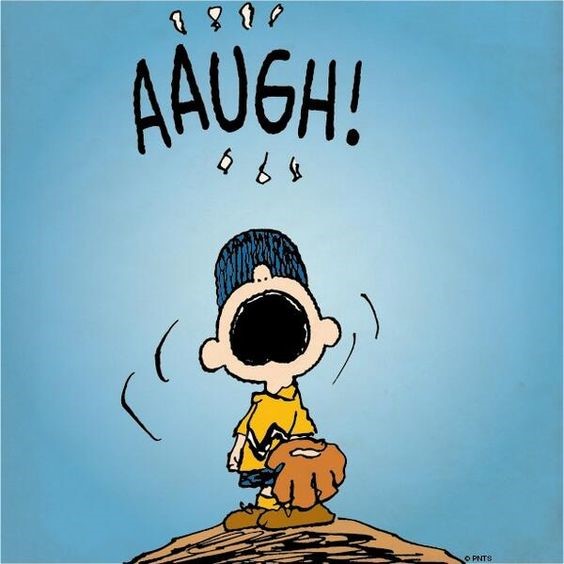
… As Charlie Brown would say, “AAUGH!”
When our lives are like this, time passes quickly. Opportunities are lost.
Are your days overflowing with firefighting, reacting to interruptions, and a lot of drama?
When our lives are like this, time passes quickly. Opportunities are lost.
It’s now February. January is gone. Many of us are progressing with our 2019 New Year’s Resolutions (**high five**). However, others barely wrote down some thoughts on 2019 targets and are stuck in a too-familiar, unfulfilling existence of just being busy.
You know the routine because we've all been there: Get up in the morning. Go to work. Spend most of the day reacting to circumstances rather than driving strategic outcomes. Drag ourselves home. Eat. Sleep. Repeat… repeat… repeat…
As Charlie Brown would say, “AAUGH!”
Click here for image
STOP THE MADNESS!! :-/
Yes, changing our bad habits takes more time than a quick household chore, and we can’t jump into a phone booth (if we could even find one anymore) to rip off our clothes down to our neon blue tights, bright red cape and muscle shirt with the “S” on the chest to save the world.
So… maybe you lost the first month of 2019 to busyness. That’s okay, but what are you going to do about it?
Embrace February 1 as your new New Year! Break out of your busyness matrix. This is a second opportunity to make 2019 your best year yet.
Start here. Read this overview of Navy Admiral William McRaven’s commencement speech to the 2014 graduating class of University of Texas at Austin. He gives simple daily habits to develop guaranteed to change the world, starting with your own.

Click here to listen to the full speech
If you want to change the world, then…

Click here for image
#1 – Make your bed
… immediately after you get up in the morning, and do it with excellence! Let this responsibility start the day as an accomplishment reinforcing your commitment to be the best you can be.
Not only that, but when you are worn out at the end of the day, it’s wonderful to get into a clean, fresh, inviting bed.

Click here to view this photo of the miracle 1936 University of Washington crew team’s Olympic win.
#2 – Work in teams.
You cannot change your world, or the world around you, alone. Choose your team well because change requires assistance from others. Your mother was right: We become like the people with whom we spend the most time.
Your job is fun and fulfilling when you enjoy the people with whom you work. It’s a disaster when you and/or your leaders hire the wrong people or retain poor performers too long.
Admiral McRaven uses the analogy of a crew team with fellow rowers and a coxswain. You need others, and they need to be the right people. It’s a good picture to remember.

Click here for image
#3 – Measure a person by the size of their heart
… not the size of their flippers.
Often people jump to judgment based on a person’s height, ethnicity, education, or social status. It is important to acknowledge the exterior of a person, however, do not stop there. The most important human qualities manifest from the inside out – our values, character, soft skills, competence, intelligence, willingness to grow/change, our ability to be coached, and actual skills.
Here are three standards that help build a good team, which I call “Simple Liberty:” (1) Good character wins; (2) Equal opportunity for everyone; and (3) Work for the common good and/or a higher purpose. Teams thrive when there is a shared commitment to these three values.

Click here for image
#4 – Being a “sugar cookie” is temporary
… when we learn from our mistakes and apply what this new knowledge to avoid repeating those errors. During SEAL training a “sugar cookie” is someone who failed uniform inspection and was required to run, fully clothed into the surf, and then, soaking wet from head-to-toe, roll in the sand. The SEAL then had to stay in that wet, cold, sand-covered uniform for the rest of the day.
Failure happens! But it’s a stop along the journey, not your destination. You have keep going. Tenacity over perseverance are both ways to overcome the failures we all experience in life. Perseverance means we don’t give up. Tenacity means we apply what we learn to not repeat mistakes and discover better ways to achieve.
Be tenacious.

#5 – Don’t fear the circus.
Every day the Admiral’s class of SEALS were put through grinding physical challenges – obstacle courses, long swims and/or runs, hours of calisthenics, etc. to test their mental toughness as well as build them up physically. Every activity had a standard to meet.
When someone failed, and everyone did at times, their name was put on the “circus” list. The circus was TWO MORE HOURS of calisthenics designed to break you, or build you – your choice.
Admiral McRaven encourages us that everyone gets stronger in a “circus.” This is important to remember. Life’s challenges can seem like a burden, but with a good attitude and tenacity the extra work required to overcome each challenge strengthens you.
Continue through each of your challenges with tenacious focus, positivity, and an openness to learning. Tunnels are temporary. There is a light at the end.

Click here for image
#6 – Take reasonable risks.
Admiral McRaven shares the story of a Navy SEAL who conquered an obstacle course by sliding down one portion head-first, when everyone for decades had crawled or climbed. The result of his reasonable risk was to complete the course in record-setting time.
How did he do it?
The SEAL first carefully assessed the situation and completed the route safely multiple times the standard way. Then he felt the potential for success outweighed the risk of injury. He made a tough decision and went for it. What many of us fail to realize is all of life is risky. Carefully assess each situation and take reasonable risks.

Click here for image
#7 – Don’t back down from sharks.
Navy SEALS train in the ocean. Sharks live in the ocean. Therefore, sharks are a constant threat to anything/anyone in the ocean. The SEALS are trained to hold their ground if a shark starts to circle their position. Do not back away. If the shark attacks, they are instructed to summon all their strength and punch him in the snout. He will back away.
If you are to change the world, then you must not let bullies convince you to back down. Our “bully” may be a person, a debt to pay, a tempting opportunity we are pressured to pursue but should not, an internal message from a life wound, a failing relationship, or another circumstance.
There are many bullies in this world we encounter on our life’s journey. Prepare. Courageously hold your ground. Stand for good character, equal opportunity, and the common good.

Click here for image
#8 – Be your best when life is its darkest.
Admiral McRaven explains part of SEAL training is to place bombs on the hulls of large ships at port. Due to the hull’s design, depth of the water, and the fact the drill is done at night, the SEAL cannot even see their own hand in front of their face when they are next to the hull. Nevertheless, the bomb HAS to be placed accurately on the hull of the ship. There is no room for error.
The SEAL swims 2 miles underwater to reach the target. The training simulates working with live ammunition, and an enemy seeking to kill them if discovered. It is cold, lonely, and highly stressful. If you are going to change the world, then you have to learn to be your best when times are awful. Remember, just as day follows night, darkness is overcome by light. Whatever you are facing, the challenge will pass.
Most of us are not SEALS and don’t have to scuba solo. However, there are times when we find ourselves cold, in the dark moments of life, and highly stressed.
Stay calm. Remain focused. Proceed systematically. Go back to Life Lesson #2 – Work in teams. Reach out to people you trust. Their support helps you fully consider your map, the risks of each route, and how to better reach your destination.

Click here for image
#9 – Start singing instead of giving up.
The ninth week of SEAL training is Hell Week. Wednesday of that week is when the aspiring SEAL class gets to experience the mud flats above Tijuana. As sun set, the Admiral’s entire class was ordered into the shivering cold, wet mud, which consumed each man until nothing was visible except their heads.
The instructors then announced to the group that they can get out of the mud if just 5 of them quit the training. The Admiral explained some were ready to give up. The instructors continued harassing them. There were still 8 more hours of bone-chilling cold to suffer through before the sun rose and they could earn their way to freedom from the mud. The situation looked bleak.
Then one SEAL started to sing. His voice was off-key, but the core of his being was strong. His enthusiasm was contagious. Soon they all were singing and disregarding the instructors’ threats of longer mud time if they continued. They persisted. They refused to submit and quit. Instead, they prevailed without losing a single SEAL.
All it takes is one person to change the world, one person who refuses to lose hope. Consider the lives of Abraham Lincoln, Dr. Martin Luther King Jr., Nelson Mandela, and others who have overcome incredible odds to help mankind.
YOU are one person. Refuse to lose hope. Your hope is contagious. SING!

Click here for image
#10 – Don’t ever ring the bell.
In the center of the SEAL training compound there is a brass bell for all to see and have easy access. Any student can ring the bell at any time to quit. It is a temptation for some, and an inspiration for others to maintain their grit.
The Admiral’s lesson is never, ever quit.
Our lives, like SEAL training, will present challenges more difficult than we expected. Nevertheless, have confidence that though there may be mountains in your path, these mountains were made for you to climb. Each mountain helps you grow your character, wisdom, and skills.
Prepare. Stay the course. Take reasonable risks. Do NOT ring the bell.
THANK YOU, Admiral McRaven, for these 10 life lessons and your service for our nation!
Thank YOU for reading this newsletter / post!
It’s not too late to make 2019 your best year ever!!!
Visit M2W podcasts on our website and YouTube; and Dave’s Charm School as you and your teams implement the 10 Life Lessons above.
Let us help you change the world!
Move beyond your career. Live your calling.
Sincerely,
David Graham Russell
Leadership Activist, Author & Consultant

Start Here. Now.
It’s the end of 2018. Did you achieve all of your objectives this year professionally and personally? Did you even have objectives for 2018? If you are honest with yourself, the likely answer is no.
The good news is, you get another chance in 2019.
The bad news is, your unproductive habits are ready to sabotage 2019.
It’s the end of 2018. Did you achieve all of your objectives this year professionally and personally? Did you even have objectives for 2018? If you are honest with yourself, the likely answer is no.
The good news is, you get another chance in 2019.
The bad news is, your unproductive habits are ready to sabotage 2019.
In the 1999 science fiction film, The Matrix, Morpheus awakens Neo to the real world. Neo’s reality was a ravaged wasteland where most of humanity have been captured by a race of machines that live off of the humans' body heat and electrochemical energy. Human minds are imprisoned within an artificial reality known as the Matrix.

Is your mind stuck in a Matrix of bad habits that have you imprisoned in mediocrity? Everyone has a mind matrix of their own making in at least one area of their life.
Perhaps you procrastinate on doing something different because the status quo is too comfortable. You are in a pit, on a snowy day, with a lion. Although it's scary at times, you have convinced yourself the lion will not eat you.
Most of your focus is just getting through each day rather than getting out of your pit.
Or perhaps you believe the Big Lie, that you're doing everything you can and things are okay. When you started your business, was your objective to be "okay"? When you got married, was your objective to have an "okay" marriage? When you decided to get in better shape, was your goal to be in "okay" shape?
"Okay" sucks. You are meant for more. But you must have the courage and the discipline to stop lying to yourself.
Change your expectations. Stop having a goal to just get through the day. Stop allowing yourself to react your way through each day. Stop letting your bad habits control your days.
Instead, focus on setting and achieving your career and company goals.
Start here, where you are, with a new commitment to be all that you can be. It doesn't matter how many mistakes you have made. Your age, finances, job title, knowledge, skills, and current opportunities, or lack thereof, cannot stop you if you commit to start here and now.
The most valiant warriors have wounds, but time and time again, they start here. They start now.
You can too!
Stop being a sucker for the Big Lie. In at least one area of your life you did not achieve significant progress in 2018. Rip the Big Lie from your conscious mind. Stop repeating it over and over. Stop using it as an excuse. Stop trying to feel comfortable when you know you can do better.
Do something different in 2019!
Here's a few things we are offering to help you get started:
Certified LEADER program - starting January 7 (register by Dec 31 to automatically save $250).
Dave’s Charm School - soft skills training, low cost, train 1-3 lessons each week.
Hire the Best system – you will spend $100,000 on new hires in 2019, invest a fraction of that to hire better people and avoid posers.
Talent Assessments – Improve your current employee productivity, and better match job candidates to your openings with our Talent Assessments. We have Clients who will not hire unless they consider our unique profiles and give our opinion of whether to hire or not.
LEADERSHIP Essentials – Work with me for 3-6 months to improve your leadership and company culture so your organization can thrive.
Start here. Start now. On your own, or with me.
Just do something different!
Merry Christmas! Happy Hanukkah! Happy New Year! Happy Holidays!

Weak Debriefs Are Killing You
In the book, Flawless Execution, author and former U.S. Air Force pilot James Murphy describes how the Air Force uses a continuous improvement process to reduce errors, casualties, and losses.
Two of his recommendations struck me – how the Air Force prepares for missions, and how they learn from them – the debrief. I think the debrief is a serious weakness in most companies.
In the book, Flawless Execution, author and former U.S. Air Force pilot James Murphy describes how the Air Force uses a continuous improvement process to reduce errors, casualties, and losses.
Two of his recommendations struck me – how the Air Force prepares for missions, and how they learn from them – the debrief. I think the debrief is a serious weakness in most companies.
Murphy states the U.S. Air Force has perfected the debrief process so anything learned from one mission can be applied 2-3 hours later in another mission.
Pilots are required after every mission to candidly review the mission, consider what went right, discuss where improvement is needed, and clearly define changes to make in subsequent missions to improve success.
This debrief process is exalted in Air Force circles as the key to their 98% mission completion rate.

Debriefing on board USS Ronald Reagan (CVN-76)
Now, in my work with Clients I find there are three critical, interdependent parts to successful service delivery:
Plan
Deliver
Debrief
Most service providers are reasonably effective at planning and delivering. However, any debrief is minimal because they move so quickly from ticket to ticket, project to project, and Client to Client. When problems occur, the common approach is to glance at the documentation in their PSA, patch the issue, and rush forward.
Unfortunately, this is not an efficient way to operate. Problems repeat or expand, and too often the documentation lacks important details.
This is not an employee issue. It is a cultural issue and a costly procedural flaw caused by a weak system.
Instead of operating with a reactionary firefighter mentality, try implementing a debrief process for every project and major service ticket. It will enable you to respond to issues more comprehensively so future efforts are more efficient and effective.
The Debrief Process
A transformative debrief process discusses the result of the project, what went right, where improvements can be made, and how to change processes, communication, and other aspects of future projects.
Murphy recommends a 7-step S.T.E.A.L.T.H. debrief process. Let’s use his process, with my suggestions, as a baseline for you to implement a better debrief process in your organization:
Set the Time
I’m guessing your debriefs are either non-existent or pathetic. The first thing to do is add debriefs to your project plans. Even small projects benefit from a good review after completion. A comprehensive debrief is a critical part of your service delivery process.
Debrief meetings are mandatory
The time, place, and general agenda of the debrief is part of every project plan
During the debrief, schedule additional separate meetings for any strength or weakness that requires a more comprehensive review
Depending on the size of the project, the debrief should last a minimum of 10 minutes to a maximum of one hour.
Tone
Everyone in the debrief needs to feel safe when speaking candidly.
The first step to creating this open environment is to have a system for how debriefs are done.
The second step is to limit participation in debriefs to the people who were directly involved in the project, and when appropriate their manager.
The third step is before each debrief. The leader of the debrief conversation is the role model for candor, humility, active listening, and decision making.
Therefore, assess your current state-of-mind before starting any debrief. You need to treat others with respect, empathy, and kindness while facilitating clear, efficient discussion of the work completed.
If you are angry or emotionally stressed it can reduce the candor of the meeting’s conversation and damage relationships. You cannot afford either of those losses.
Also, as mentioned above, the leader sets the tone. Humbly admitting your mistakes, even when small, reinforces safety and encourages others to be equally candid. Glossing over your mistakes or dismissing them destroys the debrief.
Execution vs. Objective
Limit the agenda and focus to the project completed.
Focus on the facts during the debrief. What was the objective? Did we meet or exceed all of the expectations for this task or project? Was it on time? Were the key metrics achieved?
“Yes” and “No” are the answers. Respectfully avoid skimming over key details, allowing excuses, and indecisive conclusions.
Start by stating the objective and comment on where the project succeeded and where it could improve.
Analyze Execution
Get to the disease rather than dwell on the symptoms. What happened? Why did it succeed or fail? Where can we make changes to be even better?
Were there internal gaps in communication, or with Client contacts? Was time entry and documentation completed hourly or daily as work was completed? Can the processes we followed be improved?
Remember not to just focus on the negative. The positives should also be evaluated to consider how to do more of what worked well. This is building on your strengths.
People should not interrupt one another, or repeat what has already been said except to summarize a point and then add something new of value.
Every idea is welcomed, and reasonable extensions of ideas are considered. The goal is continuous improvement where identified changes are then tested in upcoming projects.
Lessons Learned
Gather what you learned, transfer it to a shared server / cloud location for easy team access, and then apply what was learned. This is critical.
Without this process, successes are forgotten, mistakes repeat and expand, and opportunities to bond your team around common, meaningful goals is lost. (Along with a ton of profits!)
Murphy recommends each Lesson Learned is listed:
Objective of the mission
Result of the mission
Cause of the lesson (symptom – good or bad)
Root cause of the lesson (what truly caused the need for the Lesson Learned)
Single Point of Accountability (SPA) – the key thing needing change to improve
Time – when to implement the change, and when its effectiveness will be measured
Transfer Knowledge
Next, who needs this information, when, and how do you get it to them?
Be careful to complete each communication loop of a debrief. There should not be silos of information, but rather one team with one plan pursuing one goal: Flawless execution.
Knowledge without application has no value. The Air Force applies their debrief Lessons Learned hours later in new missions. You can do the same. Apply proposed solutions right away so you can test their effectiveness.
The improvements you make based on your debrief meetings may prove to be the catalyst for growth and profitability you have been seeking.
High Note
First, cover the negatives and things needing improvement.
Second, review the positives and the potential positive impact of the changes that were agreed upon.
Last, but not least, remember to include sincere encouragement, gratitude, and recognition of great work. Everyone wants to feel sincerely valued as a member of your team. Closing with a sincere compliment to the group for their actions, ideas, conclusions, commitment… amplifies their strengths and gives them added confidence to succeed in their next project.
Conclusion
Consider implementing a better debrief process. When you think about the potential results, a well-run debrief has an incredibly high ROI.
And… join me for a transformational deep dive into leadership in our 1.5 day Leadership 201 Workshop in the Spring of 2019 – a Varnex community exclusive! Ask Tim Bynarowicz for more information.

Cousins, the Warriors, and Hiring
What happens to the taste of a stew when you add something fiery hot, meaty, and so overpowering that it can stand on its own?
Last Spring the Golden State Warriors, winners of 3 of the last 4 NBA Championships, announced they had acquired free agent DeMarcus Cousins.
What happens to the taste of a stew when you add something fiery hot, meaty, and so overpowering that it can stand on its own?
Last Spring the Golden State Warriors, winners of 3 of the last 4 NBA Championships, announced they had acquired free agent DeMarcus Cousins.
Cousins is 6’ 11”, 270 pounds, and started in the NBA in 2010 after one college season with the Kentucky Wildcats. During his first season with the Sacramento Kings, Cousins was named to the NBA All-Rookie First Team. From 2015 to 2018, he was named an NBA All-Star. He is also a two-time gold medal winner as a member of the United States national team, winning his first in 2014 at the FIBA Basketball World Cup and his second in 2016 at the Rio Olympics.
DeMarcus Cousins is a headliner, not a rookie.
So, what happens to the culture of a team when you add an outsider, who is the top player and recognized four times as one of the best in the world?
Have you ever been able to add a headliner to your team?
Let’s assume for the moment that you have a championship team. Most of us do not have a championship team, even if we are winning to some extent. For this exercise, assume you are not just competitive, you are the top dog in your market.
You are the best. You know it. The people on your team know it. The numbers prove it. Most people respect your accomplishments.
But…
There’s that “big butt” that keeps showing up, distracting you from continuing your reign of dominance.
No team is perfect. A competitor gets stronger (the Lakers acquired LeBron), then you get an opportunity to add someone who is arguably the best in their position when they are healthy. Someone who is a “headliner.”
The possible rewards of acquiring a headliner are tempting, almost overpowering. However, there are also serious risks to consider.
The Risk of Losing focus
"Focus" is such an ambiguous term, yet it's the all-encompassing word for a championship mentality. What’s the focus?
For the Warriors, the primary target is to win a third consecutive NBA Championship. It’s a BHAG (Jim Collins – Big, Hairy, Audacious Goal) and a ONE Thing (Gary Keller).
A headliner can be a distraction because he brings ego, unnecessary drama, possible turf fights, etc.
Warriors Head Coach Steve Kerr and the team can make it clear to Cousins that the team is more important than any single player. Cousins is emotional on the court, some might say he is an egomaniac. I don’t know how humble he is, or is not.
Keeping their focus on the team and winning, when Cousins fully recovers from his Achilles injury the Warriors may have checkmated their competitor’s attempt to overcome them.
The test will be to see how the team behaves when they are behind in a game, are getting what they feel are bad calls, or they lose a few games in a row. Any coach or team can look great when they are winning. A true championship team and coach behave well and remain focused when under pressure.
Weigh the risks, not just the rewards.
The Warriors are huge champions. They are today, or are close to becoming a dynasty.
However, the focus needs to be on the road ahead, not looking at yourself or living in the past (the rearview mirror).
Long-term champions manage their ego so they still can make it from Point A to Point B without disaster. Assumptions of ongoing grandeur are avoided as they keep winning step-by-step.
What are the risks of adding a headliner like DeMarcus Cousins?
Performance: Cousins has been the premier big man. However, statistics predict his performance could drop by 8% or more due to his Achilles injury last season. He still would be strong, but he may not fully recover from his Achilles injury.
Injury: What if Cousins gets another debilitating injury?
Emotions: Could his attitude set him back? He has 115 technical fouls and 14 ejections during his eight-year NBA career.
Friction: Could Cousins’ attitude, or one or more Warriors player responses to him, cause friction and distraction?
Cost: What if Cousins offends another top Warriors player and they demand to be traded, or there is another significant cost directly linked to adding this headliner?
Attitude: Cousins is Dr. Jekyll now, but is there a Mr. Hyde coming?
Slow down. Fully consider the risks AS A TEAM before adding a headliner. Only move forward with unanimous agreement.
Some of the rewards are also significant:
Better: Cousins could enable existing players to spend more time on their strengths.
Unpredictable: Cousins might make it more difficult for the competition to discern the Warriors next bold moves, play-by-play and quarter-by-quarter.
Rewards: If the headliner helps the Warriors win a third NBA Championship, then everyone gets richer - Higher revenue, market share, brand loyalty…
How do you pursue the rewards with what I call, a low CRT:
Cost: You can afford the loss. Cousins could cost as little as $5.3 million. That’s a lot of money to most people, but spare change to the Warriors. The investment is worth it.
Resources: Every organization’s success is dependent on their people. Get your people involved in the decision and determine how much of their time will be invested as your organization gives the headliner an opportunity.
Time: Pilot the headliner. Test her/him with your team beyond conversations. Discuss typical scenarios. Role play. Hire the person for a day or week to test how she/he handles the reality of your world. You can afford a short-term test. If the headliner adds value then extend the test time. If not, you have not lost much.
Don't disrupt the bond your people have
Most winning teams have a strong bond of respect and servanthood between players. There are differences, but everyone understands their strengths and weaknesses. Everyone understands how to work together as an efficient, effective group that is stronger as a team than as people working independently.
The Warriors shine in this area, and their coach Steve Kerr is an inspiring role model.
So how do you add a headliner to the mix when the current team is working so well?
First, all of your key team members if not the entire team, participate in the decision to add the headliner. Why? Because everyone, not just the boss, has to commit to make it work and help the headliner be a productive contributor who loves being on her/his new team.
One benefit with Cousins is that he is a known entity with the All Stars and Olympic players on the Warriors. They have already played ball with him, and fully support the addition of DeMarcus to their team.
Second, a headliner can be the latest “shiny object” for many leaders, absorbing the majority of their focus, time, and energy to the detriment of the team who got them where they are.
If your team makes the decision to add the headliner, fully understanding the risks as well as the rewards, then everyone should be prepared to proceed as a team. It should be clear to the headliner that she/he will receive equal attention, not more than existing team members.
Steve Kerr, the coach of the Warriors, is a former player on Michael Jordan’s Chicago Bulls. He has experienced first-hand what it’s like to be on a team with a dominant headliner, supported by other strong players. Kerr has been able to do something uncommon by shifting his career from being a great player who now is a wise, humble, inspiring coach.
Kerr can pull this off, if he continues to humbly, respectfully inspire the members of his team to continue their focus on integrating their strengths for the best of the team, rather than one person’s statistics, publicity, or compensation.
The saying, “There is no ‘i’ in team” is especially true when you add a headliner to a cohesive team, or you have a team with multiple headliners and superstars. The addition of Cousins means all five Warrior starters have been All Stars, and three of them are part of the top six scoring recordholders in the league. Exciting, but not easy.
Conclusion
Do you want to grow your business more rapidly? How about achieve significantly more profits? Is a headliner your answer?
In most cases, the answer is “no.” A headliner cannot help you, unless you are willing to make tough decisions about how you need to change, and the adjustments that need to be made to your organization. Or, you already have a strong company culture, leadership habits, and best practices. Then a humble headliner can help you transform good or great into the best.
DeMarcus Cousins probably couldn’t make the New Orleans Pelicans a championship team, or the Sacramento Kings.

Appreciating Your Team
A big part of engaging your team is showing them you appreciate their work. You can do this in a number of ways.
In 1995 Gary Chapman published a breakthrough book titled, The 5 Love Languages.
A big part of engaging your team is showing them you appreciate their work. You can do this in a number of ways.
In 1995 Gary Chapman published a breakthrough book titled, The 5 Love Languages. The Five Love Languages discusses five ways to express and experience love in five different ways. He has since written several versions of this teaching on how to understand the way you prefer to be loved / appreciated, and how to appreciate others in ways they prefer.

In 2012, he wrote, The 5 Languages of Appreciation in the Workplace: Empowering Organizations by Encouraging People. To summarize, he recommends:
Words of Affirmation
Quality Time
Acts of Service
Tangible Gifts
Physical Touch
These five "languages of appreciation" can be an excellent way to recognize and praise your team. However, there are a few nuances and tips I want to discuss.
First, be wary when utilizing the Physical Touch love language in the workplace
It’s too easy to make a mistake, or intentionally touch someone inappropriately. A high five is usually okay, an arm around the shoulder is risky, and a full-on hug can go terribly wrong. When the subject of appreciation comes up with our Clients, I usually refer to Gary’s 4 Workplace Languages of Appreciation, not 5.
Know thyself first
Look at the list of love languages above. Which is your most preferred method of appreciation? And your second? If you just don’t relate to the list or don’t fully comprehend the list above, then you need to read one of the versions of the book. Don’t hide behind “That’s not the way I was raised” or “That's not my style”. Think about the times when you have felt appreciated at work. When did someone take the time to make you feel special and how did they do it?
Buy the book and read it, or at least listen to the audio version. Study it with an open mind. Learn how to improve your ability to respectfully engage with others.
Explain to others how you want to be appreciated
Do not assume other people understand how you want to be appreciated or expect them to read your mind. Tell them. The beauty of Gary’s work is he simplifies our preferences into five categories.
Communicate to others, as appropriate, how you prefer to be appreciated.
Ask your people how they want to be appreciated
We have a wonderful appreciation survey you can download here. Part of the survey asks them to confirm their primary language of appreciation.
Make someone your Gratitude Guru.
Appoint someone in your organization who is great at appreciating others, giving praise, and making people feel special. This individual is the owner of affirmation in your organization to make certain everyone feels respected, appreciated, and valued. Setup tracking of significant recognition. Do it sincerely, equally, and respectfully based on each employee’s preferences.
Be a role model
Do not let busyness crowd out time for Sincere Gratitude, the third strand of 3strands Leadership. Make your people feel valued. Even if you delegate primary affirmation responsibilities to a Gratitude Guru, leaders still have to regularly value people in ways they prefer.
Finally, do not appreciate people the way you want to be appreciated
For instance, I know a leader who gives gifts and promises to be nice, but the recipients do not trust the person. As a result, the recipients view the gifts as insincere bribes and the promises as untrustworthy. They prefer two of the other love languages.
Why does this leader keep giving gifts and making promises? Because that’s the love languages they are most comfortable using. When encouraged to use some of the other love languages, this leader responded: “Oh, I could never do that…” Big mistake.
Would you communicate in Russian with someone who only speaks Spanish?
Would you try to relate to an Opera snob by discussing punk rock or salsa music?
Of course not! Then, why would you speak a language of appreciatio

It Wasn't The Plan
Ask any 6 year old about their dreams or what they want to be when they grow up.
None will say, “I want to be homeless, begging for money, and addicted to drugs.”
Yet... that’s reality for some people.
It wasn't the plan.
Ask any 6 year old about their dreams or what they want to be when they grow up.
None will say, “I want to be homeless, begging for money, and addicted to drugs.”
Yet... that’s reality for some people.
It wasn't the plan.

What was your plan? Was it your plan to…
- Have your business be basically the same size it was 25 years ago?
- Still be responding to texts, emails, and phone calls on evenings and weekends?
- Be in a business partnership that is frustrating, stressful, and/or abusive?
- Still have so many bad habits that hurt your effectiveness as a leader?
None of us defined any of the areas above as a goal we wanted to achieve in life. I'm sure each of you have some other regrets you could add to this list.
How do we initiate a turning point in our lives so WE NEVER GO BACK again to the bad habits that are currently holding us down?
We each need a plan that builds on our strengths, overcomes our weaknesses, and enables us to experience the fulfillment of being our best.

The starting point
If you are a leader, then I suggest the place to start is twofold:
#1 – Get an accountability partner or professional coach. Someone who helps you set clear, meaningful goals, not let you fool them with excuses, challenges you candidly, and respectfully holds you accountable.
#2 – Get certified. We are about to start our second and final 2018 class of Certified LEADER. This is 24 weeks, alternating live online training and 1:1 coaching with me. (You get coaching and an accountability partner in one!)
NOTE: Our current Certified LEADER class that started in January was oversold, so we are currently doing two group classes.
Learn more and sign-up at www.MANAGEtoWIN.com/certified-leader-program. Space is limited because I only have so many hours each week for coaching.
I have had owners, top executives, and plenty of mid-level and new managers participate. All of them have been hungry to learn how to be a great leader and willing to work on their bad habits.
If you look at our Certified LEADER page and still are wondering whether it is right for you or one of your managers, then just email us or click here to schedule time to talk about it.

What is your plan?
If you feel stuck, or stagnant, and if you have felt this way for quite some time, you need to make a change. The good news is you are not alone, a lot of leaders are in the same situation.
However, that is not really good news for you or the world. Refuse to maintain your status quo, and make a choice.
Your clock is ticking and time is passing that you will never have again.

A Simple Exercise to Measure Your Strengths and Weaknesses
Do you want a real assessment of your performance?
Here is a simple exercise to get a glimpse of your current leadership strengths, weaknesses, and impact of your company culture. It takes less than 5 minutes.
Do you want a real assessment of your performance?
Here is a simple exercise to get a glimpse of your current leadership strengths, weaknesses, and impact of your company culture. It takes less than 5 minutes.
First, jot down each list by hand, on your mobile device, computer, or print this and fill-in the blanks.
What are the 7 most important “things” one employee – a superstar, average, or struggling team member - wants from you, her/his manager, and/or your company, listed in order of priority?
List them below in order of priority. Place an "X" next to the frequency each one typically occurs.

Although they may share similar desires, each employee probably wants different things. When you focus on one person, it helps you consider how best to engage that individual. If you prefer, make a list for all of your direct reports, everyone on a team, or all employees in a group.
Now, flip the equation
How are you, their manager, and/or your company, fully engaging this individual or group of employees in a meaningful career?
List the 7 most important things you do for them in order of priority. Place an "X" next to the frequency each one typically occurs.

What are we looking for?
HOW you are engaging employees is equal to or greater than WHAT they want from their boss/employer.
In order for this to work, you need to remove all of your assumptions about how engaged your people are and list the real ways you, your leaders, and company are meeting their work-related needs.

Now, find out if your lists are correct
Your lists are probably inaccurate, but don't worry, there's a simple way to check. Simply ask the employee or group of employees to do the same exercise.
Do NOT share with them the two lists you wrote above before they write their own versions.
Ask them: What are the 7 most important “things” you want from me, your manager and/or our company, listed in order of priority?

Again, flip the equation
How am I, your manager, and/or our company fully engaging you in a meaningful career? List the 7 most important things we do for you in order of priority.

Compare your assessment to those of your employees. There will be differences, however, the key is to resolve them.
Understand the Differences
Differences between managers and employees is a common theme in troubled companies. They are most often due to a lack of Systematic Power, my first strand of 3Strands Leadership. Systems and processes are likely missing, broken, or need updates.
These systems are what I work on each week with Clients, as individual leaders or as an entire organization.
Here are some common gaps in an organization’s Systematic Power:
Inconsistent accountability
Leaders are often poor role models and they don't realize it. They have good intentions without a solid game plan, and it prevents positive results. This leads to excuses, and the ensuing drama kills any opportunities for consistent, sustained growth. Furthermore, any lack of integrity can magnify this problem until the company implodes.
Different standards
Many companies have competing internal standards. The result is an “us vs. them” mentality, whether it is between management and staff, or different work-groups. It destroys productivity, progress, and the ability to make tough, fair decisions in a reasonable time-frame.
A poor or non-existent hiring system
A poor hiring system cascades poor performance throughout a company. People are hired who do not match the needs of the position, or your culture, and it costs time, money, stress, and lost opportunities.
Lack of regular training, starting at the top
Companies often fail to train their employees on a regular basis in hard skills and soft skills. The result is a flourishing of bad habits throughout your organization. Poor productivity not only thrives, but is defended or accepted as reasonable.
What's the solution?
The solution to these problems is to first understand the areas in which your company is currently struggling. Use the surveys above to get started.
A little employee feedback can go a long way.
Once you have a measurement of your strengths and weaknesses you can take action. Expand on your strengths, while minimizing your weaknesses.
Do your employees love your pay-for-performance plan? Awesome. Do a quick review to make sure it is working properly, and confirm it's effectiveness with your team.
Do your employees want more feedback from management on their performance? Implement it. Get on a schedule of providing regular feedback to your team. Whether it's regular reviews, or a weekly habit of brief conversations, give them the feedback they need.
Take one step in the right direction and you'll be ready for another one.

The value of Employee Strategic Plans
Job descriptions are dead. They are static documents that died on completion. Into the file folder they go... never to be seen again.
Instead, why not create a success plan for every team member?
Job descriptions are dead. They are static documents that died on completion. Into the file folder they go... never to be seen again.
Instead, why not create a success plan for every team member?
Last week I explained how to avoid assumptions. The week before I shared secrets on how to better hit your TARGETs in 2018. Today is the 3rd of my 4 secrets to make next year, your best year.
Consider this statistic from the Gallup State of the American Workplace released in September 2014:
“Managers who focus on their employees’ strengths
can practically eliminate active disengagement and
double the average of U.S. workers who are engaged...”
What percentage of your employees are fully engaged in pursuing a clear plan for success?
According to Tony Schwartz in The Harvard Business Review, over 100 studies conclude only 20% of your employees are fully engaged.
Kind of makes you want to puke, doesn't it?
My 4 secrets can help you turn the tide... You help them set meaningful TARGETs. You avoid assumption drama with clear Expectations.
Now let's get all of this into a strategic plan for each team member.
The Process is Simple
Here is a brief overview of the process to create and manage employee strategic plans ("SP"):
#1 - Team members draft their strategic plan for success
#2 - Meet to agree on the plan. Focus on meaningful win-wins
#3 - Manage the plan weekly or biweekly. Stay on top of it.
#4 - Follow-up without fail
#5 - Evolve the plan. Learn from mistakes; evolve as needed.
#6 - Celebrate accomplishments
#7 - Renew commitment. Update plans annually.
Try it yourself. Contact us if you would like a sample Strategic Plan.
Leadership lessons from Reed Hastings and Netflix
You can make a great profit, maybe a HUGE profit. The project is legal. It is unique. Plus, the content could spill over into more revenue streams.
But... is it ethical?
You can make a great profit, maybe a HUGE profit. The project is legal. It is unique. Plus, the content could spill over into more revenue streams.
But... is it ethical?
In 2007, novelist Jay Asher published a book involving teenage suicide called 13 Reasons Why. I do not know why he thought it was a good idea, but darkness often sells in today's marketplace.
Here is the problem (from The Parent Resource Program):
More teenagers and young adults die from suicide than from cancer, heart disease, AIDS, birth defects, stroke, pneumonia, influenza, and chronic lung disease, COMBINED.
Each day in our nation, there are an average of over 5,240 suicide attempts by young people grades 7-12.
Actress Selena Gomez co-produced the Netflix series, 13 Reasons Why, based on Jay Asher's book by the same name. The focus of the series and book are 13 videos created by a seventeen year old girl to explain why she commits suicide, which she does in the last episode.
I have not read the book nor seen the series because I refuse to have full nude images of a teenage girl being raped and a teenager's bloody suicide in my brain. I still have images from the movie, The Exorcist, which I watched about 44 years ago (Not recommended). I don't need any more toxic waste in my brain.
Co-producer, Selena Gomez, blows off critics of the series in a NY Daily News article. It is disappointing that Gomez, who has been in rehab to overcome some of her life wounds, could not have the wisdom to kill the series rather than promote it. One of her comments is:
I just wanted it to come across in a way that kids would be frightened, but confused...
I have talked with leaders, parents and kids who have seen the 13 Reasons Why series. There is a growing wave of people, including many suicide prevention experts, who are upset about a television series available to young children that promotes suicide at any age.
In Central Oregon where we are visiting, people are deeply concerned about teen suicide motivated by the show - article in The Bulletin. We were told recently that two 12 year old children committed suicide in Redmond and Bend within the last two months.
Shame on Reed Hastings, Netflix CEO
In 2011 Reed Hastings was already four years into testing streaming video and changed Netflix subscriptions to separate DVD delivery and streaming subscriptions. There was a huge uproar over what people perceived as a price increase, whereas in truth he was adding a new service that had passed its market test. Part of the issue was also he was ahead of the trend.
I retained my Netflix subscription through that uproar.
This week's Harvard Business Review hails Hastings and Netflix as tied for #1 as a transformational business leader because of the revenue they generate from streaming content.
The article evaluates businesses based on three sets of metrics: (1) new growth, (2) core re-positioning, and (3) financial performance. I wonder, would they name a porn king as a transformational business leader because of phenomenal revenue growth in their new web business? I seriously doubt it, because it would be inappropriate. Yet a growing amount of original Netflix content is eerily inappropriate.
What is the more important standard for a truly "transformational business leader": ethics, growth, or a combination of both?
Wait... is this consistent with Netflix Values?
Netflix has 9 core values, each of which are defined more specifically by four statements. Here are some Netflix values that indicate why 13 Reasons Why and other objectionable content is exactly what Netflix CEO Reed Hastings wants of his people:
Passion| You care intensely about Netflix' success
Impact| You focus on great results rather than on process
Impact| You exhibit bias-to-action, and avoid analysis-paralysis
Selflessness| You seek what is best for Netflix, rather than best for yourself or your group
I regularly help companies define what I call "company culture cornerstones". They include a mission, vision, values, and accountability to live them out. Most people are aware of having a mission, vision, and values, however without accountability to live them out your company risks becoming an Enron.
I have used Netflix's values as an example. Nevertheless, there are two concerning flaws with Netflix's values that increase the risk of serious mistakes as Netflix grows:
#1- Each value statement starts with the pronoun "You," rather than "We" (my preference) or "I." "We" or "I" is a statement by an individual, or group of individuals committing themselves to behave a certain way. "You" demands others to live by your standards, which may be higher than the standards you exhibit in your behaviors.
#2- Every Netflix value is narcissistic towards Netflix, their growth and profit. None of their values commit a Netflix employee to be a good steward of the power they possess as a leading media company. None speak of integrity, ethics, empathy, serving others, values of moral character, or are outward-focused.
When it comes to Netflix values, they scream "It's all about me!" There seems to be a total, intentional, blind spot to communal responsibility. The standard is profit and growth without regard for how any negativity of their work could hurt others.
I have said for years that most of America and the secular, highly civilized world have three core values, consciously or subconsciously. Netflix sadly demonstrates them without remorse:
#1 - It's all about me
If it's good for Netflix, we do not care who it hurts.
#2 - It's not my fault
It's not Netflix's fault that teenage suicide rates are way too high in America and worldwide. It's not Netflix's fault that social media and Hollywood propagandize actors whose bodies and faces which have been edited to be thinner, younger, stronger... and who act out fake relationships no one will ever achieve.
It's not Netflix's fault that 5th graders are watching 13 Reasons Why episodes with repetitive scenes of hopelessness, a full nude rape scene of a young teen, and a blood-spurting teen suicide. Our local 5th grade classes are filled with kids who talk about the series, yet it seems many parents are not aware their kids are watching. In reality, younger kids probably are too.
#3 - It's not my problem
I was told a 12 year old Central Oregon girl committed suicide a few days after Easter this year... after watching 13 Reasons Why. But that's not Netflix's problem. It's a free country with free speech, unless of course, you have an opinion that disagrees with recognizing a third or fourth gender.
It's not Netflix's problem that people cannot appreciate the creativity of the 13 Reasons Why series without becoming depressed and killing themselves. It's not Netflix's problem that as a company they did not even provide a notice to parents about potentially objectionable content, or remind parents that the service includes parental controls.
But wait, Netflix IS selective about their content
Earlier this month, The Truth Seeker and other media reported Netflix banned the documentary, The Red Pill, from their service. Now, it's likely that Netflix simply decided not to list the movie on their platform. But it begs the question: Why? Is it too violent? Is it promoting death? It is inspiring rape? Is The Red Pill poor quality?
No. The Red Pill is an award-winning documentary on the Men's Rights Movement. I guess Netflix is more concerned about suppressing topics controversial in today's society than saving teenagers from despair, rape, and suicide. Wow... At least you can say Netflix lives out its values. It makes you wonder if Netflix can recover the next time its stock goes in the tank. Companies without ethics that are obsessed with profits do not last forever.
If you are interested, here is a Reddit post that provides a list of 18 video streaming platforms where you can watch The Red Pill instead of Netflix.
Time to cancel Netflix
I stuck by Netflix when they had their pricing debacle years ago. However, earlier this month I cancelled our Netflix account. I'm done with the company. Why support a company that puts profit above the safety of vulnerable kids and people who struggle with depression?
"Anything goes as long as you make money" is not the measure of a GREAT leader. It is the justification of a fool, and quite possibly, an evil person. I hope the Netflix team behind 13 Reasons Why is the former, not the latter.
Unfortunately keeping a Netflix subscription endorses content like 13 Reasons Why, and more dark media similar to it.
Consumer Reports offers five alternatives to Netflix. Find a company that has and lives out better values for the common good, not the selfish good. CR recommendations fail to endorse Amazon Video, which I have, or Hulu - the other two leaders. If you want DVD's, try Redbox.
What could Netflix have done differently?
First, they could re-evaluate their company values. Great leaders say "no" to immoral profits. Second, Netflix could have looked at teenage suicide rates and decided to use their power and influence to fight it, rather than exploit it.
People who contemplate suicide share one or more of a few attributes:
Second, some professionals conclude people who contemplate suicide may have a chemical imbalance. I don't believe this is 100% accurate. My understanding is the actual number of people who suffer from a chemical imbalance is less than many healthcare professionals would like us to believe. Still, it is a cause of the problem.
A 20 year old cousin of a friend of mine committed suicide this week. He was on antidepressants to help with a chemical imbalance. Too many people commit suicide when on antidepressants. I am not an expert who can join the debate as to whether suicide is a side effect of antidepressant drugs, or people who commit suicide were chemically going to make that decision anyway.
The bottom line is Netflix could have helped further the debate on the pros and cons of antidepressants. It could have reinforced solutions for life, rather than increase profits by dramatizing despair and death.
Third, my understanding is people who commit suicide want to end a story that is occurring in their life and start a new one. The intense emotional desire for change blinds them to the fact that suicide does not just close a chapter of their life story, it concludes the book of their life story.
Basically the desperation to close their current story makes them believe a fool's choice. A fool's choice is when you think there are only two bad options. In this case, a person can either stay in their unhappy situation or commit suicide, and anything is better than their current situation.
Russell Moore delves deeper into ending your story in a recent blog post. Instead of profiting from misery, Netflix could have creatively and effectively taught people how to comprehend the lie that suicide closes one chapter. They could have taught how it ends a life story, and they have other choices.
Fourth, it is common for people contemplating suicide to view themselves as victims. In life we consider ourselves a victim, villain, or hero; or a combination of two. The victim is narcissistic. No one has problems like mine. No one is as bad as me. It's all about me. It is an amazing dynamic of human emotions that a pity party can feel so good, so self-justifying, so right... when it is wrong.
The message of a victim is that others caused my problems, rather than I can take responsibility for my actions. Another victim message is, "I'm not good enough." Some therapists motivate patients to extend therapy by convincing them they are victims. The pity party sessions can be captivating.
This is wrong. Instead of encouraging people to feel like victims who can take an "easy way out" because they are not good enough, Netflix could have taught people how to overcome these feelings and better understand their worth as a human being.
Fifth, Netflix glorified suicide as a revenge strategy. Someone raped and/or otherwise abused you. You were neglected. You were bullied. Make them feel bad by killing yourself. Unfortunately that does not always happen. Even if it does, you paid too much to open the abuser's heart to their own mistakes.
Instead of encouraging suicide as a revenge story, Netflix could have exposed how this is a lie. Netflix could have empowered people, instead of encouraging them to kill themselves.
Sixth, this is a personal belief of mine: Netflix eliminated God, from 13 Reasons Why. No version of God is given. Jesus only gave one command - to love one another. Couldn't there have been at least one person in the series at least attempting to demonstrate this foundation of human meaning?
When I was 21 years old I had two best friends, in addition to my wife. One of them, Smitty, invited me to lunch one day. As we drove home I remember a moment as we crossed the Golden Gate Bridge when he asked me what I believed about God and who goes to heaven. I did not have a solid answer, and Smitty let the conversation move on to other topics. Thinking back, he was very troubled and trying to get answers.
Within one or two weeks of that lunch, Smitty committed suicide. It broke my heart. I had an emotional crater in my chest for years and still regret that none of us, his friends, perceived what he was planning.
It is so common for people contemplating suicide to question their spiritual beliefs about God and heaven. They also give hints. By leaving out God, Netflix avoided many of the reasons NOT to commit suicide such as: You are unique and valuable. God designed you. God has a plan for you. God ALWAYS loves you.
Unfortunately, Netflix had one objective in mind that massively overpowered any other: PROFIT. And people are taking notice.
If you want to hear more reactions to the series, I recommend reading articles in Family Life, Crosswalk, and the NY Post. Concerns are rising rapidly.
In Conclusion
Anyone can create trash TV with nudity and violence. It takes a truly great company, with truly great leaders, to say "no" to profitable, yet potentially dangerous content.
Decades ago I participated in cell-to-cell ministry in San Quentin State Prison and was the first volunteer director of Prison Fellowship in the San Francisco Bay Area. One inmate I met had done time for creating illegal pornography. Back then, more than just child pornography was illegal. I remember he desperately wanted to find a real job. He admitted to me that he could make a lot of money creating porn. He knew how to do it, how to sell it, but he did not want to hurt people anymore.
As I read about 13 Reasons Why and it's disturbing imagery, I could not help but recall my conversations with that inmate and wonder if media companies are exploiting people for profits. This guy took a stand. Too bad Reed Hastings did not do the same. What about now, Mr. Hastings? How many kids have to die for you to change your standards at Netflix? What if it was your child committing suicide after watching 13 Reasons Why? (I hope that does not happen.)
I understand the value of creative cinema and pushing the envelope. However, I completely disagree with the narrative, tone, and presentation of the character issues in this show. It is a sign that Netflix is headed in the wrong direction.
It is unfortunate that Netflix's leaders did not think twice before giving 13 Reasons Why the green light. If they had, perhaps a few young people might still be alive, and parents not wounded for life by the loss of a child.
What kind of leader will you be when you have to choose between easy profits and doing what is right?
Every leader has to make this choice, and some have to make it often.
United or Divided?
On Sunday, April 9th, United Express flight 3411 was about to depart from Chicago O'Hare airport, however, the flight was oversold. A passenger, Dr. David Dao, was told he had to give up his seat and refused. Law enforcement was called and he was dragged from the plane.
On Sunday, April 9th, United Express flight 3411 was about to depart from Chicago O'Hare airport, however, the flight was oversold. A passenger, Dr. David Dao, was told he had to give up his seat and refused. Law enforcement was called and he was dragged from the plane.

After reviewing a lot of the available information, I've got a few opinions on United Airlines, United's CEO, the police, the passengers, Dr. Dao, and the media. I will cover all of them. However, what I have to say next might shock you:
In general, United Airlines followed the proper course of action, and Dr. Dao was wrong.
Let's briefly review what happened:
United Airlines personnel boarded passengers despite the fact that Flight 3411 was oversold, apparently without first confirming volunteers to give up their seats.
It may not be the oversold situation that caused the problem. It may be that to keep other flights on schedule United needed four seats for their employees.
United asked for volunteers, offering $400 a seat. No takers.
United asked for volunteers, offering $800 a seat. No takers.
United then chose four people to give up their seats, most likely based on their United MileagePlus status. Those four people were notified.
Three passengers left the plane, disappointed but respectful of others, giving up their seats as requested by United.
Dr. Dao refused to leave the plane even though he was asked repeatedly to give up his seat.
When United's personnel could not convince Dr. Dao to leave, they followed policy and asked law enforcement for assistance.
Dr. Dao refused, even when warned by police that he would be dragged from the plane.
Law enforcement pulled Dr. Dao from his seat and dragged him from the plane because he refused to stand up. In the process, Dr. Dao's head hit an armrest and he suffered a blow to his face, causing bleeding, a concussion, and broken teeth.
Some of the other passengers were shocked. Videos were taken and later posted online.
A social media storm ensued in which many people raged at United for the incident, with some even cutting up their United mileage cards and posting pictures to Twitter.
The mainstream media further inflated the reach of the story to increase their viewers / readers, and justify the cost of their advertising.
United CEO Oscar Munoz responded at least four times about the situation. First he said that United was trying to "resolve the situation;" then described Dr. Dao as "disruptive and belligerent;" then he apologized two days later and said "no one should ever be mistreated this way."
United is now offering full refunds for every passenger on the flight. Accepting a refund may be pursuant to some restrictions.
Dr. Dao is considering a lawsuit against the airline and the city of Chicago.
At least three airport police officers have been suspended over the incident.
Now, let's consider some important questions because GREAT leaders ask the right questions.
First, is United Airlines the only airline that overbooks flights?
No. All or almost all airlines overbook their flights in anticipation of no-shows (passengers who do not show-up for their flights).
Second, why do airlines overbook flights?
Because people do not show up for their flights and airlines want to avoid flying with empty seats. To keep costs low, airlines can (a) over-book flights in the expectation that some people will not show up; (b) increase the penalty for no-shows; or (c) raise airfares. Which of the three would you prefer? The first option is the only one that does not raise your costs to fly.
Third, did United Airlines personnel follow company policy and the law?
Yes, it appears they did except in two areas:
They should have identified volunteers before boarding the plane. This is a Dept. of Transportation rule.
They could have offered the maximum reimbursement for volunteers ($1,350 per seat), which is also a DOT rule. See the same link above about flyer rights for details.
Overbooking flights is completely legal and United is within their rights to ask (and force) passengers give up their seats if a flight is overbooked.
We need to recognize that no United personnel touched Dr. Dao. Law enforcement removed him from the plane after asking him to leave and warning him of what they would do.
Based on the information above, I have a few conclusions and suggestions.
United Airlines
You may not like it, but solely blaming United Airlines for the incident is wrong. For the most part, United personnel behaved properly, respectfully, wisely, and followed procedure.
Could United Airlines have done anything different to avoid this situation? Absolutely! We don't know everything United personnel did, but it seems like they could have been a little more creative in their approach and less "by the book."
For instance, as mentioned above they could have offered the full amount for volunteer seats - $1,350. However, that may still not have worked.
They could have asked someone else to leave after Dr. Dao refused (he refused multiple times), appealing to their desire to help the doctor.
They could have simply told the passengers, "We're not leaving until someone volunteers to stay." Then they could have stood their ground until someone caved or someone called their bluff (they probably can't pull that trick for too long).
United personnel followed procedure for the most part. None of their mistakes justify Dr. Dao's behavior.
The primary mistake United personnel made was boarding people before confirming volunteers. It is much less difficult to remove people from a flight who have already agreed to do so. Demanding volunteers once people are in their plane seats can be much more challenging. United should know better.
United Airlines CEO Oscar Munoz
We can learn a lot about how NOT to behave as a leader from the jumbled responses of United CEO Oscar Munoz. Don't be surprised if he is replaced soon by their board of directors.
As a leader it can be difficult to understand what to do in a crisis. Then wait, if you can. Limit your response if you can't.
Develop a habit of asking questions to make certain you have as many facts as possible before making a decision. Reacting to a problem in which you only have one side of the story is foolish. It only gets you and your business into more trouble. Don't let the media, someone's emotional outburst, and/or your own feelings manipulate you into making a mistake.
Mr. Munoz fell prey to these common human failures. I can only imagine how the crisis unfolded itself to him. The pressure was probably intense and it was difficult to formulate a coherent response and steer his company through some rough seas.
Maybe he saw it first on social media, but most likely he first heard about it from a text or call from one of his lieutenants. Can you imagine being the CEO of a multi-billion dollar company and receiving an urgent message like this?
!! We have a problem. A flight was overbooked and United personnel had to ask police to pull a passenger off a plane. It's all over social media. It looks really bad. We're gonna get crucified. See for yourself.
If you are a leader and a crisis erupts, then do not react. Instead, consider a response process like this:
Stop
Ask questions
Confirm facts
Consider alternative responses
Delay a reasonable amount of time to formulate an empathetic decision and communication based on the facts
Consider how different recipients will respond to your explanation
Perhaps only respond to part of the situation, and promise a follow-up after more information is available
Mr. Munoz did not follow this system. He reacted, again and again. He ruined a perfectly good opportunity to stand up for his employees and make a clear change to United's policies. Unfortunately, he is now cowering in the corner after a serious media pummeling of his company.
United employees, shareholders, and law enforcement needed a strong leader. Mr. Munoz failed them.
It is a shame. I would have preferred Mr. Munoz emphasize what his people and the law enforcement folks did right rather than abandon them. I would have loved for him to fight for his people and the cops that supported them. He should focus on solutions to avoid similar situations rather than trying to buy public favor by reimbursing everyone's ticket who was on that flight, and changing his response multiple times.
I wish he had stood firm, while at the same time confirming reasonable actions that were being taken to avoid similar situations. His approach has encouraged and/or allowed the media to separate and manipulate his response into unattractive sound bites.
For instance, Mr. Munoz promised no United passenger will ever be forcibly removed from a plane again. REALLY? If you have a drunk who is trying to open a door of your plane, wouldn't you want him or her removed?
If you have someone claiming to have a bomb, wouldn't you want them removed?
If you have someone who is so sick they are projectile vomiting while your plane is still on the runway, wouldn't you want them off your plane?
I am confident everyone can come up with at least one scenario where they want Mr. Munoz to get someone off their plane. Unfortunately, he has painted his entire company into the proverbial corner of NOBODY gets kicked off.
It is interesting to note that I cannot find anywhere on www.United.com where the CEO could post a message like: "Here is what happened. Here is our apology. Here is why this happened. Here is what we are doing to avoid similar situations in the future."
The Police
Based on the information I have, the police did most everything right. Don't get me wrong, police brutality is a real issue in many cases around the country and the world. However, the airport police were only somewhat rough with Dr. Dao because he would not come with them willingly, or even stand to walk off with them.
I was raised to respect law enforcement. They are on our side, at least if you are a law-abiding citizen or foreign guest of America. When an officer pulls me over, I give the utmost respect including addressing the officer as "Sir." Even if I feel the cop is wrong, I am still respectful.
Police are human beings just like you and me, and their job can be very difficult and dangerous. When they are called on to perform a task, there are no guarantees the person they approach will respond peacefully. Remember: Police officers do get killed in the line of duty.
Does this exempt the police from treating people with respect? Absolutely not. However, it does mean they deserve our respect first and foremost. If we refuse to obey their lawful instructions, they are authorized to use necessary force to make us comply.
In this case the law enforcement personnel performed their job respectfully with Dr. Dao, clearly and repeatedly communicated the consequences of him not obeying them, and followed through as promised.
Could they have done a better job? Maybe, but Dr. Dao's injuries were his fault for not complying with the law. Have you ever had to remove a screaming passenger from a plane? It would be difficult, even if it was a relatively small, uncompliant adult. Although it is an uncomfortable situation to watch in the videos, Dr. Dao was in the wrong.
Dr. David Dao
Dr. Dao should have left the plane when United told him to give up his seat, just like the three others did. Why should he be treated differently than anyone else? He refused. He was given more opportunities to reconsider when law enforcement people boarded the plane. They asked Dr. Dao to leave, and then warned him they would drag him from the plane if necessary. He still refused.
What was he thinking?
Apparently he was stuck in a focus of only his wants. "I want..." over and over again. He gave no thought to the well-being of other passengers, the flight crew that needed to get to their destination, or the people who were planning to meet other passengers at their destination.
For Dr. Dao, it was: "It's all about me."
When asked why he refused to leave the plane, Dr. Dao responded along the lines of, "I have to work tomorrow." Well, guess what Dr. Dao? Everybody has to work tomorrow! The police are here. Get off the plane.
Would you feel comfortable with Dr. Dao as your physician after watching those videos? Not me. What type of advice would a physician give me if they believe they are above the law and are unwilling to consider the facts?
I am sincerely sorry Dr. Dao was hurt and that he had to give up his seat. Nevertheless, neither of these results justify him breaking the law.
WARNING: It would be unfortunate if any court of law rewarded Dr. Dao in a lawsuit because that decision elevates narcissism over what is best for the common good of all the people.
The Passengers
The reaction of some of the other passengers is very disturbing. Some might say their response of shock and dismay is typical of the zombie, me-first culture we live in today. Did you watch the videos? Dr. Dao screaming. A woman practically wailing, "This is wrong!" Multiple camera angles from cell phone videos.
REALLY? Lots of people sitting and watching the whole thing.
Why does this concern me? Well, if the situation bothered them so much, why didn't they give up their seat?
What would you do? If I was there, I hope I would have volunteered to give up my seat. None of them moved. None of them volunteered. Narcissism is not just embedded in the most vocal or violent of our population, it is often deeply ingrained in the judgmental folks who sit on the sidelines.
The entire scandal could have been prevented by one humble, empathetic person.
The Media
There has been a lot of hype and outrage from this incident. I hope at least we can agree on one conclusion:
People on social media and the mainstream media cannot and should not be taken at face value.
We live in an outrage culture that is often misled, unreasonable, and motivated by less obvious (hidden?) agendas. Many people who are outspoken and the media in general are too often looking for the "next big story." They rush to shove it in our faces with cries of outrage rather than doing their due diligence to gather and consider more of the information.
WHY? Because we pay attention to them, and sadly, too often they only provide information they want us to hear and leave out important facts.
I suggest you wait for more information to come to light before becoming convinced by a one-minute video taken by a mobile phone. Ask why something is happening. Ask why that person or media outlet is sharing the story. Ask if they have a bias. Keep asking and wait. Give a story a few days to materialize before getting all worked up about it.
There is a proverb in a 2,000 year old bestselling book that says: A fool shows his annoyance at once, but a wise man overlooks an insult.
I encourage us to be wise.
Was the BIG issue that a passenger had to be dragged off a plane? No, not really. The big issue is how many fools allow themselves to be manipulated by emotions in a brief cell phone video (that does not provide the whole story) rather than facts.
The bottom line
Dr. Dao was selfish and unwilling to obey law enforcement. Whether the police are right or wrong, our responsibility as individuals is to obey the law, and the police. Dr. Dao was wrong, he should have left the plane.
A lesser blame goes to United Airlines for making the mistake of boarding an oversold flight without first confirming volunteers. It's a lot easier to stop a person from getting on a plane than to get them off.
Hopefully everyone learns from this situation and similar issues are avoided in the future.
What can we learn from this mess that can help us make better decisions during a crisis? I suggest you use this incident, and the lessons learned, as a training exercise for your leadership team, if not your entire company.
Choose wisdom. Choose to be a role model. Choose behaviors that unite us for the good of the many, rather than divide us in the selfishness of the solitary.
NOTE #1: I am an A-List Southwest Airlines flyer, and a lowly Premier flyer on United. My impression is the burly, bearded, friendly guy who manages my United gate at Roberts Field in Redmond, Oregon for my 5:30 a.m. departure would never make this mistake. He asks for volunteers before an oversold flight. I know because I've volunteered.
Also, get this: This United representative - I can't remember his name - booked me on a competitor's flight and even walked down to the gate of that airline to make certain I got on the other flight. He was exceptional in his approach to serving United flyers.
One bad incident should not convince us other every other person of that company, group, or person of some heritage should be condemned.
NOTE #2: An airline pilot's wife posted a similar view to mine here. At the time of my viewing her post there were 1,437 comments, mostly rude, full of expletives, emotional "who cares about the facts" condemnations. Apparently the abusive, threatening comments were so bad that comments on that post are closed.
It is disappointing that in our narcissistic society people have lost the discipline of civility in debate. Too many people feel they have the right to bash others cruelly while requiring people with different views to leave them alone.
I hope you practice kindness, empathy, respect, and the Golden Rule in your interactions with others... even when they disagree with you, and yes, even on the internet.
You are mistaken if you disagree with me and believe you can shout down a different opinion than your own. Peaceful protest and perspective always wins in the end. Study Ghandi, Dr. Martin Luther King Jr., and others.
I do not expect this newsletter / blog post to be popular, however I was raised to hold everyone to the same standards and stand up to bullies.