
Your people problems? Gone.
The 4 Management Disciplines Newsletter delivers proven ways to be your best and lead a championship team.
Every championship sports team runs proven plays.
Every Monday morning - I give you four proven plays great leaders use to solve problems in how you Hire, Manage, Develop, and Retain great people.
2 minute read. No fluff. No ads.
Trusted by over 10,000 leaders.
NOTE: David is no longer writing this newsletter. Visit www.simpleliberty.com to read his latest posts.
All Newsletters
Your most important homework
The woman was speaking of her life experiences to a packed house. Her energy and F-bombs fully engaged the audience in laughter and thoughtful consideration of how she was growing.
Then she mentioned a man she met who did something remarkable, and then died unexpectantly two weeks later. He wrote a list of things he would never change about himself.
I was jolted by the thought and had to hold back tears. I've never been asked to do that. Have you?
This is not a typical list of your strengths, but something deeper. Amidst a holiday message barrage that you are not good enough unless you buy something... as you close out the year striving to achieve goals that if not achieved imply you are good enough... as you rush around shopping and preparing your home and/or other activities to prove you care enough...
It will be incredibly powerful for you to write a list of the things you would never change about yourself, and I suggest, the reasons why.
Yes, we all are told to make lists of things to change, improve, fix, GET BETTER... As a matter of fact, people hire me to improve as leaders (and people). Our first meeting is to define lists of behaviors and processes that need to be improved. This is important, but we are missing the balance of recognizing our deepest strengths.
 STRENGTH. Dr. Karyn Marshall, DC, is an American Olympic weightlifter of Norwegian descent who is notable for being world champion in 1987.
What if I started each engagement with a new Client by requiring them to write a list of things they would never change about themselves, and why? Unfortunately too many of us have life experiences where a boss, coworker, "friend," or family member believe they have the spiritual or intellectual gift of correction. And we are their target.
During this season of love, I encourage you to do what might be the most important homework you have to complete before year end: Write a list of the things you would never change about yourself, and why.
There is a lot of good there. And it is very healthy to remind yourself of it not just now, but often.
I would love to read your list if you want to send it to me. If you cannot think of anything to write, then contact us and let's work together to remind you of what a special blessing you are. Our conversation can be totally confidential.
Last week I talked about how forgiveness leads to gratitude.
This week, please accept my sincere encouragement to forgive yourself because no one is perfect, and be grateful for what you do best. Appreciate your deepest strengths. You are unique, just as you were designed to be, and that's a wonderful fact.
P.S. This is also a very powerful exercise to do about someone else. The list of things you would never change about them may be short, but it will help you better focus on areas you can appreciate in them. Think of a Christmas gathering where everyone shared one thing they would not change in each of the other people? It would be incredibly powerful.
When to Lie
The message you communicate when you say the phrase, "To be honest..." is that at some other point in your relationship with that person you have been less honest. Therefore I always encourage my Clients to develop the habit of saying, "To be candid..." instead. I believe this idea came from Zig Ziglar decades ago.
In general we believe to have integrity you must be totally honest at all times, but the key consideration is the word, "totally." For instance, if a terrorist is threatening your life, the circumstances may force you to be less than totally honest. It is logical to withhold information, or even lie in that situation for survival.
One cornerstone consideration is our lives can spin out of control if we are dishonest with ourselves. Self-honesty is crucial to our well-being and success. On the other hand, complete transparency with others about the details of our personal and professional lives requires careful discernment. There is a difference between being honest and sharing every little detail. Having integrity does not require us to be foolish.

I am NOT advocating lying. Lying hurts people, including yourself. There are plenty of reasons against lying. I hope none of us ever lie to ourselves, people we love, and our coworkers. My point is that you may need to consider a qualification or two if you want to make a commitment to "never lie" under any circumstances. That vow by itself is not logical or wise because the statement is too broad.
The challenge, in varying degrees by person, is always demonstrating wise discernment for when less than total honesty and/or full disclosure is appropriate. Let me give you some examples beyond the one above with the terrorist:
1. Unreliable: At times in our career we may work with people who cannot meet a deadline or be on time to a meeting to save their life. Or at least it seems that way... Therefore we may have to develop a habit of setting a schedule with them that is earlier than the real schedule. For instance, if you want something completed by Friday, you may have to tell them the due date is Wednesday to make certain they do not make you late on your commitments.
2. Fake Questions: Sometimes we receive a demand for validation that is disguised as a sincere question. For example your spouse or special other may ask, "Honey, do these pants make me look fat?" A good habit to learn is to buy a moment of time to think. You might initially respond to their request with a delay, such as, "Hmmm... let me look." Use those few seconds to consider whether they truly want your feedback, or are merely seeking validation of the decision they have already made and will not change.
3. Poor Performers: Similar to #2 above, we may have coworkers who are performing poorly. We have opportunities to comment on their performance and have to decide whether our response can be totally candid. Unfortunately in many company cultures we have to be careful what we say even when the facts support our conclusion that the person is not contributing as much as they should. Hopefully we can avoid an outright lie, but unless the other party is going to be receptive to our conclusions it is often best to be less than fully honest. Withholding information to avoid confrontation is not ideal, but sometimes necessary.
4. Surprises: Some of the happiest moments you can give someone else is to surprise them in ways they appreciate. This may require you to be less than truthful for a short amount of time. I think this is self-explanatory, yet this example is a good reminder. "Honesty is the best policy," is true, but sometimes withholding information or redirecting people asking questions rather than answering candidly may be appropriate. (Notice often you can avoid an outright lie.)
5. Promotions: It may happen in your career that you are offered a promotion that increases your responsibility, but not your authority. These are dangerous offers and should not be confused with opportunities. Most of the time it is a bad decision to accept any promotion unless you can confirm the ways your new authority matches your responsibilities in clear, measurable ways.
In closing, I encourage you to develop a habit of saying, "...to be candid..." and avoid situations that tempt you to lie. Consider walking away instead of adding another unhealthy element to an already unproductive situation.
PLEASE NOTE: It is a lot easier to remember what you said when you tell the truth all the time, even if at times you believe it is best to withhold some information.
FOLLOW-UP
Consider Dan Busby's 100 Quotes on Trust. These truisms apply to us all, nonprofit, for profit... any leader.
Thank John Pearson for sending this link along. John is one of the most respected consultants for Christian nonprofits in the world. I am blessed to consider him a friend. Reach out to John if you ever need his type of guidance. You won't be disappointed.
One question was raised by my email yesterday: "What is the primary way leaders lie to others?"
If we consider "primary" to mean most often, then I suggest there is one habit that plagues most leaders. The difference between an average or poor leader, and a truly great one, is the great leaders learn new, more powerful and positive habits and skills to overcome their bad habits.
The most common "lie" of leaders is they:
Fail to fulfill their commitments on time and/or as expected.
I have several Clients right now who are wondering if I am speaking about them. The answer is "yes," but "no," not you specifically.
Failing to follow-through means you did not do what you said you would do. Some people call that a lie. Others have different words for it. I suggest too often leaders make commitments overly optimistically, because they do not want to say "no," and/or they do not have good delegating or communication skills.
You need new leadership systems and new habits. In particular, these new habits take time to develop. Don't wait! Contact if you think I may be able to help or have any questions.
It’s October – have you completed your 2016 Budget yet?
Guest blog from Brian Hoppe, vCFO and Senior Consultant, MANAGEtoWIN
It is hard to believe this is October already. Time flies. My guess is most of you have not started a budget for 2016, much less completed it.
Avoid repeating this mistake. Join me and David Russell as I explain the WHY – WHAT – HOW of budgeting for IT service organizations. I have been a service manager and CFO of a highly profitable MSP. Let me help you.
Click here to register. Space is limited.
If you have thought about budgeting, you might not have any idea where to start. Let’s change that. Today you can learn WHY you must have a budget to grow profitably, WHAT life looks like with a budget, and HOW to create one for your business.
Why a budget?
Most of us equate budgeting with personal finance and restrictions on spending and therefore we hate it. Do not get stuck in this way of thinking!
In reality, a budget creates FREEDOM. Freedom to plan, freedom to strategize, and freedom for your company to perform its best!
When you have a budget in place, it provides you:
- A target at which to shoot, not only for revenue, but for Gross Margin, profitability, and performance for your people.
- Understanding of what you need to do to achieve your goals.
- Clarity as to where your people need accountability.
- Ability to plan for resource needs into the future.
According to Service Leadership, having a budget and tracking your performance-to-budget on at least a monthly basis is a key indicator of maturity and profitability for all IT solution provider businesses. Not only that, but incentivizing your management team heavily on achievement of budget will increase your chances of success.

Start by Building the Model
Now that we know budgeting is a good idea, how do you go about it? The answer: It is a simple process, but not easy! A good way to start is by building a budget model for your business – start at the top with the major categories and work your way down.
Here are the six different major categories you need to budget:
- Revenue
- COGS
- GM
- Expenses
- EBITDA
- Net Income
There are many ways to build a great budget model. There are also plenty of different systems you can use, and your accounting software likely has a module built in for budgeting. For simplicity’s sake, I recommend you exporting your P&L by Month to Excel and work from there.
NOTE: Make certain your Chart of Accounts is setup appropriately for this exercise. To read more about this, google “Normalized Solution Provider Chart of Accounts” and you’ll find plenty of helpful tips.
Budget Your Revenue
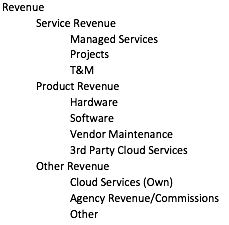
Define a reasonable estimate of your revenue for each revenue category monthly and annual total. For instance, if your Managed Services revenue has been $20,000 per month, how much are you going to grow that each month in 2016? You might say we can reasonably grow it $1,500/month each month next year. This means January managed services recurring revenue increases to $21,500; February to $23,000, and so on. Will that happen every month? Make a reasonable assumption based on your level of activity, expectations of your team, and historical data.
When done correctly, your Revenue lines might look something like this:
Once you have your revenue budgeted, you are ready to budget your Cost of Goods Sold.
Cost of Goods Sold
Put every cost associated with delivering the revenue for each particular line of business in Cost of Goods Sold. You will probably have multiple COGS lines for each revenue line. For instance, Managed Services has costs for the tools you use (such as PSA and RMM), costs for people (including salaries, taxes, insurance, etc…), and possibly travel or other items. All costs to deliver revenue must be included to most accurately gauge your profitability!
Enter these costs into the appropriate columns and you are ready to calculate your budgeted Gross Margin.
Gross Margin
Follow these steps to calculate your Gross Margin:
- Take the revenue line and subtract the sum of the COGS line for that revenue line. This determines your Gross Margin dollars for that Line of Business.
- Let’s also go one step further to calculate our GM percentage by dividing the GM dollars by Revenue dollars. This determines your budgeted GM percentage. Ideally, this number should be north of 50% on services and over 15% on product.
- Repeat steps 1 and 2 for each revenue/COGS line. Total them at the bottom to find your total Gross Margin.
Are you hitting the right Gross Margin numbers for your business? If you are not hitting those numbers, what do you need to change in your cost structures to improve on them and increase your profits? You may be pricing your products and services too low, or perhaps you are paying your people too much. Performing these calculations provides insight into your business and allows you to make the right adjustments.
Expenses
Next, budget expenses. You have a history for all your expenses, and expenses “below the line” of Gross Margin should not change much on a monthly basis. These include your administrative salaries, building costs, Sales & Marketing, and other expenses. When budgeted appropriately, you should understand the amount of your “nut,” or total costs per month (exclusive of the items that are required to deliver services). Budgeting all your expenses significantly improves your ability to correctly comprehend the total Gross Margin dollars you need each month to cover those expenses, and therefore make money!
EBITDA
Simple math: You make money when you spend less in expenses than you earn as Gross Margin dollars. Congratulations! Many of your peers are unable to achieve this!
EBITDA refers to Earnings Before Interest, Taxes, Depreciation, and Amortization. To calculate this, simply subtract your Expenses from your total Gross Margin. It is one way to define profit targets, but not the only way.
Net Income
The final calculation we perform is Net Income. Calculate the Interest, Taxes, Depreciation, and Amortization on your earnings (EBITDA) and subtract it from your earnings to get our Net Income number. Again, for 2016 these numbers are estimated based on what they have been in the past and how you project they will change based on your company’s growth in 2016 (and beyond).
Done! Well, at least the numbers part is… Net Income is your final number, no more calculations. I sincerely hope it is positive. If not, you need to take a hard look at your business and decide where to make some changes.
This leads me to my final point: A budget is worthless if you refuse to hold your Company accountable to achieving it. Positive, inspiring accountability drives every successful organization that has a wisely defined budget.
Do not delay budgeting. Take this as your chance to do something different for next year to bridge you to new territories of profitable growth. Our goal is to help educate and mentor leaders to develop new habits and implement better systems that positively impact your business now and for years to come. If you need help, email me!
And DO NOT MISS my webinar explaining the WHY – WHAT – HOW of budgeting for IT service organizations. Click here to register. Space is limited.
Quick time saving tip
Would you like to have more time in your day? It is relatively simple. Consider these challenges from Anthony Iannarino:
There is an old Buddhist saying that goes like this: "If you don't have time to meditate for one hour, meditate for two hours." Here are a few other ideas along this same line.
If you think that someone else is the problem, thinking that is your problem. If you think the problem is external, your problem is not recognizing that it's internal.
If you believe that something or someone is preventing you from being or having what you want, you don't yet recognize that you are the only person that can prevent you from being or doing what you want.
If you think that you don't have time to do the things that you want, your problem has nothing to do with time. It has everything to do with your priorities. (Dave's boldface...)
Anthony reminded me of our LEADERSHIP Essentials approach to creating more time in your day by:
#1 - Take time in Sanctuary (no distractions) weekly for 1-2 hours to review your TARGET goals and key objectives, and then set your priorities.
#2 - Remove emotion. Set aside "wants" and focus on needs - what will really build your career / company / wealth to have more freedom to positively impact others. Remove less important activities from your calendar so you have time to do what you do best.
#3 - Plan weekly in Sanctuary. Hold yourself accountable daily in a shorter Sanctuary each evening or early morning.
Now here is the rest of Anthony's advice from yesterday:
If you think you can't have more money unless or until someone gives you more money, then you don't understand that the only way to earn more is to create more value for others.
If you think you will be happy when something happens, or when you move to some new location in the future, then you misunderstand happiness. Happiness is a decision you make in the present moment. The present moment is the only one you have. The past is only pictures and movies, and so is the future.
If you think that your clients or prospects are your problems, that belief is your problem. Until you change your approach to them, they cannot change their approach to you.
What limits do you believe you have because someone or something is imposing those limits?
What would you do if you didn't believe you had those limits?
Time management and focus are key skills of effective leaders. Sign-up your leaders, including yourself, for our Certified LEADER program that starts the week of October 5 and runs through March 2016. Tell me what you want them to learn and will work with them to develop those habits.
3 questions to confirm you will make it
Are you wasting time? Could you get to your career / financial destination faster? Time lost can NEVER be regained.
Just get perspective here... If you fail to achieve the additional $100,000 you could have earned each year for 10 years, how much have you lost? Most of you will say, $1,000,000 but you would be wrong.
If you were wise enough to make the additional $100,000 a year, then you WOULD HAVE BEEN shrewd enough to make multiples of that amount in subsequent years. In other words, $100K in Year 1; $200K in Year 2; $400K in Year 3...
The bottom line is our lack of focus costs us much more than we realize when we are "too busy firefighting" (working in the business instead of on the business) to be our best.
Note: I use the "J-word" a few times today, but not religiously. No matter what our spiritual beliefs are, no leader has impacted more people's lives than Jesus of Nazareth. There is a lot we can learn from him. Please don't be offended.
QUICK SURVEY - 3 Questions to confirm you will make it. ("It" being wherever you want to go in your career or wealth.)
Who are you serving?
It should be someone who is more skilled, connected, successful... than you are. This is someone you want to be mentored by, but you cannot create a connection.
Rather than asking to be mentored or become their friend, just dive in and serve them. Let me give you two examples:
Decades ago Ray Johnston was a youth pastor. Although we were in a small couples group for about three years, I could not develop a close relationship with him. I tried twice... only twice. He was busy. Ray went on to start Bayside Church, which is the fastest growing, largest church in Northern California which now has over 15,000 people attending weekly services on multiple campuses. I do not blame Ray. It was my fault. If I had only served in his ministry, we could have developed a close relationship rather than just be friends.
Second story: One of my cousins, Robert MacPhee, wanted to become a professional speaker and he really liked Jack Canfield, author of the Chicken Soup for the Soul books. So he went and served at Canfield's events and over many years learned so much that now he speaks professionally himself.
Who are you serving during this season of your life? Are you learning things you could never learn on your own? Get close and sincerely serve.
Who are you investing in?
(1) Mentoring someone less experienced whom you want to mentor. (2) Who are you sacrificing yourself for? This is possibly someone you do not really want to mentor, but needs your help and you can give it sincerely, patiently, and professionally. Or it is a person you are excited to help. What are you doing to help someone who may never thank you?
If we are receiving as a servant, then we must be willing to give as an investor. Jesus taught if we give, then it will be given to us. (He was not speaking about business.) This does not mean we should expect a mentee, someone we are mentoring, to do anything for us, although you always gain from a mentee. I suggest it is simply the law of natural reciprocity: If you give then ultimately you will receive, in part because your giving creates a natural desire for others to give back to you.
Years ago I heard a very wise man explain a cord of three strands is not easily broken. This was the seed that became my 3strands LEADER definition. The first strand of your "rope" that leads you to climb your mountains is you. The second strand is we must be in relationship with someone who is wiser than us and actively learning from that person. The third strand is we should be investing in someone less experienced than ourselves.
In whom are you investing during this season of your life?
What is the core essence of your legacy?
Jesus said love. For some people it is money. Others want power. I am not here to judge your objectives.
My concern: How can you focus better on achieving your legacy... or have you even defined it? Way too many leaders have no clear end-goal defined. They just go through the day doing their best. Your best is not good enough.
Why? Because if you have not defined your destination then you are driving to nowhere. At some point a crisis will hit, and you will be off on some country road rather than at your destination. At that point, you may or may not be able to get where you MUST go to resolve the crisis. What is your destiny, and are you spending enough time on it during this season of your life?
BONUS QUESTION
How are you prioritizing your time to achieve these three strands of your legacy?
The bottom line is (1) We need a clear definition of what we want to achieve and when; (2) We need to spend more time on what we do best.
Trim your vines
This past weekend I did a "honey do" project of clearing dead vines off part of our fencing.
As leaders, are you clearing the dead vines from your organization throughout the year, as needed? They choke out profits like crazy...
 This is a picture of the vines before I cleared them out. They were actually much worse than it looks.
Leadership "Dead Vine" Examples
1. Sanctuary
If you are allowing other activities to crowd-out your ability to have a quiet time weekly (preferably daily), then you are less focused on your most important priorities each week. Clear out the "dead vines" crowding your schedule and your freedom will allow you to better achieve your growth objectives.
2. People
All of your employees have some value, or you would not have hired them in the first place. However, some might not be performing at an optimum level, or worse. You may even have one (or more) that are toxic. You will waste hundreds of thousands of dollars hoping for miracle behavioral change in a poor performing or toxic employee. I have never seen it happen in a toxic employee. This is particularly true after you have tried to work with them to improve and they have failed.
The #1 hated job of a manager is to fire anyone... even someone who is toxic. However if we do not remove toxins and growing viruses from our body (company) then we die, or exist in a severely weakened state. Respectfully, empathetically, quickly, and properly terminate employees when it is clear they are hurting your organization. These "dead vines" choke out productive workers, and in some cases, motivate some of your good team members to leave.
NOTE: Letting a poor performing employee go is often the best thing for them too!
3. Process
When you know a process is weak or broken, work with your team to schedule its improvement. Do not procrastinate. Do not put it on the to-do list that lives forever. Schedule/delegate the work now, or put it in the "fridge" (better analogy than a "parking lot") with a specific date to schedule its repair. Set a reminder to check your fridge on time and bring it out to be "cooked" and fuel your growth. Missing or poor processes allow your people to get tangled up unnecessarily. Clear them out.
4. Habits
We all have habits that are unproductive. The challenge for most of us is not acknowledging them, but defining and committing to a step-by-step action plan with accountability to overpower a bad habit with a new one. If you are not working on overcoming a bad habit then you are allowing at least one to thrive. It is stealing time, money, health, relationships, everything from you. Bad habits are dead vines crowding out your ability to live your dreams. Focus. Clear them out one-by-one. Get help if you need it.
5. Relationships
Most people do not have many, if any, deep, caring friendships. When we die, the ONLY true asset we have is our relationships. If this is a challenge for you there are options, but you have to comprehend your relational habits and overcome fears. There are church and secular adventure groups. Nonprofits involved in causes that are meaningful to you. Exercise clubs of all varieties. (One of our developers is a CrossFit fanatic BECAUSE it is a group activity.) Get rid of the dead vines (unhealthy relationships) and work on building deeper relationships before it is too late.
TIP: If you want to build a relationship with someone, then serve them. If they are the leader of a nonprofit, then serve the nonprofit. It may take some time, but your service creates the opportunity for a healthy relationship to sprout, grow, and mature.
Do what makes more profits. Profit more from what you do.
We help leaders like you succeed more profitably and joyfully. We provide coaching, consulting, tools to better understand the strengths and motivators of your team, plus inspiring keynotes / workshops for your conferences, customer events, and internal gatherings. Contact us if you would like to learn more.
2 things you must be doing now
This will be quick. The cost of not doing these two things is too substantial to avoid this moment of accountability.
Money
PLEASE, stop losing money unnecessarily. We had a great webinar yesterday considering the Top 4 MSP Financial Mistakes. (There is something to learn here for my Clients in every industry.)
You need to see / listen this not only for the learning and opportunity to hold yourself accountable to implementing systems and developing habits of higher profitability, but also to see the poll results of other leaders.
PPT Deck & Audio - listen while you drive or workout...
Brochure on our vCFO services
3strands LEADERSHIP and Weekly W.I.N.s
The discipline of slowing down to think, hold ourselves accountable, and focus on what is truly most important is often our biggest problem. Take 2 minutes to review my updated online summary of 3strands LEADERSHIP and how to achieve a Weekly W.I.N. here.
That page also has a link to download my updated T.A.R.G.E.T. Goals Guide for employees that explains how to set and achieve significant objectives on a regular basis. Consider memorizing my new tag line to remind yourself to focus on profits, because they fuel your freedom to pursue your dreams:
Do what makes more profits. Profit more from what you do.
Let us help you succeed more profitably and joyfully. We provide coaching, consulting, tools to better understand the strengths and motivators of your team, plus inspiring keynotes / workshops for your conferences, customer events, and internal gatherings.
The 4 Biggest Financial Failures of MSPs
Every year we watch managed service providers succeed and fail. Leaders often drive their team to new heights, or stumble to new lows. Unfortunately, failing executives often equate busy-ness with high productivity or profitability and forget the core basics of money.
Because there is such a need for CFO expertise, we are launching a Virtual CFO service ("vCFO"). Email me if you want to learn more.
To help you today better understand where your profits are leaking out of your organization, we reached out to Brian Hoppe, former CFO of McLane Intelligent Solutions. Brian has spent years at MSPs managing operations and improving financial health.
Here are his 4 Biggest MSP Financial Failures (they apply to almost any industry) - each one could be costing you thousands in unnecessary waste, inefficiencies, and risk:
#1 - Ignoring the Metrics
Either you master the metrics, or they master you. Your business is speaking to you every day, if not every hour. If you are not willing to listen, then you miss out on huge opportunities for improvement.
Are you tracking the right metrics daily - weekly - monthly? Do you clearly and correctly assess your services gross margin? Are you tracking a 2-3X billing and 5-10X sales model to achieve maximum product, project, and managed services contract profitability? Are your revenue and CoGS in the right buckets? Is your chart of accounts set up correctly? Are you tracking sales so you catch issues early, before you lose opportunities?
We know many MSP's whose systems track many of the metrics they need, but lack the discipline to monitor them. The result is poor financial performance. Not sure what metrics to track or how to find them? Another MSP we know doesn't have all the metrics they need, but is implementing systems to generate them. They are following a plan to get where they need to be within the next 3-6 months and you can too.
#2 - Lurking in "Tomorrowland"
You tell yourself, "We're not profitable now, or as profitable as we would like, but if we can just add more revenue then we will be." That's foolish.
We see this happen too often. One MSP we know is always thinking about tomorrow and never focused on today! As a result, they have not fixed their metric and margin issues for years and remain in a financial abyss. More revenue is great, but it does not solve your problem. Even if you can increase revenue despite your margin issues, you have the same problems, they are just bigger.
On the other hand, we know of another MSP who engaged a virtual CFO, reversed their fortunes within a year, and built a six-figure cash reserve.
Which company do you want to be?
#3 - Easy Sales Compensation
Too often sales people, particularly if they are long-term employees, are paid too much salary rather than being challenged by a more heavily weighted performance-based plan.
Do you have a monthly quota for each sales person? Is it realistic? Are you managing it with them daily and weekly? Are you compensating behaviors that lead to sales, or just the sales? Are you paying based on the gross or net? Where is each type of compensation appropriate? Are you targeting a 5-10X sales model for compensation to automatically drive profitability?
Managing a sales team can be like adult daycare or coaching an Olympic athletic team. It depends on your strategy and the people you hire. Make sure you have the right people on the bus, your sales strategy is clear, your plan is effective, and you have someone in place to drive the details plus help each individual meet or exceed their targets.
#4 - No Budget = Limited Profits
It is amazing how many managed service providers operate without a clearly defined budget based on numbers from the previous period, with clear projections and targets. Without this basic discipline there is limited upside you can achieve because every review of finances is a best guess rather than a focus on the facts that bring the most money possible to your bottom line.
Budgeting is one of the most important things you can do. What would it take for you to put together a budget for the next 3-12 months? Do you know the right questions to ask? Is your budget based on real numbers, or hope? Does your budget fluctuate monthly based on historical information? Do you know what your returns should be? Are you looking through the windshield rather than the rear view mirror?
Do you want more? Join us for a 30-45 minute webinar on Tuesday, August 11th at 10:00 a.m. PST / 11 MST / noon CST / 1pm EST. I am interviewing Brian Hoppe to get more of his perspective on these costly financial failures. Click here to register.
Finally, this is not a complete list of every financial mistake you can make, just the most common ones. Contact us if you would like to learn more about how you can improve the financial health and operational efficiency of your business, or our upcoming vCFO services.
Fear. You got it. Know it.
Yeah, I know, you feel very capable. However, EVERYONE has fears. If you can be candid enough to understand your fears then you will be a better leader.
Our fears affect everything we do. Often subconsciously. Therefore taking time to better understand them can be incredibly valuable.
Let me just give you three examples to consider:
Trust
You do not trust someone. The problem is not trust. The main issue is fear. Without the fear you would trust them, so the fear comes first. You are afraid they will... whatever.
You have two options: (1) Remove your fear. For instance, if you believe God will protect you, then you do not have to be afraid. You just have to be humbly discerning. Or, you can choose to make the behavior of others that you fear an expectation rather than a fear. Then because you expect the behavior it is no longer a surprise and you can design systems to limit or eliminate any negative impact. (2) Remove the person from your business or personal life if their behaviors are unacceptable.
Winning
You want to win so bad that you fear failure, which paralyzes your ability to make timely decisions. Too often you suffer from "analysis paralysis" and it bottlenecks the growth of your team.
Again, you have two options: (1) Delegate more, but not all decisions. Focus on asking questions to confirm risk and how to shut out competition. This plays to your strengths, but then require a one-page summary of the opportunity. You make your decision based on that information. Decide overnight, no more. (2) Organize a four-person team to make decisions. You only get one vote and may not hold up key decisions that have reasonable risk.
Esteem
This is another version where you fear failure. You have an internal voice telling you, "I'm not good enough." Therefore you are sensitive when competitors succeed while you struggle. You do not quit activities that fill your schedule and move on as long as the "patient is still breathing." If you stop something it feels like confirmation you are not good enough. Another failure.
Yet again, you have two options: (1) Set deadlines with accountability partners. These are people you trust. When you want to extend the deadline let them decide, not you. (2) Narrow your focus. Often one of your key problems is that you are over-extended. Win in one thing rather than try to stay in the game in multiple activities. Cut way back, and then expand slowly with accountability from others.
Fear affects everyone.
I hope you take a moment in your Sanctuary time, driving in the car, or working out, to consider your fears. Mastering them is important for fully living your dreams.
Let me know if I can help in any way. Do what you love. Love what you do. Lots of people have said this (it is a slogan of Life is Good apparel). But it takes action to achieve.
The Secret Sauce of U.S. Navy Seals
Last week we discussed the core attribute of a 3strands LEADER. It was good character. Unless you have good character, at the end of the day nothing else matters.
I was struck this past week by an article on the Navy SEALs approach to training by Michael Schrage at HBR. He believes business training needs a makeover to be more like U.S. Navy SEALs training. Too much training in business today is weak.
Years ago the Navy decided they needed to improve their SEAL training. Before Brandon Webb's radical redesign of the curriculum, SEAL sniper school participants had an average attrition rate of 30% (3 out of 10 dropped out or failed).
After they changed the curriculum, "the course standards got harder, if anything", but the graduation rate increased from 70% to 95% and held there. Why?
I believe one reason is the motivation behind the learning experience moved beyond HOW to do things like operating firearms or executing a mission plan to WHY the training was important. The ability to perform in any situation demanded more training on WHAT to expect in combat situations and an in-depth explanation of HOW their equipment worked. They also paired everyone up with a mentor to increase accountability.
The four attributes of the new SEAL training that we are working to incorporate into our Certified LEADER program:
- Product Excellence - Not "Above Average"
- Incentivize Excellence, Not Competence
- Incorporate New Ideas From The Ground
- Lead by Example
Schrage does not endorse my 3strands LEADER system, but consider how the Systematic Power of training more thoroughly engages your employes in Meaningful Work. Also, mentoring/encouraging them like SEALs communicates you value them as team members (Sincere Gratitude).
These are the three attributes of a 3strands LEADER.
Ponder this wisdom during your weekly Sanctuary time, or take up to a day in seclusion to assess how you could better apply it in your organization. While not all of us can be trained by the best, we can still learn from them.
In 2014 you said 2015
Nike has this great slogan, "Yesterday you said tomorrow." Of course you have to follow that with Nike's "Just Do It" and it begs the question: You may have had a good year in 2014, but could it have been better?

What got pushed to the back burner last year as you worked in your business fighting fires? Too often the answer is, "I really wanted to..." and rarely, "I'm so glad I got this done." Perhaps you wanted to:
- Work on your company culture
- Not just set clear, measurable goals, but actually follow-up on them
- Improve communication, productivity... between your people ANDy our clients!
Your woulda-shoulda-coulda list of ways you wanted to work on your business might be different, but one thing is for sure: Whatever you postponed in 2014 is still a problem in 2015 AND it involves people.
WHAT SHOULD YOU DO?
Slow down this month and meet with someone who has been where you want to be. Find a person who has no emotional bias in the decisions you have to make and have a discussion that includes:
- Reflect on what you did well last year. How do you multiply this success for more rapid expansion in 2015?
- Identify the three key things you wanted to do last year, but did not, to better engage every employee in your organization. How much did that cost you in sales and profit? This year, how much additional sales / profit could we achieve by making these changes NOW (not this instant, but as quickly as possible to do a great job)? A suggestion: I just do it. Schedule it in your calendar now. Or, delegate/outsource it to someone else inside your organization or outside it.
- Identify the three key things you wanted to do last year, but did not, to improve the experience each Client has with your company. How much did that cost you in sales and profit? This year, how much additional sales / profit could you achieve by making these changes NOW (not this instant, but as quickly as possible to do a great job)? Again, just do it. Schedule it on your calendar now or delegate it.
Do not try to be a Lone Ranger. Even he had Tonto by his side to help out. Contact us if you would like to talk through what you want to achieve.
CAUTION: If this year was "Groundhog Day" for you - you entered the year with regrets similar to when you started 2014... then talk with someone you trust and have a candid conversation. Do NOT waste another year.
Buddy System
PLEASE NOTE: The following does not describe one of my Clients, but it does relate to the effectiveness of your leadership.
Graham woke up tired, but that was typical. He went through his morning routine and landed at his desk with a fresh cup of coffee. He was focused, he was productive, he was... hungry about one hour later.
You see, Graham has a habit of having a huge sugary Danish about one hour after starting work. He regularly eats enough daily to feed 2-3 average-sized people.
Graham tries several times a year to lose weight, but as illogical as it sounds, it is easier for him (in his mind) to carry an extra 100+ pounds than it is to change his eating and exercise habits.
Graham is risking diabetes, heart disease or failure, and a variety of other health challenges. He knows the risks. He even acknowledges that any of these weight-related health setbacks are permanent, yet his behavioral patterns still do not change.
Why?
It is complicated. Graham's behaviors stem from a variety of different possible causes. Some might be from his childhood. Others might be triggered by adult relational wounds. That might be the reason he avoids fully considering the effects of his decisions, although he can analyze the technology environment as well as the best people in the industry.
Graham is risking death, or permanent disability...
Again, we ask WHY does he continue to live out these destructive behaviors?
At least 2-3 times a year Graham summons all his willpower to begin a new diet. Sometimes exercise is involved. Every time he attempts a program for a few weeks, but fails to develop a new habit.
The symptom or consequences of Graham's problem is weight. It negatively affects his professional and personal performance, opportunities to fully enjoy life, and makes it challenging for people to fully believe in him.
The disease is the bad habit.
The symptoms of your primary behavioral issues may not be your weight or physical health. It might be poor financial stewardship, follow-up or follow-through, leadership, negativity... The list goes on. The bottom line is we all have issues. No one is perfect.
This article is not to explore the reasons behind your unhealthy behaviors. My focus is how to change your bad habits and negative patterns.
Two things hold us back from overcoming our toxic habits:
(1) Willpower is not enough. Do you realize that bad habits never go away? This is the conclusion of a variety of experts and Dr. Henry Cloud's comments recently at Willow Creek Church,which are part of the focus of his latest book, Never Go Back.
Let me say that again: BAD HABITS NEVER GO AWAY.
My understanding is willpower alone consistently loses its wars against bad habits. Willpower can win some early battles, like Graham starting a new exercise program or diet, but it always loses the war when it tries to overcome bad habits rather than be a catalyst to replace them.
It is illogical then to focus our efforts primarily on increasing our willpower. (Just TRY HARDER...) Instead we have to create new, more healthy and positive habits that replace and overpower our bad habits.
This is why Alcoholics Anonymous and similar groups encourage people to attend meetings regularly and hold each other accountable. The habit of attending a meeting and actively participating replaces the bad habit of the addiction.
Do you have a bad habit that could be called an addiction or negative pattern that is hurting you or others in some way?
If you do, then Dr. Cloud recommends is a three step process to initiate a change of behaviors. It takes willpower to initiate a positive change, but focuses on developing new, more powerful habits to sustain positive change over time:
- Realize the mistake and commit not to go there again.
- Get help.
- Demonstrate positive change.
You may have apologized regularly for your worst leadership habit. We all have... and then we do it again anyway. Unfortunately, if the habit continues for years, sometimes decades, then you are missing HUGE opportunities. Significant rewards are being left behind forever.
How Do Successful People Do It?
Dr. Cloud's research concludes that "successful" people, however you define success to be, make a mistake and/or realize they have a negative behavior, and then commit to Never Go Back there again.
The successful people do not have an edge, or something you are missing. Studies indicate their intelligence, resources, and opportunities are about equal to the people who do not experience similar rewards.
The difference between being successful or not is simply replacing negative behaviors with positive ones.
The sooner you develop the positive habits the better, but it is never too late for anyone to experience transformational change.
Dr. Cloud tells what he says is a common story about addiction that I think applies to ongoing bad leadership habits. I am quoting an online version by Portia Nelson, but there are others:
Chapter 1
I walk down the street. There is a deep hole in the sidewalk. I fall in. I am lost... I am helpless. It isn't my fault. It takes forever to find a way out.
Chapter 2
I walk down the same street. There is a deep hole in the sidewalk. I pretend I don't see it. I fall in again. I can't believe I am in the same place. But, it isn't my fault. It still takes a long time to get out.
Chapter 3
I walk down the same street. There is a deep hole in the sidewalk. I see it is there. I still fall in... it's a habit. My eyes are open. I know where I am. It is my fault. I get out immediately.
Chapter 4
I walk down the same street. There is a deep hole in the sidewalk. I walk around it.
Chapter 5
I walk down another street.
Developing new, positive, powerful habits that overcome and replace our bad habits is walking in a new direction. Anything less than that repeats your decision to fall in the hole again.
You have to commit to Never Go Back there again.
(2) Commit to a Buddy. Alone we are weak. Without a support structure or some form of accountability, our chances of replacing our old bad habits with new ones are slim to none. However, we are stronger when we work together with others.
In a study of married couples who exercised, John Raglin, Ph.D, MS and exercise physiologist Janet P. Wallace found that only 8 percent of the participants who exercised with their spouses quit compared to half of the participants who exercised independently of their spouses.
Work together with one or more buddies on developing better habits and you will have more success than if you go it alone.
Keep in mind, depending on your situation, if you have a really bad habit or negative pattern you might want to seek professional counseling. There is nothing wrong with this. Asking a friend or family member to join you in your efforts might be a life-changing option too. Regardless, every approach will make you stronger and more successful when you commit to work on your new habits with one or more "buddies" for accountability.
For example, I am 57 years old. Part of my exercise routine is swimming. It is incredibly boring for me to swim laps alone. My favorite swimming is to play water polo with the local high school boys team, which is coached by my old friend Carl Lundgren.
When I am not playing water polo, then I try to schedule my lap swimming with Carl, Danny, or Jimmy. Alone I swim about as fast as a slug on salt, but with friends to keep me going and banter between sets I get a great workout.
Do not allow yourself to slip into a deep depression because you finally deal with a toxic habit. Remember Robin. Robin Williams made a bad decision recently and ended his life. There is abundant life after failure. Depression is not the purpose of this process. You can overpower any toxic behavior and experience the full potential of the life you have been given.
One proven way to accomplish this goal is to follow Dr. Cloud's simple process.
Start Developing Those New Habits
In conclusion, consider what would happen to your life if you changed your worst bad habit, or at least one of them.
Try this 3strands approach to overcome bad habits or negative patterns that have plagued you for years:
- Buy a copy of Dr. Henry Cloud's new book, Never Go Back, and read it with a highlighter so you can remember the key points that jump out at you.
- With great vulnerability accept responsibility for a bad habit that has hurt you, people you love, and others. Then make a commitment to Never Go Back.
- Commit to one or more buddies. Engage with your spouse, family and/or friends who will reliably, respectfully, and encouragingly walk with you through this transition and beyond. Demonstrate progress daily and never stop believing in yourself. (If you need professional help, then identify a highly recommended resource and give him/her a try.)
I work with clients on a regular basis who have one or more bad habits. They all have the capability to replace them with better habits. Too often they rely on new ideas and apply willpower just to jump from one idea to the next. They think if they just push themselves harder or jump to a new idea then things will change.
Things do not change unless you consistently work on developing and sustaining your new habits with your buddies.
There's an old saying that goes:
Watch your thoughts, for they become words.
Watch your words, for they become actions.
Watch your actions, for they become habits.
Watch your habits, for they become character.
Watch your character, for it becomes your destiny.
Habits are learned, so only spend time with people of strong character because they will help you become your best.
One of the greatest challenges I have with Clients is to get them to believe in themselves as much as I believe in them. Believe in yourself and your future!
Be a 3strands Leader
Demonstrate Systematic Leadership as you inspire others in Meaningful Work, and consistently express Sincere Gratitude to people around you.
David Russell, CEO
MANAGEtoWIN
DO IT RIGHT. The Importance of Performance Reviews Webinar
We had good attendance and interaction on our webinar yesterday morning titled:
DO IT RIGHT: Motivational Employee "Halftime Reviews" vs. Once-a-Year-Agony.
You can download the PPT or view the 30 minute video.
If you want to learn more, then forward this email to us (info@MANAGEtoWIN.com) to confirm you would like me to do 1-4 more brief training webinars:
- Step-by-Step Review Process for Managers & Employees
- 360 Reviews: Positives & Pitfalls (Some people like them, others do not.)
- Goals That Work: Learn from Specific Examples
- Documenting The Good, The Bad, and The Ugly ("log events")
Learn. Ask questions. Gain insights. Let me know...
In this brief webinar, CEO David Russell discusses the importance of performance reviews and their effect on company culture.
Upcoming Webinar - DO IT RIGHT: Motivational Employee Reviews
How would you like to have motivational employee performance reviews instead of a once-a-year agony?
Register here to attend this less than 30 minute webinar at 8:30 a.m. PDT on Thursday, August 28th, 2014.
As you know, ConnectWise recently endorsed MANAGEtoWIN as the platform they have used the past year to do annual employee performance reviews, and confidential 360 peer feedback.
Do you hate your annual review process, or at least think it could be more consistent and/or efficient?
In less than 30 minutes I will explain why ConnectWise and thousands of employees working for our other clients automate their performance reviews and MANAGEtoWIN. You will learn:
- The 7 Warning Signs your current employee review process is a risk and a burden, rather than a benefit
- The 7 Reasons you must do written employee performance reviews to maximize profitability and growth
- How ConnectWise and other companies use MANAGEtoWIN to automate their employee performance review process
Learn. Ask questions. Gain insights. Space is limited. Register now.
I will send you a link to the recorded webinar after it's done.
2 Biggest Failures of Leaders
Probably 8-10 years ago I realized the two biggest failures of leaders who otherwise operate with integrity in general:
- Not setting goals that are clear and measurable where each employee has the skills and authority to achieve them; and
- Not following-up systematically enough to make certain progress is being made to achieve each objective. (I am NOT advocating micro-management.)
I run into this scenario over and over again: A boss, often an owner, is frustrated that their people do not achieve more, take on additional responsibility, and do their best all the time... but the boss:
- Has not clearly defined what the employees are to do.
- Does not give employees authority that matches their responsibility.
- Wants every employee to act like them.
- Sees the negative of each employee crystal clearly, but not their positive contributions or POTENTIAL.
The list goes on, but the bottom line is the owner has not structured an environment where employees motivate themselves to do their best. The systems are not in place to achieve their company objectives. (We teach how to do this in our Ownership Culture program.
Sorry, but nearly every problem employee is the boss's fault. We hired them, manage them, develop them, retain them, and want to kill them (at times - figuratively speaking). They will do better when we do better as leaders.
WHERE TO START? Stop making the first two, most common mistakes of leaders. Set clear, measurable goals and then follow-up systematically.
It is Friday. ACCOUNTABILITY TIME!
- How are you doing on your 3strands this week?
- Is the work remaining to complete this week's 3strands scheduled in your calendar so you can work uninterrupted?
- Have you scheduled your Sanctuary time later today or over the weekend for personal accountability and focus?
Stay on track.
Why Listen to Opinions
Opinions are like human ears. Just about everybody has them, and yours are most important to you.
I know of leaders who believe the best policy is to not pay attention to their critics, however I suggest within reason considering different opinions is a strategic asset for any leader.
I have gotten some of my best ideas from the comments of others that have led me to think of something different, not specifically their suggestion or critical comment.
Listening is so important for leaders. We underestimate the power of our ears, which are organs in our body, not just things sticking out the side of our head. Did you know this about ears?
-
Outer Ear: Human beings actually localize sound within our central nervous system by comparing the arrival time differences and loudness from each ear, in the brain circuits that connect our ears. This process is referred to as EPS, or Echo Positioning System. Some animals can point their ears to better receive sound.
LEADERS: Are you listening to people who disagree with you, express concerns, or make requests? If so, you are gaining new opportunities for growth and avoiding problems. Good job!
-
Middle Ear: Sound is transmitted from the tympanic membrane through three bones (ossicles) to the ventricles of the ear. The ossicles help in the amplification of sound waves by nearly 30 times. I could go on, the complexity is fascinating...
LEADERS: Are you too quick to blow off employee comments? Rather than dismiss them, there is strategic value in fully considering them - magnifying their ideas and considering alternatives. You cannot fully engage employees or best serve clients without great listening skills.
-
Inner Ear: Your inner ear contains sensory organs for balance, motion, and of course, hearing.
LEADERS: Employee and client opinions affect the balance and growth of your organization, but you have to be willing to hear them. How well are you doing significantly affects your bottom line.
I suggest your willingness to listen and process both encouraging and negative information is done with a balance of truth and grace.
Truth by listening and fully considering what others have to say without allowing negative people rip you apart. Grace by being humble enough to consider their opinions and realize that some of those who communicate poorly have other issues affecting their lives so do not let their negativity bring you down.
Have a meeting with your leadership team, or you can do this alone as part of your weekly Sanctuary time, to consider where you have traveled and what destination you truly want to reach.
This can be a long exercise or a relatively short one.
- List the ideas, complaints, encouragement, and other comments you have heard during the past day.
- Start with three of them. Carefully consider each one.
- Is the comment a symptom, or a disease. If a symptom than consider the root cause of the problem or the core of the opportunity.
- Think about it. Pray about it. Ask people for their opinion.
- Pilot ideas.
Be Micro Ambitious
"Micro" and "macro" are prefixes that are placed before nouns to make their reference small or large.
For instance, there is micro and macro economics. The study of the overall economy and how it works is called macroeconomics whereas microeconomics focuses on an individual person, company or industry.
Another example is microevolution, which is small changes in living matter due to four different processes: mutation, selection (natural and artificial), gene flow, and genetic drift. Macro evolution supposes large-scale changes in living things may occur over an ever-expanding period of time.
What do I mean when I say that you should be Micro Ambitious?
Our process of writing Goals That Work is a macro exercise to define annual, clear, measurable objectives that meet or exceed your objectives for growth each year.
Our 3strands process enables you to focus daily and weekly on achieving the micro activities that lead to accomplishing your macro Goals That Work objectives. This is a process for daily and weekly progress.
Be Micro Ambitious this week by doing this:
- Define your 3strands by Monday morning at 9:00 a.m.;
- Schedule uninterruptible time in your calendar by Monday morning at 9:00 a.m. to complete them;
- Look at your 3strands each morning for self accountability; and
- Complete them in full with excellence this week.
Being Micro Ambitious is a good thing...
It is Monday. ACCOUNTABILITY TIME!
- Did you take Sanctuary time over the weekend to improve your focus?
- How did you do on your 3Strands last week?
- Have you defined your 3Strands for this week?
- By 9:00 a.m. this morning you should have 3Strands emails from each of your direct reports.
Stay on track.
The Two Most Common Failures of Leadership
What are the two most common failures of leadership that I come across?
- Failure to consistently set clear, measurable goals.
- Failure to follow-up and follow through on goals, promises, and expectations.
Of course there are plenty of other issues. You may find it interesting that I also often talk with leaders who do these two things well yet struggle in other areas, but their companies are growing.
This is part of the reason why Systematic Leadership is the first strand of 3strands LEADERSHIP. Systematically defining clear, measurable goals plus following up and following through help free your people to do their best.
Do you have clear, measurable goals? Are you on track to achieve them? When is the last time you looked at them?
How well do you follow-up on goals your people are pursuing (not micromanagement, but a 3strands process)? How well do you follow-up and follow-through on your other commitments?
These are important skills to develop. Consider piloting new behaviors if you are struggling in either area, or consider contacting me if you need help.
It is Monday. ACCOUNTABILITY TIME!
- Did you take Sanctuary time over the weekend to improve your focus?
- How did you do on your 3Strands last week?
- Have you defined your 3Strands for this week?
- By 9:00 a.m. this morning you should have 3Strands emails from each of your direct reports.
Stay on track.
Leadership Dementia
My 86-year-old mother has slight dementia. Most of the time she remembers things, but she can struggle at times. I love my Mom. She's not perfect, but she is "the best." (Hopefully you feel that way about your mother too.)
This past Monday I was with her. As we were driving home from her doctor's appointment she asked me to set up the movie, An Unfinished Life, for her because she likes to watch it over and over again.
I decided to joke with her and responded, "Is it because of your dementia that you can watch the same movie over and over again, and still enjoy it?"
She responded without missing a beat, "You're just jealous." We both had a good laugh.
Unfortunately many leaders suffer from what I might call "Leadership Dementia." They too easily forget the work their employees do well, the ideas they suggest that are valuable, and the times when their people went beyond what was required.
It is simple math: Positive contributions + mistakes = work performance
When you eliminate the positive contributions then all you remember are the mistakes. And by the way, some leaders have the reverse problem: They are unwilling to fully consider the mistakes.
Here are two quick suggestions for this weekend:
- Visit someone special to enjoy their company. Before you leave, remind them how much you love them.
- Consider your selective memory of employee performance. We all do it to a certain extent. Do you need to develop a more balanced perspective? If so, how you will do that?
It is Friday. ACCOUNTABILITY TIME!
- How are you doing on your 3strands this week?
- Is the work remaining to complete this week's 3strands scheduled in your calendar so you can work uninterrupted?
- Have you scheduled your Sanctuary time later today or over the weekend for personal accountability and focus?
Stay on track.
What They Need Most From You
On Sunday we start the final month of the second quarter. How are you doing on your 2014 goals? Consider this question in your Sanctuary time of self accountability and reflection this weekend:
What do they need most from me?
Take a step-by-step process to consider each "they." Work through this exercise in an order that makes the most sense to you based on the different definitions of "they." Identify the one most important thing each "they" wants from you and assess how well you are doing in that area with them. Take your time...
- God
- My spouse or girlfriend/boyfriend
- My kids
- My extended family
- My closest friend(s)
- My employees (first because without them you cannot serve others)
- My clients
- My vendors
- My community
- Me
Just gauge how well you are doing in one area with each "they." Do that one thing exceptionally well and it will positively affect the other aspects of the relationship.
My suggestion: What they need most is you, just fully you.
Unfortunately to do this well we have to focus on personal development, engage with accountability, and develop a discipline of Sanctuary. This is easy to write, but challenging for most people to accomplish.
Email me if you want to learn leadership skills. (That is how we pay the bills.) Today is the last day of the special offer on our All-In LEADERSHIP program.
It is Friday. ACCOUNTABILITY TIME!
- How are you doing on your 3strands this week?
- Is the work remaining to complete this week's 3strands scheduled in your calendar so you can work uninterrupted?
- Have you scheduled your Sanctuary time later today or over the weekend for personal accountability and focus?
Stay on track.