
Your people problems? Gone.
The 4 Management Disciplines Newsletter delivers proven ways to be your best and lead a championship team.
Every championship sports team runs proven plays.
Every Monday morning - I give you four proven plays great leaders use to solve problems in how you Hire, Manage, Develop, and Retain great people.
2 minute read. No fluff. No ads.
Trusted by over 10,000 leaders.
NOTE: David is no longer writing this newsletter. Visit www.simpleliberty.com to read his latest posts.
All Newsletters

Develop These 3 Habits to Identify When Someone is Not Telling the Truth
Years ago we worked with LaRae Que, a former FBI agent and author of the book, SECRETS of a Strong Mind (2nd edition): : How to Build Inner Strength to Overcome Life's Obstacles.
LaRae spent twenty years as an undercover and counterintelligence agent for the FBI and served as an FBI spokesperson in Northern California for four years. During her time as a counterintelligence agent, her primary goal was to identify foreign agents operating in the United States, find out what they were doing, stop them, assess their potential as an asset, and persuade them to work for the U.S. government.
Years ago we worked with LaRae Que, a former FBI agent and author of the book, SECRETS of a Strong Mind (2nd edition): : How to Build Inner Strength to Overcome Life's Obstacles.
LaRae spent twenty years as an undercover and counterintelligence agent for the FBI and served as an FBI spokesperson in Northern California for four years. During her time as a counterintelligence agent, her primary goal was to identify foreign agents operating in the United States, find out what they were doing, stop them, assess their potential as an asset, and persuade them to work for the U.S. government. To accomplish this, she had to develop the skills required of an undercover agent.
One of those skills was the ability to identify when someone was not being forthcoming with the truth.
Here are three habits you can develop to notice when people are not telling you the entire truth, or are outright lying.
The Truth, the Whole Truth, and Nothing but the Truth
First, let’s consider some of the people who lie to you occasionally or often:
Your unconscious self, which might only be the accusing, negative voice inside you.
Your conscious self, who gets tempted either for selfish gain, laziness, or protection.
Spouse or special other.
Family or friends.
People in your work environment.
People you interact with outside of your work environment.
The media and people in the media, especially social media.
Where should you start?
Start with the person you see most often in the mirror: You.

The person you can control the most is you. This includes your unconscious and conscious selves. The most important lies you want to catch are your own. We all get tempted to lie and then justify our actions, but we can make better choices. Therefore, start with yourself if you’re concerned about falsehoods and want to know how to spot a lie before it hurts you.
After you have taken a good look at yourself, observe the people around you.
First, watch for changes in behavior. Someone may have one or more of the following behaviors naturally. You want to catch a change.
To catch a change in behavior, LaRae suggests you establish a baseline for a person’s typical, natural behaviors. This enables you to understand when they are behaving differently. One way to do this with people you do not know is to start the conversation with general questions about the weather, a recent professional sports game…
Then, as you watch for these behaviors, look for clusters of irregular behavior. If someone exhibits one or more of these behaviors a single time, then it may not be significant. However, if you understand their typical behaviors and all of a sudden they start behaving abnormally, then you should take notice and consider whether something is wrong.
1. Listen to their voice
Everyone has a tone of voice and style to their speech. Watch for these changes from their baseline communication style:
Changes in tone of voice.
The rhythm or flow of their words, along with the speed of their speech.
Using too many words (this can indicate the person is trying to find something that resonates with you in order to hide the truth effectively).
Repeating words, statements or what has been said (may indicate an attempt to gather their thoughts or internally validate misleading information).
If they start removing themselves from their explanations it might be to distance themselves from a lie.
Emphasizing they are telling the truth by adding a qualifying statement such as, “I swear to God.”
Adding unnecessary superlatives such as “amazing” or “incredible”.
Using absolute statements that include “always” or “never”.
Trouble remembering what they previously said. This is different from adding new information or correcting a previous statement.
2. Watch their facial expressions
In addition to paying attention to facial expressions, be aware of the phenomenon of microfacial expressions. Microfacial expressions are tiny changes in a person’s expression that occur within a second or a fraction of a second. You can see microfacial expressions if you watch for them even though they occur so quickly. This is because the person often repeats them.
These are common facial expressions or microfacial expressions that occur when someone is hiding the truth:
Some people’s faces become a light shade of pink
Saying “No,” and looking in different direction
Nostrils may flare
Biting lips
Rapid blinking, which is a reaction; or the opposite, which is an intentional response, they stare at you to intimidate and control the conversation
Perspiration
3. Observe their body language
One of the most humorous indicators is when someone says “No” to an incriminating question, but their head is nodding “Yes.” Body language is one of the easier areas to watch because some of the behaviors are so extreme.
A change to heavy breathing may indicate they are out of breath from stress.
Touching or covering their mouth, or covering sensitive areas such as their gut, chest, throat, or head.
Fidgeting, or the opposite - freezing their motion or standing still. Both these behaviors are different than natural body movement when in conversation.
If the person is standing, they start shuffling their feet. This may be their subconscious mind directing them to flee.
Sudden head movements, particularly just before a response.
Suddenly pursing or biting their lips.
May have difficulty speaking because their mouth gets dry due to stress, which decreases the salivary flow in the mouth.
Pointing at someone or something to direct attention away from them.
Are you interested in the different types of lies? Dawson McAllister believes there are Eight Types of Lies that People Tell.
There’s another discussion on the intent behind lying. For instance, are certain lies acceptable because the intent is sincere?
Additionally, some extremists believe there is no truth. If there is no truth, then there cannot be lying because everyone gets to define their own truth. Hiring people like this may pose an issue…
We encourage you to develop a habit of looking for clusters of irregular behavior so you can lessen the times that someone takes advantage of you by lying. Developing habits in the three areas above should be helpful.
If you want training, Paul Ekman has great micro-expressions training packages. We also read the book LieSpotting years ago and they provide additional content online.
Just remember: If you want to be your best, start with yourself. Often the most damaging lies are in our own head.
Please note: We are an Amazon Associate and we earn from qualifying purchases using the links in this article.

What Are Leadership Essentials?
Too often people get promoted into leadership without any training. Then they struggle or fail. It’s not really fair. They were good or even superstar employees previously. Why not train them on the essentials of being a great leader so they can thrive?
Too often people get promoted into leadership without any training. Then they struggle or fail. It’s not really fair. They were good or even superstar employees previously. Why not train them on the essentials of being a great leader so they can thrive?
What are leadership essentials?
The list can be long or short. Let me give you a Goldilocks-length list of essential skills that we train in our Leadership Essentials 6-month training program:
Leadership - We teach a simple yet powerful 3strands Leadership approach.
Time management - How to improve focus, deliver on time, and teach your team to do the same.
Goals - How to define, pursue, and consistently achieve targets / objectives / rocks… individually and as a team.
Expectations - How to set and manage expectations with others so assumptions and misunderstandings don’t kill your productivity.
Employee Strategic Plans - How to develop a success plan for yourself and every member of your team and manage it to fruition.
Hiring - How to hire the best and avoid the rest.
Communication - Leaders must be master communicators in-writing (text, email, other messaging) and verbally to have your people fully immersed in your culture, feeling safe to fully interact with everyone on your team, and more.
Meetings - We teach you how to become a meeting master who only organizes, manages, and participates in highly effective meetings.
Workplace Drama - Leaders have to be role models all the time, but one area that’s particularly important is when your workplace becomes “adult daycare” because one or more people choose to behave unprofessionally or there is anger. We teach how to avoid these situations and rapidly diffuse them when confrontation occurs.
Excellence - Speaking of being a role model… we teach leaders to set an example of always striving for excellence and improving their team’s ability to work together to be their best.
Engagement - Leaders must know how to fully engage each member of their team, including how to adjust to what is meaningful to each person (it’s different per person).
PIP - Most leaders do not know how to address poor performance on their team. We teach a simple three-step approach that rapidly restores a good employee, or terminates one who cannot meet your standards.
There are other issues such as compensation, building company culture, team bonding activities, etc. However, if you or one of your managers are weak in any of the areas above it is really hurting your organization and causing that individual unnecessary stress.
Leaders must be trained.
A person can be born with leadership attributes, but leadership skills require training, mentoring, and development.
Why train leaders?

It’s important to train your leaders because they are responsible for the 4 Management Disciplines that drive your organization’s success. These disciplines are the soft skills, relational habits and hard skill process and systems that determine who joins your company and how they perform.
The 4 Management Disciplines are how your leaders:
Hire people
Manage employees
Develop talent
Retain every great person who works in your organization

Learn Leadership Essentials
Manage 2 Win has a solution for you to consider: Our Leadership Essentials program.
Every leader must know the essentials. The good news is our Leadership Essentials program helps all leaders at any maturity level. It especially closes the gap for Experienced and Strong Start leaders. However, it also helps Mature leaders overcome bad habits that trip them up.
Join our 6-month program starting June 1st to be part of a powerful peer group for training, and separately one-on-one tactical coaching sessions with me (David Russell) to fully develop your leadership potential.
Six months in, and then you’re done! Your leaders will have a firm foundation for growth, high engagement with their people, and maximum productivity to achieve results.
Every participant will:
Increase your emotional intelligence (understand YOU better);
Learn how to build on your strengths and what you love to do;
Gain new habits and processes to overcome areas of weakness;
Receive coaching on how to pilot new strategies, processes, schedules, habits, and behaviors; and
Be respectfully, yet firmly, held accountable to improve yourself.
Learn more at https://www.manage2win.com/leadership-essentials.
We have learned a lot over the past 15 years teaching our Leadership Essentials best practices. As a result, NEW CONTENT is incorporated into this Leadership Essentials course starting June 1, 2021.
The group is limited to five leaders who work with David Russell for six months. Sign up and you will be interviewed to confirm you are a fit for the program.
Upgrading a leader’s skills often increases the outcomes of their team by 10-20% or more.
5 Seats available. Starts June 1. Click Here to Learn More.
Questions? Schedule a 25-minute call to talk with Dave. Or you can email us to learn more.

4 Great Minds on How to Engage Remote Workers
Join me, Adam Goller (oversees 450 people), Laura Berman Fortgang (as seen on Oprah), Bruce Eckfeldt (super entrepreneur and coach), and Jeffrey Tebele (guru of tech company - RCS Professional Services) as we explain how to fully engage your employees onsite and remote… ESPECIALLY your people working REMOTELY!
Join David Russell of Manage 2 Win, Adam Goller (oversees 450 people), Laura Berman Fortgang (as seen on Oprah), Bruce Eckfeldt (super entrepreneur and coach), and Jeffrey Tebele (guru of tech company - RCS Professional Services) as we explain how to fully engage your employees onsite and remote… ESPECIALLY your people working REMOTELY!
Signup here - https://lnkd.in/dY_5Dcg
Send me questions in advance, or send them to Esther at RCS, the event producer.
Some of questions we plan to answer include:
-How to hire and train new employees in the remote environment
-How to run an effective virtual meeting (Too many virtual meetings waste gobs of time!)
-How to understand your strengths and find your passion so you do what you love and it doesn't feel like work.
-How to respond when your employee tells you they are moving across the world... and more!!
Learn from other people’s questions, hear from the experts, and learn how to move beyond whatever is holding you back... NEXT THURSDAY!!


Every Leader's MUST-HAVE Leadership Essentials
Do you have leaders with one of these three issues?
Leadership attributes, but poor habits and processes.
Individual superstar, but limited skills guiding a team, or
Average / low performance individually and/or of their team.
If you answered “Yes” that you or one of your leaders has one or more of these issues, then your leaders do NOT know the essentials of leadership.
Here is one way to start.
Do you have leaders with one of these three issues?
Leadership attributes, but poor habits and processes.
Individual superstar, but limited skills guiding a team, or
Average / low performance individually and/or of their team.
If you answered “Yes” that you or one of your leaders has one or more of these issues, then your leaders do NOT know the essentials of leadership.
Here is one way to start. Develop a simple 3-step discipline to develop your leaders:
(1) Train your leaders weekly or biweekly;
(2) Engage a coach for 6-12 months to develop your leader’s soft skills, habits, and hire-manage-develop-retain great employee processes; and
(3) Hold your leaders accountable on a daily or weekly schedule, with broader discussions monthly, and quarterly 2 hour-to-2-day retreats out of the office.
Why is it important to train your leaders?

It’s important to train your leaders because they are responsible for the 4 Management Disciplines that drive your organization’s success. These disciplines are the soft skills, relational habits and hard skill process and systems that determine who joins your company and how they perform.
The 4 Management Disciplines are how your leaders:
1. Hire people
2. Manage employees
3. Develop talent
4. Retain every great person who works in your organization
You can have an incredibly meaningful purpose in your organization, but weak leadership will stagnate your growth or even kill your company.
You can have amazing products or services, but weak leadership will fail to capitalize on the opportunity and your competitors will pass you by.
You can have the greatest people, but weak leadership will drive them away or transform your superstars into average performing lemmings.
Leaders typically fall into one of three categories. They either know and regularly demonstrate the essentials of great leadership, or not. You might call it a mess because most companies have a mix of leadership skills rather than consistently strong leaders:
#1 – Mature
These fully developed leaders never stop learning through peers, coaches, reading, and other forms of knowledge acquisition.
#2 – Experienced
These leaders have two or more years of experience and do some things exceptionally well. However, they also have bad habits or broken processes that hold their teams back. Their learning, growth, and performance are inconsistent.
#3 – Strong Start
These new leaders have aptitude, but limited knowledge, experience, and skills. To grow into effective, powerfully positive leaders they need coaching on the systems and habits of our 4 Management Disciplines: How to hire, manage, develop, and retain great people.

One Way out of the MESS
Manage 2 Win has a solution for you to consider: Our Leadership Essentials program.
Every leader must know the essentials. The good news is our Leadership Essentials program helps all leaders at any maturity level. It especially closes the gap for Experienced and Strong Start leaders. However, it also helps Mature leaders overcome bad habits that trip them up.
Join our 6-month program starting June 1st to be part of a powerful peer group for training, and separately one-on-one tactical coaching sessions with me (David Russell) to fully develop your leadership potential.
Six months in, and then you’re done! Your leaders will have a firm foundation for growth, high engagement with their people, and maximum productivity to achieve results.
Every participant will:
Increase your emotional intelligence (understand YOU better);
Learn how to build on your strengths and what you love to do;
Gain new habits and processes to overcome areas of weakness;
Receive coaching on how to pilot new strategies, processes, schedules, habits, and behaviors; and
Be respectfully, yet firmly, held accountable to improve yourself.
Learn more at https://www.manage2win.com/leadership-essentials.
We have learned a lot over the past 15 years teaching our Leadership Essentials best practices. As a result, NEW CONTENT is incorporated into this Leadership Essentials course starting June 1, 2021.
The group is limited to five leaders who work with David Russell for six months. Sign up and you will be interviewed to confirm you are a fit for the program.
Improve Your Leadership Skills In a Relatively Short Time
Six months is a small amount of time in which you can radically improve your leadership skills. We have taught our Leadership Essentials best practices to hundreds of leaders and the results can be amazing!
For less than the monthly cost of many SEO programs, one employee’s family health insurance, and many other company expenses, you can transform any leader from Strong Start to an Experienced leader; from Experienced to become a Mature leader; or from a Mature leader with some bad habits to a Mature leader with new, more powerfully positive habits that overcome the bad ones.
Upgrading a leader’s skills often increases the outcomes of their team by 10-20% or more.
This is one reason the ROI on the M2W Leadership Essentials program is typically one month. However, it depends on the number of people the leader is hiring, managing, developing, and retaining; and the results their team is striving to achieve.
5 Seats available. Starts June 1. Click Here to Learn More.
Questions? Schedule a 25-minute call to talk with Dave. Or you can email us to learn more.

Do Good. Better.
The mission of Yoko Co. is: Do Good. Better.
Does that honestly describe what you are doing today professionally and personally?
Yoko Co. is a digital marketing and creativity SWAT team. They reached 127 million people in 2020. Chris Yoko, the CEO, has worked with some of the planet’s largest and most impactful brands, such as Ritz Carlton, Pampers, and Living Social. He’s equally adept at positively impacting smaller brands, like FHI360, Life Sherpa, and Genomic Health.
It’s awesome! But that’s not why I’m mentioning him and Yoko Co…
The mission of Yoko Co. is: Do Good. Better.
Does that honestly describe what you are doing today professionally and personally?
Yoko Co. is a digital marketing and creativity SWAT team. They reached 127 million people in 2020. Chris Yoko, the CEO, has worked with some of the planet’s largest and most impactful brands, such as Ritz Carlton, Pampers, and Living Social. He’s equally adept at positively impacting smaller brands, like FHI360, Life Sherpa, and Genomic Health.
It’s awesome! But that’s not why I’m mentioning him and Yoko Co…

Purpose Beyond Profit and The Yoko Manifesto
Chris has a passion to work with organizations who are driven by a purpose beyond profit. It wasn’t always this way. There was a time when he was driven one way personally, and by other objectives in his career.
No more.
Chris has posted a challenge to the world, and America in particular. It’s called, The Yoko Manifesto. This public declaration defines seven major transitions people must navigate during our lifetimes for mankind to successfully continue our evolution and expand our knowledge.
Check out Episode #120 of The Manage 2 Win Podcast to learn about Chris and why he wrote The Yoko Manifesto.
Meaningful Work and Your Purpose
In our full Habitly course on Leadership Essentials, the middle strand is Meaningful Work, which is exactly what Chris is connecting to through his manifesto. Connecting people to meaningful work is the most important thing leaders do. Compare Chris’ manifesto to how deep you are connecting your people to meaningful work on your team.
Work doesn’t have to be a drag. It can be your calling.

Noticeable in 1-2 Weeks
What if you could follow a system to change a significant habit and OTHER PEOPLE would notice a difference in as little as 1-2 weeks?
What if you could follow a system to change a significant habit and OTHER PEOPLE would notice a difference in as little as 1-2 weeks?
For instance, you want to:
1. Better manage that employee who has an issue,
2. Create one hour of additional time in your day by saying “no” more often, or
3. Get along better with that “other person.”
David Taylor-Klaus, a serial entrepreneur, executive coach to multi-millionaires, and author, has a proven system to change bad habits / behaviors in as little as 1-2 weeks.
He calls it, “The REWIRE Framework.” Download it on this page. Read about it in his book, Mindset Mondays with DTK.
Listen to David discuss The Rewire Framework with me on this week’s M2W Podcast (below and in our Podcasts section).
The issue is soft skills – how behaviors and habits affect relationships and productivity. Test DTK’s REWIRE Framework on yourself, while you and your team try Dave’s Charm School at no charge for 30 days!
Changing habits in only 1-2 weeks? That could mean BIG BUCKS, more joy, less stress, and more importantly, a FUN, MEANINGFUL LIFE!
Redefine what it means to “win” in your life.
David


Team Bonding, Hiring, and PIP's
Here’s a conversation overflowing with advice on how to have awesome team bonding events, get to know job candidates at a deeper level, and have more effective performance improvement plans (“PIP”). We use Manage 2 Win Talent Assessments as a tool. However, there’s a lot of valuable insights here separate of our assessments.
Here’s a conversation overflowing with advice on how to have awesome team bonding events, get to know job candidates at a deeper level, and have more effective performance improvement plans (“PIP”). We use Manage 2 Win Talent Assessments as a tool. However, there’s a lot of valuable insights here separate of our assessments.
Do you want to maximize your 2021?
Click below for one great place to start!
Sincerely,
David

2 Short Hiring Podcasts
Check these two podcasts I recently did with some amazing leaders on hiring.
Polish My Pitch with Chala Dincoy is a great example for you to consider how to improve how you introduce your services to someone new.
The second is an interview with Dr. Katrina Burris on her MKB podcast discussing the challenges of hiring and how to be your best at it.
Check these two podcasts I recently did with some amazing leaders on hiring.
Polish My Pitch with Chala Dincoy is a great example for you to consider how to improve how you introduce your services to someone new.
The second is an interview with Dr. Katrina Burris on her MKB podcast discussing the challenges of hiring and how to be your best at it.
Contact us if you have any questions.
David


Dave's Dirty Dozen Email Rules
It’s been four years since we launched Dave's Charm School’s online platform and many people have benefited from the courses, not least of which is the Communications 101 course covering active listening, body language, communicating respectfully, and more.
One of the lessons in the course is titled “Email, IM, Texting Standards” and includes my Dirty Dozen Email Rules. These rules are incredibly helpful for any executive, manager, or front-line employee that wants to present themselves professionally and communicate effectively via email.
Every rule may not apply to you, but most of them probably do. Feel free to copy and edit my list to create your own list that works at your company.
It’s been four years since we launched Dave's Charm School’s online platform and many people have benefited from the courses, not least of which is the Communications 101 course about active listening, body language, communicating respectfully, and more.
One of the lessons in the course is titled “Email, IM, Texting Standards” and includes my Dirty Dozen Email Rules. These rules are incredibly helpful for any executive, manager, or front-line employee that wants to present themselves professionally and communicate effectively via email.
Every rule may not apply to you, but most of them probably do. Feel free to copy and edit my list to create your own list that works at your company.
Without further ado, here’s Dave’s Dirty Dozen Email Rules:
#1 Communicate based on their preferred style
The best way to get your message across in a written medium is to adjust your writing style to the way the recipient of your email prefers to receive information. If you don't know what that is, figure it out in advance, because it may determine whether your message is received properly or not.
For example, executives are often juggling multiple priorities at once and don’t have time for a lengthy story on why Employee A was having a problem with Employee B. When emailing them, you’ll want to be clear, concise, and to the point.
One resource that can help with communication is knowing someone’s preferred communication styles. Our Clients use our talent assessments for this and benefit greatly.
#2 No hiding behind email – speak, do not write negatives
When we are experiencing difficulty with others there is a high sensitivity to written words. There is no tone of voice, no visual cues as to the person’s feelings or intention, and it’s difficult to ask a quick question to clarify something.
If you have an issue with someone it is best to talk with them in-person or by phone. Avoid “flaming emails”. You know, those emails where someone just unloads all their frustrations in multiple paragraphs. Don’t do that.
When there is a problem, verbal conversations are best. Don’t hide behind your computer. If necessary, follow-up after the verbal conversation with a brief, respectful email to confirm key points.
#3 Make the subject line clear, updated, and catchy
Every email you send should have a good, relevant subject line. Be brief. Be clear. Motivate.
The subject line of your email can determine whether or not your communication is read at all. Do you need it to be a hook to motivate someone to open your email? Then try to grab their attention with something catchy, especially if the information is important/urgent. Then, as you go back and forth with someone and the length of the email gets longer and longer, update the the subject line to keep it relevant as the focus of your comments change.
#4 Only copy necessary people
If you use email a lot, it probably runs your workday. Don’t you hate receiving an email that you didn’t need to be copied on? It’s a waste of time for you and anyone else involved.
Make sure you only copy people on emails who absolutely need to be informed. Blind copies can come back to bite you, so use the BCC option discriminately. Forward emails to others only when appropriate, and only when you would be comfortable if they were doing the same thing with your communications. Consider the cost of a BCC becoming public.
#5 Be brief
There’s a time and a place for your full report. Email probably isn’t it, and if it is, you should attach the report, not put it in the text of the email.
Be brief. Be bright. Be gone. The vast majority of people, especially at work, don’t want to read your life story. We’ve all got work to do, people! Get to the point.
Use attachments and links to limit the length of email body copy. Schedule a verbal discussion when interaction is needed. Use email for notes, brief announcements, and confirmation of details, action items, and agreement.
#6 Format information for scanning, not reading
There is too much to do and not enough time. In addition to being brief in your length of content, you should also format your content for easy digestion.
Here’s how: Design your communication to be scanned rather than read. Take those big paragraphs and put them into bullet points. This will take you a little bit more time to compose your email, but it demonstrates respect to the recipient, increases the likelihood of a response, and improves overall productivity.
#7 Make it easy to take action
This is an easy one that is often overlooked. What’s the purpose of all this email? To get work done.
Therefore, if you want someone to do something in-person or online, take the time to provide accurate info and links.
NOTE: Check your links before sending.
#8 Never say anything you do not want in the newspaper
In a verbal conversation, people will forget an off-hand comment or joke in a matter of minutes. But email never dies, unless managed by an unethical politician (zing!).
Therefore, you should choose your words cautiously when composing an email. As my eighth grade English teacher used to say, "Peruse your verbatim carefully” before clicking the Send button. A wise person chooses to avoid risk and save some comments for a verbal conversation at another time, if at all.
#9 Use drafts, proofread, and auto spell/grammar check
Since email can be such a difficult medium for communication, you want to make sure you are sending the right email. You don’t always have to send the first version. If the text doesn’t feel right for an important email, let it sit in your Drafts folder for 30 minutes, then revisit. You may even want to wait until the next day to send a very important, non-urgent email.
When you do review your draft, proofread it multiple times. Do a spelling and grammar check. Draft a second version, if necessary.
Finally, if there’s a voice in your head telling you to get a second opinion, ask someone you trust to review your email and provide their opinion. Usually that voice encouraging you to get their opinion is trying to save you from unnecessary drama.
#10 Include a professional signature
This is easy. Have a consistent professional signature for everyone in your organization. There are many ways to do this, but the key components of a signature should be the following:
An end to your email, like “Sincerely, David”
Your full name
Your title
Your email address and possibly a phone number
Your company name
Your company logo
Links to social media, meeting scheduling services, or support (optional)
We use Calendly to help automate the process of setting appointments, so I include a link in my email signature for people to schedule appointments with me. Here is an example of my signature:

#11 Schedule time for email
I turned off notifications for every email coming into my Inbox years ago. I now limit my time each day to look at email, although at times I will pop in for brief bursts of Inbox review in between meetings.
The simple fact is email can be a huge distraction. I don’t have control over when my emails arrive, how urgent they are, or how many there are. But I do have control over myself and I can choose how much control my inbox has over me.
Unless you work in customer support, you don’t have to be on constant alert. Close your email program, focus all your efforts on work, then check your email at regular intervals.
#12 Respond quickly and clear Inbox daily
Your goal each day should be to clear your Inbox. For some of us it is a Herculean task. But it’s a really great way to keep you focused, clear your head for the next project, and make sure to tie up any loose ends.
Try to touch an email only once. Open it, respond to it or take action, then file it away. I like to use folders to save emails for future reference. Quick, brief responses are fine. Sometimes your quick reply may be only to commit to get something done at a later time.
No response is UNACCEPTABLE if the email is from someone you know.
——
And that’s it!
I could go on. The course is called Communications 101, after all, and there are so many unwritten rules to communicating effectively. However, this should give you plenty to consider. I hope you found these tips helpful and can apply them to save time, avoid drama, and improve relationships moving forward.

2020 Election Recommendation
Whether we agree politically or not, I encourage you to vote on November 3rd. Our freedoms depend on our responsibility. A core responsibility of every citizen is to educate ourselves on the candidates and issues, and regularly vote.
NOT voting creates the possibility someday of not being allowed to vote and losing other freedoms.
Wouldn’t it be great to vote for love and trust in this election?
I love this lawn sign. You can find it and similar ones on Etsy.

Whether we agree politically or not, I encourage you to vote on November 3rd. Our freedoms depend on our responsibility. A core responsibility of every citizen is to educate ourselves on the candidates and issues, and regularly vote.
NOT voting creates the possibility someday of not being allowed to vote and losing other freedoms.
Let’s practice sincere gratitude and be thankful for what we have in America.
Our thankfulness will then inspire us to responsibly strengthen America’s integrity, unity, and freedoms for all our citizens.
Sincerely,
David
Teach Solving NOT Selling
We just launched our latest course, Solving NOT Selling, in Dave’s Charm School.
This 14-lesson course is designed for service technicians who are uncomfortable discussing unexpected problems that cost a Client additional money.
However, everyone in your organization needs the skills and habits to discuss difficult topics.
Although this training is focused on service techs, we encourage everyone in your company to complete this course. This includes owners, CEOs, executives, receptionists, maintenance workers, and warehouse staff. Everyone means ALL your people.
We just launched our latest course, Solving NOT Selling, in Dave’s Charm School.
This 14-lesson course is designed for service technicians who are uncomfortable discussing unexpected problems that cost a Client additional money.
However, everyone in your organization needs the skills and habits to discuss difficult topics.
Although this training is focused on service techs, we encourage everyone in your company to complete this course. This includes owners, CEOs, executives, receptionists, maintenance workers, and warehouse staff. Everyone means ALL your people.

Back to our wonderful service technicians… One big concern of service techs is they don’t want to be perceived as selling anything. The good news is you do NOT have to sell. You just have to solve problems.
The lessons are:
Fear
Cost
Time
Our Clients Pay For…
Solving With a Sales Team
Solving on Your Own
Communication Soft Skills
Problem and Presentation
Selling Behaviors
Buying Behaviors
Driving Forces / Motivators
Why Speak Up
Let’s Talk Money
4 Common Outcomes
Explain a Problem, Propose a Solution
Each of these typical outcomes reinforce the fact service techs solve problems and do NOT sell. Your primary responsibility is to promptly and competently explain a problem and your proposed solutions in a manner Clients can understand. Then, your Clients make the decision whether or not to act on your advice.
We encourage you to discuss these lessons with others on your team. Decide how each person can comfortably respond to these unexpected situations in ways that solve the problems and remove the pain, cost, and risk to your Clients.
Please note: This course discusses service technicians who are onsite and/or face-to-face with Clients. However, our advice and best practices still apply in similar situations where remote services are being provided.
Try 30-day free on Dave’s Charm School. Start with Solving NOT Selling, or another one of our popular soft skills courses.
How to Disagree
Do you want to have a strong team? Teach them how to disagree productively.
A good starting point is to first evaluate how you and your team argue with others.
There are different ways people disagree, argue, or debate. Typically, some disagreeable situations are more emotional than others. Disagreement is not bad. However, the way people disagree can be unproductive and/or hurtful.
Do you want to have a strong team? Teach them how to disagree productively.
A good starting point is to first evaluate how you and your team argue with others.
There are different ways people disagree, argue, or debate. Typically, some disagreeable situations are more emotional than others. Disagreement is not bad. However, the way people disagree can be unproductive and/or hurtful.
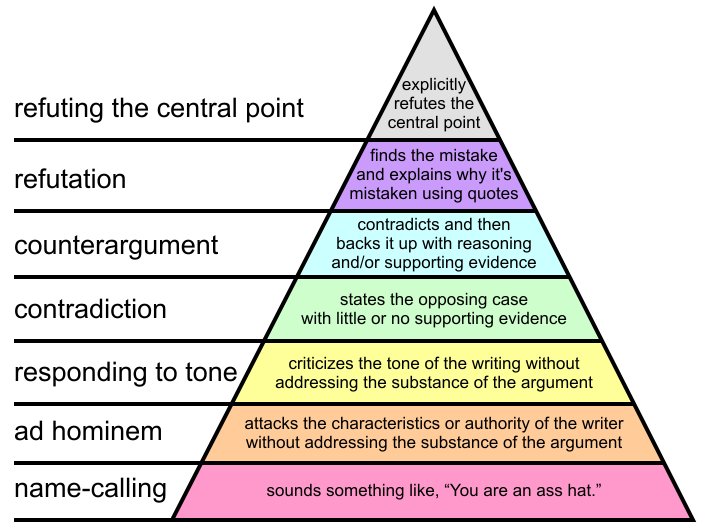
Paul Graham, a smart programmer and successful entrepreneur proposed a "disagreement hierarchy" in a 2008 essay, How to Disagree. He organized styles of arguments into a seven-point hierarchy and suggested, "If moving up the disagreement hierarchy makes people less mean, that will make most of them happier."
Graham also designed the hierarchy as a pyramid. This is logical because there are a limited number of people who are highly skilled at resolving disagreements. Therefore, the smallest space of his hierarchy (the top) represents the disagreement style demonstrated by the least number of people. (Wikipedia)
Here is Graham’s disagreement hierarchy:

Disagreements, arguments, and debates are words that can have a negative tone. However, these conversations can be very healthy, sincere, respectful, truth seeking, and productive. It is positive that people have different opinions, approaches, perspectives, and additional facts. Debate and disagreement are often necessary to determine the best solution.
Would you like to win every disagreement?
It is possible.
However, it depends on your definition of “winning.” The most common objective of people who disagree effectively is to find the best answer without unnecessarily harming their relationship with the other party. Adopt this approach and you can win every argument. The only exception is when you must withdraw because the other party is unreasonable or not aligned with your objectives.
Learn from the Hierarchy
Ask yourself two questions as you consider these seven disagreement styles as an individual, or with a group:
#1 – What disagreement style best describes my most common behavior when I’m arguing with others?
#2 – What style best describes my peers at work, and people I hang out with personally?
Comprehending your disagreement style enables you to develop better habits that result in reaching agreement more calmly, efficiently, and effectively.
Considering how others disagree is important because studies have concluded we become like the people with whom we spend the most time. If their habits are good, then they help us develop better habits. However, when their habits are bad, they subconsciously teach us negative behaviors.
Another important clue to consider: How you respond to each of these styles.
This discussion does not include how to respond to each disagreement style. However, you can learn how to avoid or more positively respond and resolve arguments in less time by developing habits based on these best practices.
There is one other habit that can help you tremendously.
It is: Don’t take anything said personally. Another person’s negativity says more about their wounds and mistakes than it does about you. James Clear, author of Atomic Habits, puts it this way: “Not taking things personally is a superpower.” (04/30/2020 post)
The focus of this teaching is how to effectively disagree in real-time arguments that occur in-person, during online meetings, and in-writing. This advice applies somewhat differently to indirect disagreements, such as online attacks, gossip, or internal anger and frustration.
The following is how we explain each disagreement style, and my advice based on our work at www.manage2win.com and my 47 years’ business experience.

Name-Calling
This first disagreement style is a bullying or fear response, rather than providing facts to refute something. Name-calling is a red flag to be extra careful in how you respond to the person or avoid them altogether. It may indicate the wounds from their life experience are fueling fears and a distorted perception of reality.
Name-callers are quick to judge others negatively. It’s often rude, coarse commentary that’s unhealthy, unproductive, and partially or totally untrue.
CONCLUSION: Name-calling does not help avoid or resolve an argument.
Ad Hominem
The second style is, Ad hominem, which is Latin for “to the man (or person).” It means someone attacks the character, motive, or other attribute of a person who has an opposing view rather than simply calling them a derogatory name or term.
Ad hominem is often based on partial truth. Part of the overall statement is true, but not all of it. Partial truths can connect with and fuel the fears of the attacker. This fools them into exaggerating the partial truth into an unfair, negative belief about the other person.
For instance, Joe may attack Susan, saying she wants Marilyn to lead a project because Marilyn is her friend. He says Susan’s totally biased. However, there is more to the truth. Marilyn is Susan’s friend. However, Marilyn is also very capable to lead the project, has one or more skills that make her a good choice, and there is time in her schedule to do the work.
Sometimes the Ad hominem approach is used because the attacker is trying to manipulate the other person without being candid about their reasoning. For instance, Joe might be motivated to attack Susan because he wants to lead the project or have one of his buddies do it.
CONCLUSION: Attacking someone ad hominem does not help avoid or resolve an argument.
Responding to Tone
The third style is how people respond to the tone of someone’s voice or writing. For instance, someone may have a condescending or angry tone, or they are rude in some other way.
The respondent who attacks the person’s tone may be correct the other person’s tone is offensive or inappropriate. However, tone is subjective. It does not determine the accuracy of the rude person’s statement or conclusions.
Getting upset about someone’s tone focuses on how they deliver their argument. This is better than attacking a person. However, it is still not offering facts or logic to prove the attacker’s position in the argument or debate.
CONCLUSION: Attacking someone’s tone of voice does not help avoid or resolve an argument.

Contradiction
This fourth style is the turning point in argumentative skills. However, it is still weak because the response simply states disagreement as opinion. No facts or qualified references are offered.
Using the example above, Joe may complain, “Marilyn is not senior enough for this project. Bernie would be a better choice.”
Susan might respond defensively with a simple statement, “Marilyn’s the best choice.” As you can see, neither side in the argument has provided facts or qualified references to reinforce their statements.
The good news is this approach is not attacking a person. It can start a process for the parties to focus on where they agree and disagree.
However, contradiction is a surface conversation that can cause two problems: (1) It can inflame emotions because there is no factual data to bring about a new decision; and (2) The argument can be controlled by the person who has better communication skills; or simply is a verbal and/or physical bully. This is true even when their opinion is wrong.
CONCLUSION: Respectfully contradicting someone with an opposing opinion rather than facts and quality references may start productive dialog. It can also negatively intensify the emotions of an argument or give the more highly skilled communicator an unfair advantage because the approach remains subjective.
Counterargument
The fifth style is counterarguments. This approach is disagreeing with facts and/or qualified references supporting your conclusions. When done respectfully, this positive behavior can make progress towards agreement, or at least identify where you agree to disagree.
However, problems occur when counterargument statements are too broad or general. As a result, the person offering the counterargument may shift the disagreement away from the main point. This may focus on part of the other person’s conclusion, a point they feel was indicated by the original person’s statement, or something they feel is related.
Continuing with our prior example, Joe may say, “Are you sure Marilyn’s the best choice? That project is important. Marilyn’s great, but she doesn’t have many certifications.” Susan could respond by saying, “I don’t think certifications are important. You do a lot of great work in areas where you don’t have any certifications. When’s the last time you got certified, and on what?”
In this example, the counterargument led to a debate about certifications, rather than who’s the best person to lead the project.
Another issue is when counterarguments extend the disagreement into assumptions, and/or judgment based on partial information or bias by one or both people.
Ideally, someone using the counterargument style is phrasing statements as questions to promote an open dialog. They also listen carefully to consider the other person’s thoughts. This approach succeeds when it is done within seven boundaries for polite, sincere disagreement:
#1 - Protect the relationship you have with the other person by being respectful and empathetic.
#2 - Clarify the specific issue being argued.
#3 – Sincerely seek to understand the other party’s conclusions, with an intent to find common ground. It is important to respect the person’s emotions. However, focus the conversation on the facts and how they relate to resolving the issue.
#4 – Discuss the facts and conclusions from qualified references.
#5 - Be open to gathering more facts and qualified opinions / research.
#6 - Focus first on where you both agree, and next on where you still disagree.
#7 - Don’t feel pressure to resolve the disagreement at once when the issue is not urgent.
CONCLUSION: Counterarguments are most effective as questions that lead to further discussions. This lays a strong, safe foundation to move to agreement through discussion, research, and consideration of facts and conclusions of qualified references.
Refutation
The sixth style is refutation, which is when someone attempts to disprove something. It is important to note that you must be an active listener to effectively refute anyone. This is because active listening enables you to comprehend what they believe, the emotions behind their conclusions, and the facts they’re presenting.
Active listening is giving someone your full attention when they are speaking. You are listening to what they say while also considering their nonverbal communication. At appropriate times, you respectfully repeat back brief statements they made to confirm you are correctly comprehending the information. If applicable, at the conclusion of the conversation you verify their expectations and action items to be taken.
As you repeat back each summary, it is effective to first explain where you agree, and possibly why. This demonstrates how you are working with the other person and often creates options to consider that lead to resolution.
Here is a productive approach to refuting someone’s statements:
#1 – State something where you disagree and ask them to confirm you are understanding them correctly.
Listen and fully consider their response.
#2 - Ask questions about facts that seem to contradict the other person’s conclusions.
Listen and fully consider their response.
#3 - Discuss where you feel qualified references and/or research contradict those the other person presented.
Listen and fully consider their response.
#4 – Assuming you have not changed your mind, explain why you feel your conclusion remains the most logical, accurate based on the facts, and fair considering the impact of the decision on others.
Listen and fully consider their response.
Active listening and respectful dialog help the other person feel safe. This encourages candor as you work through the issues. It also should enable both of you to be more open to consider alternatives to your original conclusions. New decisions occur based on trust and new information.
CONCLUSION: Respectful refutation can help people disagree more calmly, and reach resolution more quickly.

Refuting the Central Point
This seventh and best disagreement style is the top of the pyramid. It builds upon Counterarguments and Refutation to be the most skilled method of disagreeing with others, particularly when you are refuting someone in a respectful, empathetic, and specific manner.
Refuting the Central Point means the conversation starts by agreeing on a clear statement of where there is disagreement, and a mutual desire to find the best outcome. This focus fuels healthy conversation.
The discussion to confirm a clear central point may shift one person’s focus to something slightly different, or to one or more minor points that individually or collectively are significant to her/him. Although this may be frustrating, it emphasizes the value of having a clear central point or statement, so the disagreement does not decline into less important areas.
The key to refuting the other party’s position is to prove their central point is incorrect, or not the best. It is best to avoid debating your opinions. It is more productive and respectful to refute the specific central point by providing specific facts and/or the conclusions of qualified references and/or research that reinforce your proposed solution.
In a sincere dialog, you may decide to adopt their conclusion. This occurs when new information is shared that leads you to agree with part or all of the other person’s position. This is healthy. This conclusion is still a win because the goal is not fight or flight survival, but to find the best answer.
Beware of partial truths, opinions posed as facts, and references based on weak or otherwise flawed research or actual events. Assume the other person’s mistakes are honest. They are simply unaware of the truth or best decision. However, they are sincerely open to finding the best solution.
In other cases, people are intentionally dishonest or afraid to admit they’re wrong. The higher up your disagreement style and skills are on this pyramid, the easier it is for you to identify these two issues and overcome them.
Conclusion
Someone may win a debate because they are more eloquent, a bully, or simply because the data discussed was intentionally or unintentionally limited, or false.
Winning does not always mean the winner is right.
What can you do?
Train yourself and your people how to disagree with one another respectfully and empathetically. Part of this development is discussing real-life scenarios where your people individually and/or as a team have encountered disagreement. Help people to always choose integrity and put relationships first.
These skills help you stop a more skillful debater or bully from forcing a bad decision.
Never stop developing your habits, and those of your team, to have positive, respectful, and productive disagreements. These behaviors are required for your organization to be its best and thrive in any environment.

Why They Never Ask
Decades ago I took a Dale Carnegie course. It was 13 weeks straight, three hours one night each week. It was fabulous because the instructor, Alan, was awesome.
Every week we meet new people. Alan taught a story metaphor to systematically start a comfortable conversation with a person you’ve never met before. This simple framework helps you bond with people and learn about them. It also sets the stage to ask additional questions as you engage them in sincere conversation.
Decades ago I took a Dale Carnegie course. It was 13 weeks straight, three hours one night each week. It was fabulous because the instructor, Alan, was awesome.
Every week we meet new people. Alan taught a story metaphor to systematically start a comfortable conversation with a person you’ve never met before. This simple framework helps you bond with people and learn about them. It also sets the stage to ask additional questions as you engage them in sincere conversation.
As I recall, it goes something like this:
#1 - Picture a huge name tag. Introduce yourself, and ask, “What’s your name?”
#2 - Think of a house. The roof peak of the house’s highest point is breaking through the name tag. You ask, “Where do you live?”
#3 - There is a foot-long hot dog coming out of the chimney of the house. You ask, “How long have you lived there?”
#4 - On top of the hot dog is a workman’s glove. You ask, “What do you do for a living?”
#5 - The thumb and index finger of the workman’s glove are holding the wingtip of a commercial airplane. You ask, “Do you like to travel?”
#6 - Standing on the opposite wing of the plane are one or more members of your family. Coming out of the ear of one family member is a snow ski, or something else that indicates a hobby. You ask, “What you like to do when you’re not working?”
#7 - Perched on top of the snow ski’s tip is a lightbulb, which indicates ideas, goals, or dreams. You ask, “What ideas do you have, or goals are you pursuing that really excite you?”
Remembering this story metaphor enables you to develop a habit of easily entering into conversations with virtually anyone.
However, let’s return to the original challenge of this post:
Why They Never Ask
When someone asks you what you do, why do they rarely ask for any details after you respond?
For instance, somebody asks you: “What do you do for a living?”
You respond:
“I’m a CPA.”
“I work at Starbucks.”
“I sell insurance.”
“I work for an IT managed services company.”
Most of the time people nod their head, don’t ask more questions related to your work, and then shift the conversation in a different direction. Another response might be that they say nothing, or walk away! This is particularly true if they think you’re going to sell them something, which I’m not recommending you do.
However, it can be mutually rewarding to learn more about what someone does for a living and/or their personal life, as appropriate.
I love people. I get into conversations easily. At some point, they ask what I do. My response used to be:
“I help bad bosses become great leaders. Have you ever had a bad boss?”
Almost everyone laughed and said they’ve had a bad boss. Some have had several bad bosses. Then they said something like, “Oh, that’s great! We definitely need more great leaders.”
BUT… they rarely asked questions.

Why Don’t They Want to Learn More?
This situation reminds me of fishing. There are lots of different ways to fish, and 28,000 known fish species. To succeed in fishing, you have to know what you’re fishing for, use the right equipment, and the correct bait. Otherwise, you’re probably not going to hook anything.
Remember my response above was, “I help bad bosses become great leaders. Have you ever had a bad boss?” People would engage in that statement. However, most of them immediately thought of…
How someone else should change, rather than themselves.
Here are some possible reasons for the way people respond to us when we share our profession:
#1 – We live in a self-centered society. Consciously and subconsciously many people are primarily focused on themselves. Asking you questions means they have to listen to your answers, you may talk too long, be boring, or ask them questions they don’t want to discuss. It may be they’re just shy, or simply not interested in you.
However, there’s no benefit to blame this problem totally on others. Let’s own our part of the problem. We can take action to improve our habits.
The result can be a win-win when we connect with others based on identifying and discussing shared beliefs, habits, interests, and knowledge. Therefore, how can we change our response so we connect better with nice people?
#2 - My response lacked detail and connection. It did focus the other person on “bad bosses,” but in doing so, it triggered judgmental thoughts of others rather than self-reflection.
Therefore, similar to my fishing analogy, focus on catching a specific type of fish. Do NOT try to sell anything. The “fish” to catch is a sincere connection with the person with whom you’re speaking. Therefore, our answer to their question about what we do for a living must specifically connect back to them.
#3 - The “equipment” I was using had a negative term, “bad bosses,” which is a label people instinctively want to avoid for themselves. This created a barrier for connection, except as it related to them judging someone else.
Therefore, another change we must make is to remove any negatives.
#4 – My response lacked a good hook and the right bait. Lastly, expert fishermen (women or men) must use the right bait on a good hook to catch their desired fish. This means our brief explanation of what we do for a living must motivate the person to learn more about us. We do this by getting them to talk about themselves.
Again, we are NOT selling. Let’s simply enjoy connecting with people and learning more about them. This approach might result in us asking almost all of the questions because they are more comfortable talking than listening. That’s fine.
Therefore, as an example, I recently changed my response to something like this:
“I teach a simple three-step discipline that can make anyone an incredible leader. What’s the biggest challenge you’re facing at work?”
Notice how these two statements indicate hit all the criteria for successfully fishing:
#1 – It’s focused on them, not me.
#2 – I’m not talking generically. Instead, my response engages with the other person by asking them a specific question.
#3 - I removed the negative “bad bosses” from my reply. Instead, I emphasize the simplicity of my approach, and how it can positively help anyone.
#4 – I adjusted my second statement to focus the other person on discussing the biggest problem they’re facing.
It helps to be sincerely interested in other people. Another thing that contributes to the success of this approach is whether the person sincerely wants to meet others.
Be prepared for people to only talk about themselves. This may occur because they’re nervous, not egotistical. Start the conversation. Find ways to enjoy it. Then, graciously end it and move onto others if you’re not connecting or have limited time.
Conclusion
We encourage you to develop a sincere interest in others. In the process, they will share experiences that benefit you, and you may have opportunities to explain something you’ve learned that can help them.
One way to engage more deeply with others is to develop a response that better connects with their question about what you do for a living. Consider the thoughts above. Develop a brief response that motivates the other person to talk more. Practice it and memorize your response. Have fun with it, and enjoy your new friends!
Don’t hesitate to contact us if you have any questions.

Four Questions to Ask When Creating Succession Plans
Back in 2007 the The Wall Street Journal published an article titled Too Many Companies Lack Succession Plans, Wasting Time, Talent.
In the article, Carol Hymowitz discussed the importance of succession plans and how “Only about half of public and private corporate boards have CEO-succession plans in place… This is the case even at giant global companies that have thousands of employees and spend millions each year to recruit and train talent.”
Carol’s article primarily focuses on large companies, but succession plans are just as important for SMBs (more on that below).
Does you have a succession plan?
Back in 2007 the The Wall Street Journal published an article titled Too Many Companies Lack Succession Plans, Wasting Time, Talent.
In the article, Carol Hymowitz discussed the importance of succession plans and how “Only about half of public and private corporate boards have CEO-succession plans in place… This is the case even at giant global companies that have thousands of employees and spend millions each year to recruit and train talent.”
Carol’s article primarily focuses on large companies, but succession plans are just as important for SMBs (more on that below).
Does you have a succession plan?

I’ll keep it simple: If your answer is “no”, you should create a succession plan for the key roles in your company. If you die or become unable to work for whatever reason it is important for your business to run smoothly in your absence. A succession plan protects your assets and serves your customers. Being lazy and procrastinating about succession plans is irresponsible.
The Importance of a Succession Plan
Let’s do a quick review: A succession plan is basically your process for identifying and preparing people for leadership roles. It’s your “If I die here’s who will be in charge” plan. It’s also a way to insure your company against unexpected departures among key employees.
Also, a succession plan is not a one-time process. It is an integral part of a company’s culture.
“Succession planning isn’t an event, it is a process best managed over three, five, even ten years…”
Companies who are wisely managed know who takes over for key executives should they leave the company for any reason. Think of it like backing up company data - except the data in this case is people.
Succession Plans are Just as Important for Small-to-Midsize Companies as they are for Large Companies (and maybe even more important)
Many companies, large and small, fail in the area of succession planning. Too many CEOs neglect to acknowledge their own mortality, or lack the humility to properly share the responsibility of their role with a successor. More commonly, corporate boards and company executives simply fail to prepare for catastrophe. When things are going well, it’s easy to procrastinate about preparing for change.
For instance, back in the 2000s, Citigroup and Merrill Lynch didn’t begin searching for replacement CEOs until the moment the current CEO stepped down or was ousted.
Is that surprising? To many people it is. Despite history’s many examples to the contrary, the prevailing notion is to believe large organizations are better organized than everyone else. But it’s often not true. Large organizations are not much different than small organizations when it comes to predicting and planning for problems.

However, large companies do have one advantage over small companies: More resources.
Imagine a small, family-owned business with 25 employees that suddenly loses its CEO to a tragic accident. The CEO essentially ran the company, juggling multiple responsibilities and serving as it’s key representative. Unfortunately, the CEO was not grooming anyone to take over the top leadership role.
Now, imagine the same situation occurs with a large company that has 25,000 employees.
To find a replacement CEO, there are technically more people qualified to run the 25-person business. But the larger company simply has way more resources. They have more money, more people, a larger collective network to draw from, and more benefits. Even if the business is failing, there are plenty of people who would jump at the chance to run a 25,000 person company than a 25-person company. Just putting that experience on a resume is beneficial.
That’s why it’s just as important for small businesses to take succession planning seriously. If the unexpected happens, you owe it to your employees to have a plan in place.
Four Questions to Ask Yourself When Creating Succession Plans
Want to start working on a succession plan, or fine tune your existing succession plan? Start with these four simple questions:
What are the key roles in our company?
Who are the candidates who could fill those roles in the future?
What do candidates need to learn and experience to make them fully capable of performing the key role?
How can we schedule activities to train and provide opportunities for the candidates to experience situations that enable them to develop the skills and perspective to fill a key role?
Now, answering these questions will put you on the right track. But you still must adopt the right mindset.
Sitting executives must practice humility and be willing to let go. Surround yourself with people who are willing to offer new perspectives, and be ready to share power with your successors. Consider grooming your successor by promoting them to positions of power, like President or COO, and give them more responsibility. Work closely together and familiarize your board with the heir apparent.
Finally, choose your successors based on their future ability to succeed, not by their past accomplishments. Your company may need leaders with different strengths and talents than previous leaders.
Please consider developing or updating your succession plan as part of your key priorities every year. To be an effective leader you need to be developing others.

1-page Behavior & Driving Force Guides
Have you ever wondered why someone behaved the way they did?
The answer is a combination of “how” they are acting based on their most intense natural behaviors, and “why” they are motivated to behave that way based on their most intense driving forces.
Have you ever wondered why someone behaved the way they did?
The answer is a combination of “how” they are acting based on their most intense natural behaviors, and “why” they are motivated to behave that way based on their most intense driving forces.
At Manage 2 Win, we’ve done over 1,000 assessments of people’s behaviors and driving forces / motivators over the past 16 years. We review and make hiring recommendations, or provide advice on how to better engage employees on 99% of our Talent Assessments.
Our Clients use our assessments to confirm hiring decisions, improve productivity within their organization, and gain insights on how to better engage employees who are not performing well.

Having people complete our Talent Assessments is the most thorough way to comprehend how best to work with them. However, we interact with a lot of people who have not taken our assessments because asking them to do so would be inappropriate. For instance, our customers, family members, neighbors, people in our community, etc.
Many Clients have asked us to provide one-page summaries of the 8 key attributes of the DISC behavioral language (4 high and 4 low); and 12 driving forces based on the original six PIAV motivators, as defined in Eduard Spranger’s model of Personal Interests Attitudes and Values.
Today we are releasing the latest updates to our one-page summaries. Click on these links to download the DISC and Driving Forces summaries.
We encourage you to use one-page summaries these to more intentionally apply what you learn from our Talent Assessments, and to better discern the natural behaviors and driving forces of others who have not taken one of our assessments.
Applying what we’ve learned can help you increase productivity, avoid unnecessary drama, and deepen positive relationships with others.
Don’t hesitate to contact us if you have any questions.
We hope you are safe, healthy, and thriving during these challenging times.

A Business Horror Story: Why Your Company is Only as Strong as Your Relationship with Employees
Your business is only as strong as your relationship with your employees. If management isn’t developing a culture of connection, loyalty and trust tend to fall by the wayside.
This is a horror story of one company who accidentally let the leash out too far on some employees they thought they could trust.
Your business is only as strong as your relationship with your employees. If management isn’t developing a culture of connection, loyalty and trust tend to fall by the wayside.
This is a horror story of one company who accidentally let the leash out too far on some employees they thought they could trust.
Navigant Consulting and Two Rogue Employees
John Wilkinson and Sharon Taulman were managers for Navigant Consulting in 2001. They were in charge of its claims administration practice in Dallas. Wilkinson and Taulman were responsible for staffing, business development, client relations, and contract negotiation for Navigant. As employees they had signed non-compete, non-solicitation and confidentiality agreements.
In April 2001, a Navigant competitor, First Union, expressed interest in purchasing Navigant’s claims administration practice. Wilkinson and Taulman prepared a proposal that involved a transfer of the practice’s clients and employees in exchange for $22.5 million.
The problem? Wilkinson and Taulman planned to pocket all the money and not give any to Navigant.

The proposal to First Union included the disclosure of business information about the claims administration practice, including revenue projections, margin rates, potential engagements being bid, and staffing rates. Wilkinson and Taulman did not tell Navigant headquarters that First Union had expressed an interest in purchasing the claims administration practice, nor that they had submitted a proposal that included a payment to their corporation.
However, the proposal fell through.
Throughout the rest of 2001 and 2002, Wilkinson and Taulman attempted to sell the claims administration practice to other competitors of Navigant. While these negotiations were taking place, Wilkinson executed a four-year lease in Navigant’s name for office space in downtown Dallas.
In June 2002, a Navigant computer technician working for Wilkinson and Taulman was told to copy company information onto a portable, non-Navigant server and not to inform Navigant’s corporate office of the data transfer. Suspicious, the technician contacted the corporate office. In response, Navigant’s general counsel initiated an investigation into the Dallas office.
Wilkinson was told by Navigant headquarters not to transfer company data to outside servers. But that didn’t stop him from contacting one of the possible purchasers, LECG (formerly owned by Navigant), to advise them that he wanted to “move quickly” on a deal. The scheme included a new proposal to sell the claims administration practice through Wilkinson’s and Taulman’s corporation in exchange for options on 250,000 shares of LECG stock and $1.2 million in cash.
Then shortly thereafter, Wilkinson met with Navigant to try and force them to sign over the claims administration practice to him in exchange for his assumption of Navigant’s obligation on the four-year office lease in Dallas. Of course, Wilkinson is the one who had created the lease liability in the first place. He attempted to demonstrate the losses Navigant would incur, including the lease obligation if it refused Wilkinson’s proposal.
Wilkinson also argued there would be an “unprofitable contract with ‘negative cash flow’” if he left Navigant, as well as severance and accrued vacation payments that would need to be paid to departing employees.
Navigant executives rejected Wilkinson’s offer.
Wilkinson and Taulman submitted their resignations two days later and accepted employment at LECG. Then Navigant filed suit against Wilkinson and Taulman, alleging claims of breach of fiduciary duty, breach of contract and misappropriation of trade secrets.
The case went to court in a trial by jury.
In the course of his testimony, Wilkinson admitted that the proposals to sell the claims administration practice were made without Navigant’s knowledge or authorization and would have provided no proceeds to Navigant.
On November 15th, 2007, a jury for the United States Court of Appeals for the Fifth Circuit found Wilkinson and Taulman liable on each claim, awarding Navigant nearly $2 million in damages against both Wilkinson and Taulman, plus punitive damages of $200,000 against each of them and attorneys’ fees.
A Basic Expectation
At the core of the employment relationship is an expectation that employees will be loyal to their employer and fulfill their work obligations. When that basic expectation fails and your employees try to steal from you, it can be devastating.
It’s true, you can succeed in suing them for damages. According to the 5th U.S. Circuit Court of Appeals, you can sue them and you can win. Furthermore, depending on the situation your employees can be liable for damages that total millions of dollars.
But it’s best to avoid lawsuits as much as possible.
Unfortunately, Navigant’s story is just one of many that happen in the United States every year. People are far from perfect, and white collar crime is common. Whether it stems from greed, or a lack of employee satisfaction, it’s important for employers to be aware of the potential for employee wrongdoing.
Deter and Prevent Wrongdoing by Being a Good Leader
It’s also equally important to practice good leadership habits that help deter and prevent employees from criminal activity. An employee is much less likely to engage in fraudulent acts if they are part of a valuable, respected team in which executives are leading by example.
For instance, let’s say your company over-bills a client for a contract. You originally billed the client $12,000 for equipment and $15,500 for labor. However, the job wasn’t as difficult as it turned out to be, and it only cost $10,433 for equipment and $8,200 for labor. The client has already paid and they are happy with the result.
We have heard of this exact situation happening multiple times before. What’s the right response?
As a leader, it’s your responsibility to set the tone for how your company does business. Your team knows you over-billed. If you do nothing and keep the extra money, you are not only being dishonest and hurting your client but you are setting a bad precedent for the future. You are setting a bad example for your employees that leads them to think it’s okay to be dishonest. Then when the opportunity arises for an employee to be dishonest, but this time the dishonesty hurts your company, they will simply follow your example.
Instead, run a tight ship. Set the tone. Refund the excess costs to the client.
Your employees will respect your honesty, your clients will recognize your integrity, and loyalty in both groups will increase. Also, they will be more likely to emulate your decision.
Now, I am not implying that the behavior of Navigant’s leaders caused John Wilkinson and Sharon Taulman to engage in fraudulent behavior. Sometimes people just make greedy, stupid decisions completely on their own. But I do wonder if perhaps there were moments in John and Sharon’s career when someone could have demonstrated for them the right way to act (and held them accountable).
Hopefully you never have to deal with a similar situation.
The story of Navigant and John Wilkinson and Sharon Taulman was originally sourced from an article by SHRM on December 15, 2007 titled: 5th Circuit: Multimillion-dollar Verdict Against Disloyal Employees Affirmed, by Scott M. Wich, an attorney with the law firm of Clifton Budd & DeMaria LLP in New York.

Look beyond COVID
This crisis will end. All of them do.
What are you doing today for your organization to rise out of COVID-19 with a stronger, more enduring competitive advantage?
This crisis will end. All of them do.
What are you doing today for your organization to rise out of COVID-19 with a stronger, more enduring competitive advantage?
Yes, there are hard decisions leaders need to make today.
Lots of people are giving you advice of what to do today. Follow the good advice.
However, today will be gone before you know it and the recovery will have started.

In 1940, Sir Winston Churchill said:
“It is the time to dare and endure.”
Today is similar.
You can be distracted by the media bombs, political posturing, and hysteria of fear… or you can think carefully, develop a sound strategy, and rally your troops to emerge from this crisis stronger than ever.
Stop spending all your emotional energy and time firefighting or avoiding the fear.
Think beyond this crisis
Pause. Retreat to a quiet place. Reflect on how to:
#1 – Be a role model for your family, employees, clients, and community.
#2 – Strengthen your client / customer relationships.
#3 – Engage your top performing employees in strategic activities.
#4 – Train your employees to remove weaknesses, or let go of people who cannot meet your standards.
#5 – Prepare your employees to attack your markets as they reopen.
#6 – Have capable employees fix / update processes to eliminate costs, streamline work, improve security, and strengthen your competitive edge.
#7 – Help clients with their challenges, on paid time and when appropriate, without charge.
There’s more to consider, therefore don’t develop your plan alone.
“Make plans by seeking advice; if you wage war, obtain guidance.”
Proverbs 20:18

The starter’s grip is tightening on the gun to start the race back to growth. Many will be left at the starting line, and others even further behind, distracted with fear and wandering in confusion.
It may not be time to run yet, but it’s definitely time to prepare for the race.
Our world needs leaders who are prepared to lead us out of this mess. People need light to emerge from this darkness.
Keep the faith. Don’t succumb to fear. There are better times ahead.
Get ready for them now.
Sincerely,
David

Focus on Connection When Hiring to Win the "Talent War" and Build Healthy Relationships
the following is an excerpt from the second course of our new Hire the Best training, coming soon
You may have heard the term, “Talent Acquisition is War,” or seen a headline with the words “The War for Talent.” That kind of rhetoric sounds like hiring managers are setting up bunkers at job fairs, dressed in full camouflage, ready to fight for resumes with company branded t-shirt launchers and notepad covers.
It’s silly.
the following is an excerpt from the second course of our new Hire the Best training, coming soon
You may have heard the term, “Talent Acquisition is War,” or seen a headline with the words “The War for Talent.” That kind of rhetoric sounds like hiring managers are setting up bunkers at job fairs, dressed in full camouflage, ready to fight for resumes with company branded t-shirt launchers and notepad covers.
It’s silly. Hiring isn’t a war. Sure, it’s a competition, but it shouldn’t be treated like combat.
Instead, hiring is more like a matchmaking exercise. You should approach hiring the way you would develop a close friendship. Focus on connecting the dots of similarity, interests, and purpose. Focus on bringing people together in a mutually fulfilling, meaningful, long-term relationship. When it’s a match, wonderful! When it’s not, you look elsewhere.

Your goal should be to help each person find the best career choice. If it’s with your company you will see the connection between their skills and the needs of your organization. Don’t worry if they are interviewing with other companies. The right person will join your team because there is genuine compatibility.
Turn your back on the “talent war”. Instead, focus on building a relationship with the right person who will integrate with and bolster your efforts.
Focus on Finding the Right Match
Luis and Ronni Alvarez of Alvarez Technology Group in Salinas, California are successful entrepreneurs. Since they live close to a lot of California farms they are one of the few IT experts serving the California agricultural sector.
In August 2013 their company had doubled in size twice and was continuing to grow rapidly. More importantly, their growth did not include much of the drama and turnover many companies experience.
How did they do this?
They have a strong company culture, and at times they wisely work with outside consultants to bolster their strengths and shore up their weaknesses.
In August 2013 we had the pleasure of working with Alvarez Technology Group to maximize their Systematic Power: the systems and processes they use to hire, manage, develop, and retain great employees. We worked together for six months and they were a model client, applying just about everything we teach. The results included improved communication with employees, better defined roles, clear productivity metrics, and a more structured hiring process (much of which was already in place).
One aspect of the Alvarez Hiring Plan was an option to have us interview any candidates they were struggling to evaluate.
One time we interviewed a candidate who was talented, but his job history and personal life had some serious mistakes. Let's call him Peter. Many companies would not have considered Peter, but Luis and Ronni felt he had turned the corner toward a better life and deserved an opportunity. They have always done a good job of connecting with people in their company and their community. Part of the reason for their openness was the fact that Peter had spent a year working for a friend of Luis and had proven his worth as a solid team player.
Luis and Ronni were leaning towards hiring Peter but wanted a second opinion, so they called us. We recommended Peter take one of our Talent Assessments and then we interviewed him by phone.
It turned out we agreed with the choice to hire him. Despite his past, Peter was a great fit culturally, and he had learned from his worst mistakes. He was clearly on a new, healthier path.
Six years later and Peter continues to be a wonderful addition to their team.
An Emphasis on Relationships
It is Luis and Ronni’s focus on relationships that makes their company such a great place to work. Nowhere is this more evident than in their hiring practices where they focus on connecting with the right people. In turn, those people have a strong desire to contribute to Alvarez Technology Group’s mission. The positive effects spill over into their client relationships and produce strong business results.
Every job candidate you turn down and employee who leaves your company becomes a reference for your organization. There are exceptions, but for the most part, you control whether that job candidate or employee becomes a good or bad reference.
Hiring with the right priorities in mind reflects positively on you and your organization, and sets the stage for productive, long-term relationships.
—-
Need help with your hiring process? Contact us today to schedule a conversation.

Practicing the Platinum Rule: How to Recognize Employees Using Wish Lists
Back in 2007 I was speaking at an Entrepreneurs Organization (EO) group meeting in San Antonio, Texas, when a question came up about employee recognition. How effective is cash?
I responded cash works with some people, but at least 75% of employees do not prefer cash. You see, giving someone cash is really easy. There’s hardly any effort or thought required. At most it’s a trip to the bank and an accounting entry. When a gift takes so little of time and effort to give, it becomes meaningless.
There are so many other ways to motivate and recognize people that are better than cash.
Back in 2007 I was speaking at an Entrepreneurs Organization (EO) group meeting in San Antonio, Texas, when a question came up about employee recognition. How effective is cash?
I responded cash works with some people, but at least 75% of employees do not prefer cash. You see, giving someone cash is really easy. There’s hardly any effort or thought required. At most it’s a trip to the bank and an accounting entry. When a gift takes so little time and effort to give, it becomes meaningless.
There are so many other ways to motivate and recognize people that are better than cash.
The Platinum Rule
Fortunately, I didn’t have to mention one of the recognition methods during my talk, because one audience member shared his solution, which is super easy:
“Every 6 months we send out an email to every employee asking for their wish list - how they want to be recognized. Then when we want to recognize the person, we give them what they want instead of what their boss thinks they want. ”
This is a great example of The Platinum Rule. You’ve heard of the Golden Rule, right?
Do unto others as you would have them do unto you. (Mathew 7:12 and Luke 6:31).
Well, using Employee Wish Lists to recognize people is a variation of the Golden Rule. It’s called the Platinum Rule.
The Platinum Rule is a different version of the Golden Rule that takes into account the fact we are all different. Treating someone the way you want to be treated isn’t always the best way to interact with other people. Instead, perhaps you should treat someone the way they want to be treated.

This principle is true when it comes to recognition. Your employees are all different. Why would you reward them all the same? It makes no sense. They value each reward differently based on their personal preferences.
Instead, the Platinum Rule encourages us to think about others first.
How can you treat them the way they want to be treated? How can you reward each employee in a way that is meaningful to them?
That’s where employee wish lists come into play.
Employees Understand and Appreciate Wish Lists
You might say, “But what if my employees ask for really expensive stuff? My people are hard to please!”
Well, you might be surprised.
The EO member went on to say the responses they received were surprising. Before they started asking for employee wish lists they were worried employees would ask for really costly things like jewelry or concert tickets.
But they were wrong. Virtually everyone’s wish list was full of things that cost less than they would have expected. For instance, some people asked for a Starbucks card. One employee wanted a one-on-one lunch with the CEO. Almost all of the items on people’s wish lists were low-cost or no-cost items.
The best part about it? Employees really enjoy filling out wish lists!
Everyone likes to think about rewarding themselves. The “wish list” process only serves to focus people on achieving more and getting rewarded for their efforts. Plus, you get the benefit of finding out how they want to be recognized. It’s a win-win.
Steps to Gather and Use Employee Wish Lists
Here’s a simple 3-step process you can follow to gather Employee Wish Lists:
Draft and send an email requesting wish lists from your team. It can be simple, like “Hey everyone. You’re doing a great job and we want to recognize you properly. Please make a list of five ways we can reward/recognize you and send it to HR. Thanks!”
Gather the wish lists and store them in each employee file. If you have an HRIS or Employee Performance Management system you can put the wish lists in there.
Reward employees using the wish lists. When someone does something awesome and you want to recognize/reward them, pull up their wish list and choose something from there. The employee will feel valued and appreciated.

Learn from the changes the 49ers made to put them in the Super Bowl
The last time the San Francisco 49ers were in the Super Bowl was 1994. 26 years ago.
I stopped watching them shortly thereafter.
Last season the team lost 3 of 4 preseason games and then went 4-12 in the 2018-2019 season. Who could believe these guys would be Super Bowl contenders this year?
If you stop and think about your leadership and business, are you a “Super Bowl” contender in your market?
If not, what can you learn from the San Francisco 49ers, who wallowed in mediocrity and failure for much of the past 23 years before thinking outside the box and totally changing the team’s culture?
The last time the San Francisco 49ers were in the Super Bowl was 1994. 26 years ago.
I stopped watching them shortly thereafter.
Last season the team lost 3 of 4 preseason games and then went 4-12 in the 2018-2019 season. Who could believe these guys would be Super Bowl contenders this year?
If you stop and think about your leadership and business, are you a “Super Bowl” contender in your market?
If not, what can you learn from the San Francisco 49ers, who wallowed in mediocrity and failure for much of the past 23 years before thinking outside the box and totally changing the team’s culture?
Trust in Character and Aptitude Over Popularity When Choosing Leaders
In January 2017 the 49ers were looking for a new coach after firing Head Coach Chip Kelly and General Manager Trent Balke.
They decided to hired Kyle Shanahan and John Lynch as the new head coach and general manager, when neither of them had ever been in those senior roles previously. While many fans and pundits would have preferred the 49ers hire a more seasoned head coach, that didn’t happen. Instead, they were impressed with Shanahan and decided to bet on character and aptitude, not ego and doing what would be popular.

Kyle Shanahan, 2016
Then, even though Shanahan’s first season sputtered and ended with a poor record, the team’s ownership stood by Shanahan (and Lynch). It’s important to cut your losses when character and culture are not thriving, but it’s also important to give people a chance when they are making the right choices. The 49ers ownership had the wisdom to see major change was happening, even though the numbers didn’t show it.
Shanahan and Lynch then assembled a killer coaching squad. For example, Robert Saleh is the team’s defensive coordinator. He was raised in the small town of Dearborn, Michigan. According to some friends of mine who have been following the 49ers, Saleh has a combination of creativity, wisdom, and Midwest grit that now can be seen in every single defensive players’ performance on the field, and behavior off the field.
Assemble an Awesome Team
After/while Shanahan and Lynch assembled a great coaching staff, they went to work on building a great team with the right culture.
First, they made the right decisions, often tough decisions, about people. For instance, they only kept 12 players from Chip Kelly’s 2016 squad. Only 26 of their current 90 players have played at least four full NFL seasons. Translation? Most are rookies and newbies.

Another example: Sometimes you have to remove one of the cows in your herd to get the herd’s attention. They fired top player Reuben Foster for off-the-field behavior contrary to their team values.
In contrast, they signed a number of players with huge potential, including Jimmy Garoppolo, a superstar quarterback ready for primetime. Jimmy comes from a tight-knit, blue collar, Italian family, the third of four sons, and seems like a man of character. Yet, although he is an important piece to the 49ers’ turnaround puzzle, one person doesn’t make a team.
Consider flashy, but controlled 26-year-old George Kittle, the leader of the 49ers offense. He consistently gives everything he’s got, week after week, on the field and off, and he is constantly interacting with fans and the media. He’s fun, but more importantly, he applies his people strengths to grow other young players.
One more player example, although there’s lots more: Richard Sherman is a veteran linebacker who came from the Seattle Seahawks. Some people say he plays with a chip on his shoulder, but Sherman uses any animosity inside him to his advantage on the field.
The second thing the 49ers coaching staff has done well is to focus on culture more than their win-loss record, realizing the only route to long-term success is to get the team to bond.
I’m sure the Kansas City Chiefs have their share of success stories and strong team culture. But whoever wins the Super Bowl will be the one whose players trust each other so much that no matter what the score is, or the last play, they’ll be connected with a purpose that’s beyond any individual personality or skill.
Why did I stop watching the 49ers?
I mentioned at the beginning of this article that I stopped watching the 49ers about 26 years ago. Why did I stop watching?
Well, I think the team’s culture turned me off. It was fun to watch Joe Montana, Ronnie Lott, Roger Craig, and other teammates who loved the game try to beat the odds week after week. Unfortunately, while Steve Young was a great athlete and a great quarterback, I had a hard time relating to him, his team, and the 49er teams that followed.
But now I’m back on the bandwagon, for at least a little bit, mostly because I’m so impressed by the decisions that have been made by the 49ers leadership.
I’m looking forward to this year’s Super Bowl. I feel a personal connection even though I’ve never met them.
In a similar way your market, clients, vendors, and even employees can become more or less passionate about your organization when your company culture is good or bad. Don’t you want everyone to feel a positive, personal connection to your company?
Is it time to mix it up? Perhaps, that’s up to you. If it is time to make some changes I hope you make those tough decisions and focus on the right stuff.
Enjoy the game!